

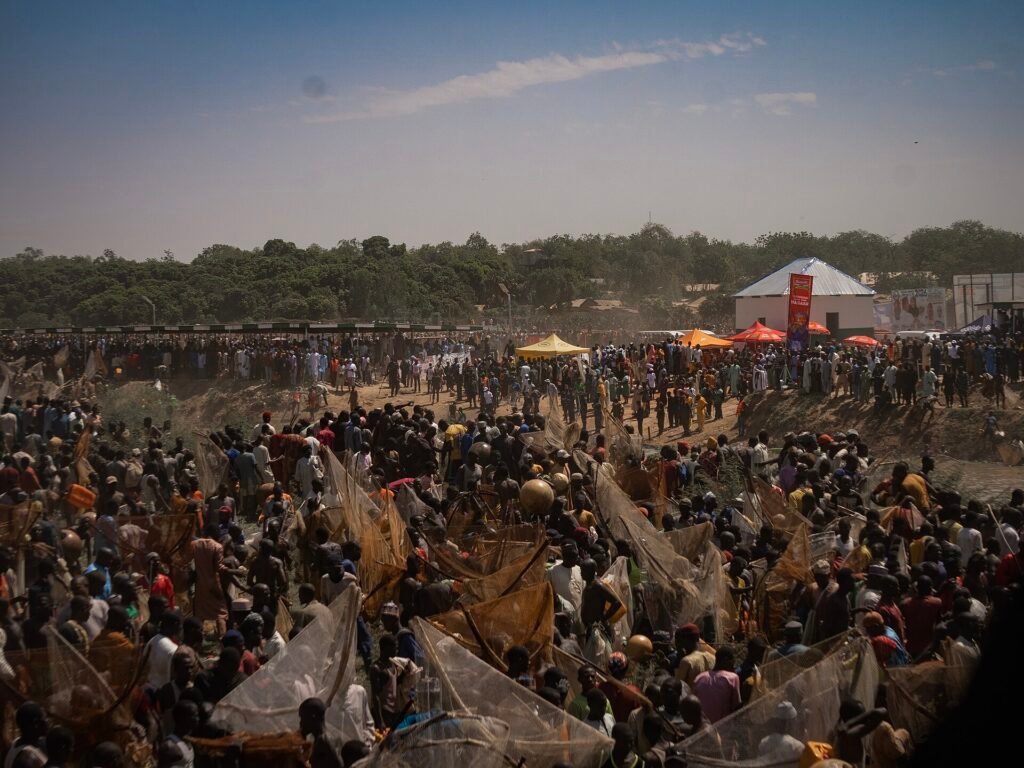
Each year, fishermen from across Nigeria converge on the Sokoto River in Argungu for a four-day festival of competition, skill, and cultural celebration. The festival draws visitors worldwide to witness a centuries-old tradition of fishing prowess and community gathering.
In UNESCO’s words
Every year in the north-west of Nigeria, communities gather to participate in the Argungu International Fishing and Cultural Festival near the Matan Fada River. The four day festival, which runs between late February and March, features kabanci – a series of water competitions including hand fishing, canoe racing, wild duck catching – as well as other traditional practices, such as the local style of wrestling and boxing. Men and boys participate in the contests, while women provide the encouragement performing songs and dances. The Argungu International Fishing and Cultural Festival, which dates back to before Nigeria’s independence, is considered a contributor to participant sense of identity and is also used as a means of maintaining peace between the Argungu and neighbouring Sokoto community by enjoying shared cultural practices together. Knowledge passed on within participating chieftaincy-holding families by the Sarkin Ruwa (who manages the river’s santitation levels) and Homa (chief of the Argungu fishermen) concerning the river’s water quality and fish stocks, has been an important factor in the festival’s continuity. Skills involved in festival activities are transmitted to younger generations formally and informally. Training occurs, for example, via apprenticeship particuarly in the case of specific fishing techniques or within families by demonstration.
Official description, UNESCO Intangible Cultural Heritage List — Argungu international fishing and cultural festival
At a glance
The Argungu International Fishing and Cultural Festival is a four-day annual gathering held in the north-west of Nigeria near the Matan Fada River, typically between late February and March. The festival centers on kabanci—a series of water competitions including hand fishing, canoe racing, and wild duck catching. Men and boys compete in these contests as well as in traditional wrestling and boxing, while women participate by performing songs and dances that encourage the competitors. The festival brings together communities to celebrate shared cultural practices.
Origins & history
The Argungu International Fishing and Cultural Festival has roots reaching back before Nigeria's independence. Knowledge of the river's water quality and fish stocks has been maintained and passed down within participating chieftaincy-holding families, particularly through the Sarkin Ruwa, who manages the river's sanitation levels, and the Homa, chief of the Argungu fishermen. This transmission of ecological knowledge between generations has been central to the festival's continued existence over time.
The practice
The festival's water competitions involve hand fishing, canoe racing, and wild duck catching, with men and boys as active participants. Women contribute through performing songs and dances that encourage the competitors. Skills specific to festival activities are transmitted to younger generations both formally through apprenticeship—particularly for fishing techniques—and informally through family demonstration and observation.
Cultural significance
The Argungu International Fishing and Cultural Festival contributes to participants' sense of identity and serves as a means of maintaining peace between the Argungu and neighbouring Sokoto community through the enjoyment of shared cultural practices together. The gathering preserves and demonstrates traditional knowledge related to the river, its resources, and sustainable practices, ensuring this understanding reaches younger generations.
Key facts
- Country: Nigeria
- Inscribed: 2016
- UNESCO list: Representative List of the Intangible Cultural Heritage of Humanity
- UNESCO reference: 00901
- UNESCO vocabulary: Festivals; Games
- Map: Argungu — the locality named in UNESCO’s official description of this element
Where to experience it
The Argungu International Fishing and Cultural Festival takes place annually in north-west Nigeria near the Matan Fada River, running between late February and March. Over four days, communities gather to participate in kabanci—a series of water competitions including hand fishing, canoe racing, and wild duck catching—alongside traditional wrestling and boxing. While men and boys compete, women encourage participants through songs and dances. Visitors can witness the festival's events and learn from the participating chieftaincy-holding families and local leaders who maintain knowledge of the river and transmit fishing skills to younger generations.
Sources & resources
- UNESCO — official element page: Argungu international fishing and cultural festival
- UNESCO — open data record: Intangible Heritage List, reference 00901
- UNESCO — official video: UNESCO film on this element — embedded on this page
- UNESCO — official photograph: Emir and his entourage being ushered to the venue of the fishing festival by Durbar horse riders and entertainers — Adeniyi Olagunju, 2008
- Reference — Wikipedia (secondary): Argungu Fishing Festival — consulted as a secondary reference, not as confirmation
- Cultural Heritage Online: Our archive and city guides

Find it on the map
See this place and what’s around it →📷 Become a Cultural Heritage Online photographer
Share your photos of places: they stay published under your name as the author. The more they're seen, the more you get noticed — and soon a contest will reward the most appreciated photos.
Log in or sign up free to add a photo