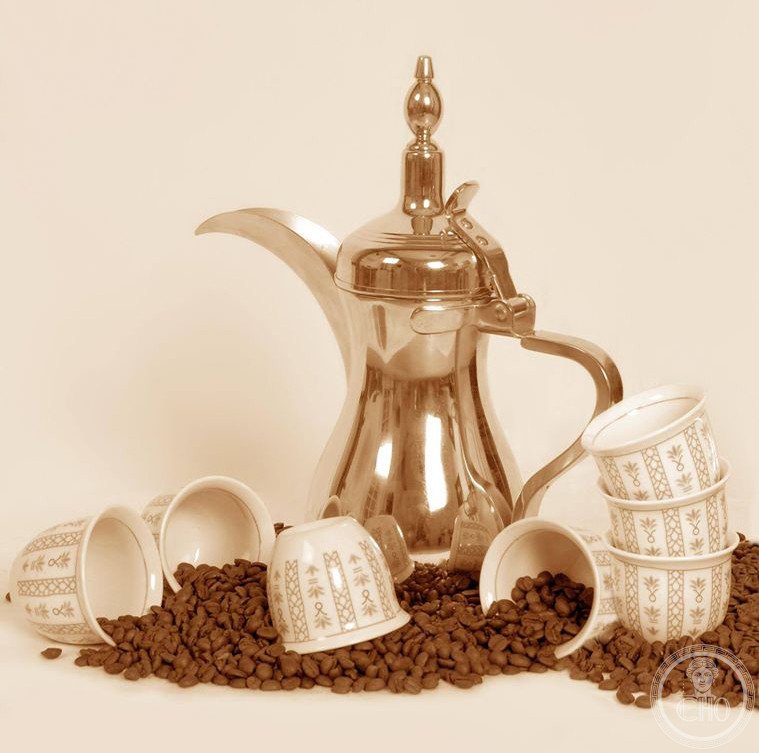
A bitter, aromatic brew steeped in Middle Eastern hospitality. Arabic coffee—qahwa—marks family gatherings, welcomes guests, and embodies centuries of culinary tradition across the Arab world.
In UNESCO’s words
Arabic coffee highlights an important aspect of generosity in Arab societies and the associated traditions of hospitality. Serving and drinking Arabic coffee is a daily ritual for communities, groups and individuals. It is served at weddings and tribal gatherings (reconciliation and conflict resolution majalis) in all submitting States including Jordan (the new submitting State). The practice is associated with specific rituals and rules of etiquette that are passed down informally from one generation to the next. For instance, older people and guests are served first, and the coffee must be poured using the right hand. It is also customary for the person drinking the coffee to shake their cup to signal that they are done. Arabic coffee is a popular practice that is enjoyed by all segments of society. In gatherings, it is often accompanied by the recitation of poetry, stimulating discussions, and the exchange of memories. In Jordan, Arabic coffee is held in high regard as a symbol of generosity and hospitality in the offices of government officials and statesmen, including ministers, representatives, and directors, and is always present in the homes of Jordanians, whether in Jordan or abroad. In addition to being a symbol of generosity, hospitality and respect, it acts as a call for peace and dialogue within and across countries.
Official description, UNESCO Intangible Cultural Heritage List — Arabic coffee, a symbol of generosity
At a glance
Arabic coffee is a daily ritual in Arab societies that expresses generosity and hospitality. Served and drunk by all segments of society, it appears at weddings, tribal gatherings, and everyday moments among communities, groups, and individuals. The practice carries specific rituals and rules of etiquette—older people and guests are served first, the right hand must pour, and drinkers shake their cup to signal completion. Gatherings often feature poetry recitation, discussion, and the exchange of memories alongside the coffee.
Origins & history
Arabic coffee originated in Greater Yemen, beginning in the port city of Mokha, where early cultivation and preparation methods took shape. From Yemen, the practice spread to Mecca in Hejaz, Egypt, the Levant, and then—in the mid-16th century—to Turkey and eventually to Europe, where coffee became a global phenomenon.
The practice
Arabic coffee is prepared and served according to rituals passed informally from generation to generation. The practice follows rules of etiquette: serving order (elders and guests first), pouring with the right hand, and the drinker's signal to finish by shaking the cup. The beverage accompanies social occasions from intimate moments to formal gatherings, creating a framework for conversation and connection among participants.
Cultural significance
Arabic coffee symbolizes generosity, hospitality, and respect within Arab communities. In Jordan, it holds particular regard in government offices and the homes of officials, representatives, and ministers, as well as in Jordanian households abroad. Beyond its cultural meaning, Arabic coffee serves as a call for peace and dialogue within and across countries, reflecting its role as a bridge between people.
Key facts
- Country: United Arab Emirates, Oman, Qatar, Saudi Arabia, Jordan
- Inscribed: 2024
- UNESCO list: Representative List of the Intangible Cultural Heritage of Humanity
- UNESCO reference: 02111
- UNESCO vocabulary: Beverages; Food preparation; Social gathering
- Map: Jordan — the locality named in UNESCO’s official description of this element
Where to experience it
Arabic coffee is served throughout communities across the Arab world, with particular significance in Jordan, where it features prominently in government offices, the homes of officials and statesmen, and in ordinary households. Visitors may encounter the tradition at weddings, tribal gatherings, and daily social occasions where it accompanies poetry recitation, conversation, and the exchange of memories. The practice remains a living symbol of generosity and hospitality, observed by all segments of society and maintained by communities both within their home countries and abroad.
Sources & resources
- UNESCO — official element page: Arabic coffee, a symbol of generosity
- UNESCO — open data record: Intangible Heritage List, reference 02111
- UNESCO — official video: UNESCO film on this element — embedded on this page
- UNESCO — official photograph: The process of rosting coffee prior to its grinding to be prepared and served — K. Renative FZ LLC, Kerelous Yacoub — Department of Culture and Tourism, Abu Dhabi, United Arab Emirates, 2022
- Reference — Wikipedia (secondary): Arabic coffee — consulted as a secondary reference, not as confirmation
- Cultural Heritage Online: Our archive and city guides

Find it on the map
See this place and what’s around it →📷 Become a Cultural Heritage Online photographer
Share your photos of places: they stay published under your name as the author. The more they're seen, the more you get noticed — and soon a contest will reward the most appreciated photos.
Log in or sign up free to add a photo