
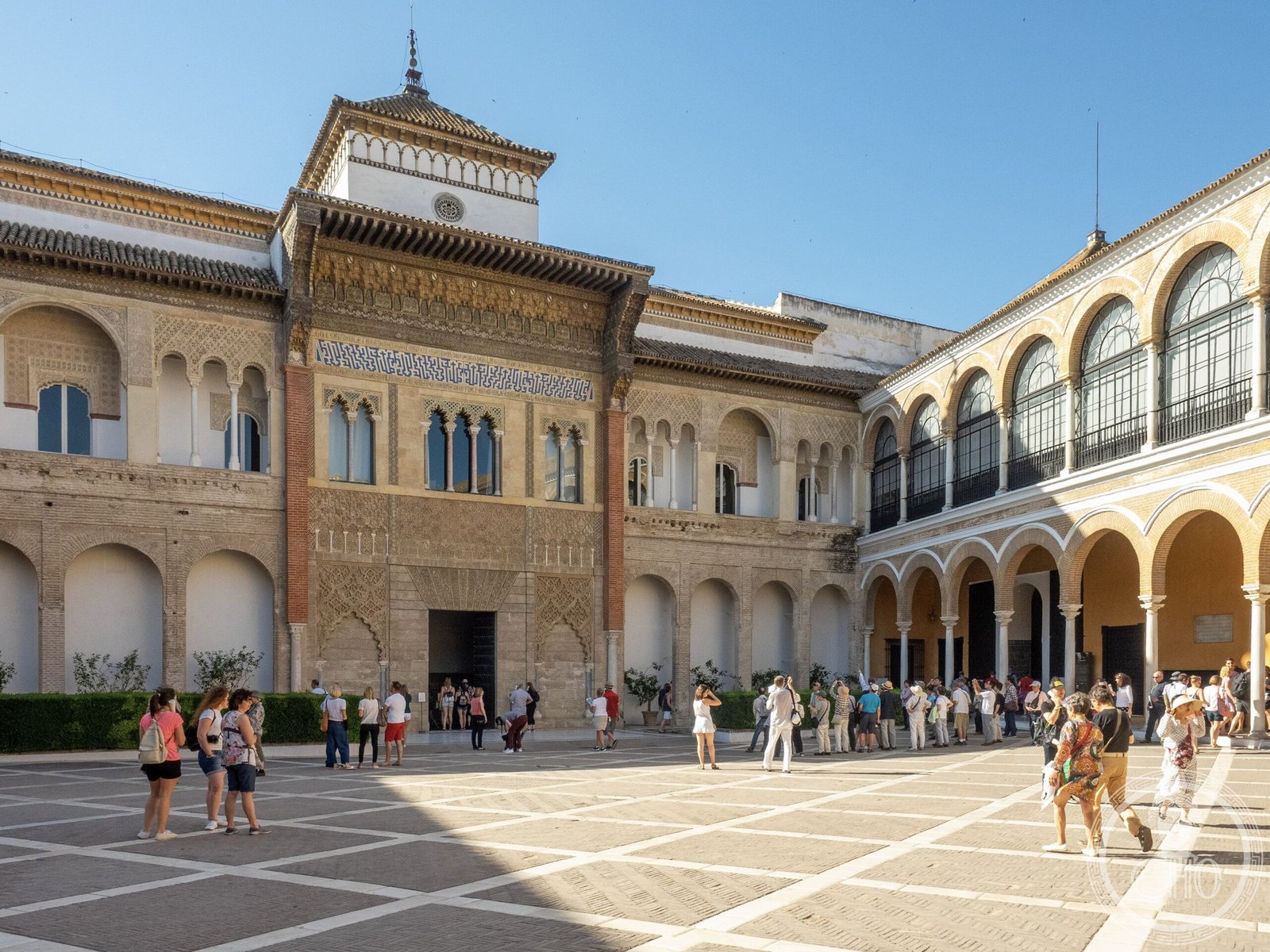
A layered royal palace where Umayyad citadel, Islamic dynasty expansion, and Christian conquest converge—crowned by Pedro I’s sumptuous Mudéjar palace of the 1360s.
At a glance
The Alcázar of Seville stands as one of Spain’s official royal residences and a supreme expression of Mudéjar architecture on the Iberian Peninsula. Built across centuries on the bones of an Islamic fortress, it combines Mudéjar decoration with Gothic and Renaissance elements, creating a visual palimpsest of conquest and cultural synthesis. The upper floors remain in active use by the Spanish royal family.
History
The site began as an Islamic-era citadel in the 10th century under Umayyad rule. The Abbadid dynasty expanded it in the 11th century, and the Almohads further developed it from the 12th to early 13th centuries. Following the Castilian conquest in 1248, Christian rulers progressively rebuilt the complex. King Pedro I commissioned the most celebrated structure—a richly ornamented Mudéjar palace—during the 1360s, establishing the palace as a seat of royal power and artistic ambition.
What you see
The palace’s defining feature is its Mudéjar style—the sophisticated blend of Islamic ornament with Christian patronage characteristic of medieval Iberia. Intricate tilework, carved stucco, and geometric patterns dominate interior surfaces. Subsequent Gothic and Renaissance additions layer further stylistic periods onto the ensemble. Courtyards, gardens, and ceremonial chambers reflect both Islamic spatial traditions and European court design.
Cultural significance
The Alcázar encodes Seville’s complex history: Islamic refinement, medieval Christian power, and dynastic continuity. It remains an active royal residence, maintaining the Spanish crown’s presence in Andalusia. As a UNESCO World Heritage Site (registered 1987), it anchors a triad of monuments—alongside Seville Cathedral and the General Archive of the Indies—that define the city’s cultural and historical importance.
Key facts
- Location: Seville, Spain (37.384°N, 5.991°W)
- Initial construction: 10th century (Umayyad citadel)
- Major Mudéjar palace: 1360s (Pedro I)
- Castilian conquest of site: 1248
- UNESCO World Heritage Site: 1987
- Current use: Official royal residence (upper floors)
Practical information & getting there
The Alcázar is located in central Seville and accessible by public transport and on foot from the cathedral. Specific visiting hours, admission details, and current royal-residence protocols are best confirmed directly with the venue or through official Spanish tourism resources before planning your visit.
Sources & resources
Find it on the map
See this place and what’s around it →
📷 Become a Cultural Heritage Online photographer
Share your photos of places: they stay published under your name as the author. The more they're seen, the more you get noticed — and soon a contest will reward the most appreciated photos.
Log in or sign up free to add a photoIs this page about you?
This page is read by travellers and heritage enthusiasts who find it on Google. Tell us how you are connected to this place and we will take it from there.