

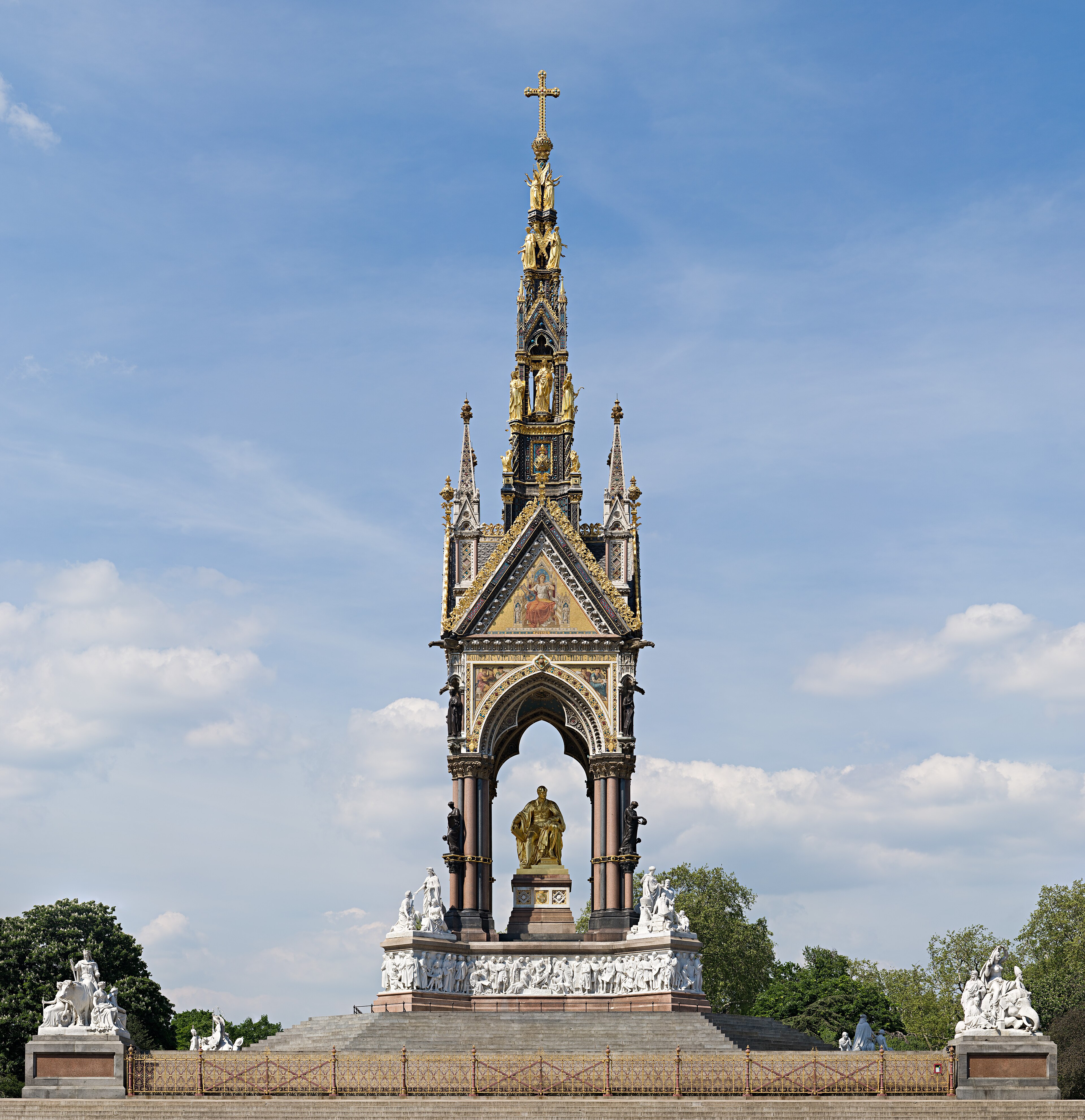
Queen Victoria’s towering tribute to Prince Albert, this Gothic Revival canopy shelters a statue of the prince and stands as one of London’s most elaborate Victorian monuments.
At a glance
A 176-foot ornate pavilion in Kensington Gardens, designed by Sir George Gilbert Scott and completed over ten years at a cost of £120,000—then an unprecedented public subscription. The memorial opened in 1872, with Albert’s statue formally installed in 1876.
History
Prince Albert died in 1861. Queen Victoria commissioned the memorial as a permanent expression of grief and devotion. Scott’s design was selected, and construction proceeded slowly, funded entirely by public contribution. The opening ceremony took place in July 1872, though the statue’s ceremonial placement occurred four years later. The monument has held Grade I listed status since 1970.
What you see
The memorial adopts the form of a Gothic Revival ciborium—the ornamental canopy that stands over a church’s high altar. Scott’s structure rises 176 feet and shelters a seated statue of Prince Albert, positioned to face south. The pavilion combines pointed arches, decorative pinnacles, and intricate stonework typical of the Revival style. Its scale and ornamentation reflect Victorian ambition and technical achievement.
Cultural significance
The Albert Memorial represents the height of Victorian commemorative architecture and Queen Victoria’s public mourning. It exemplifies Scott’s mastery of Gothic Revival design and remains an icon of 19th-century London. Its prominent location directly north of the Royal Albert Hall underscores its cultural weight.
Key facts
- Country: United Kingdom
- City: City of Westminster, London
- Coordinates: 51.50241, -0.17774
- Opened: July 1872
- Statue installed: 1876
- Height: 176 feet (54 metres)
- Designer: Sir George Gilbert Scott
- Grade I listed: Since 1970
Practical information & getting there
The memorial stands in Kensington Gardens, directly north of the Royal Albert Hall. It is freely accessible to the public and visible from various points within the gardens. London’s extensive transport network serves the area via multiple Underground stations and bus routes.
Sources & resources
Find it on the map
See this place and what’s around it →📷 Become a Cultural Heritage Online photographer
Share your photos of places: they stay published under your name as the author. The more they're seen, the more you get noticed — and soon a contest will reward the most appreciated photos.
Log in or sign up free to add a photoIs this page about you?
This page is read by travellers and heritage enthusiasts who find it on Google. Tell us how you are connected to this place and we will take it from there.