

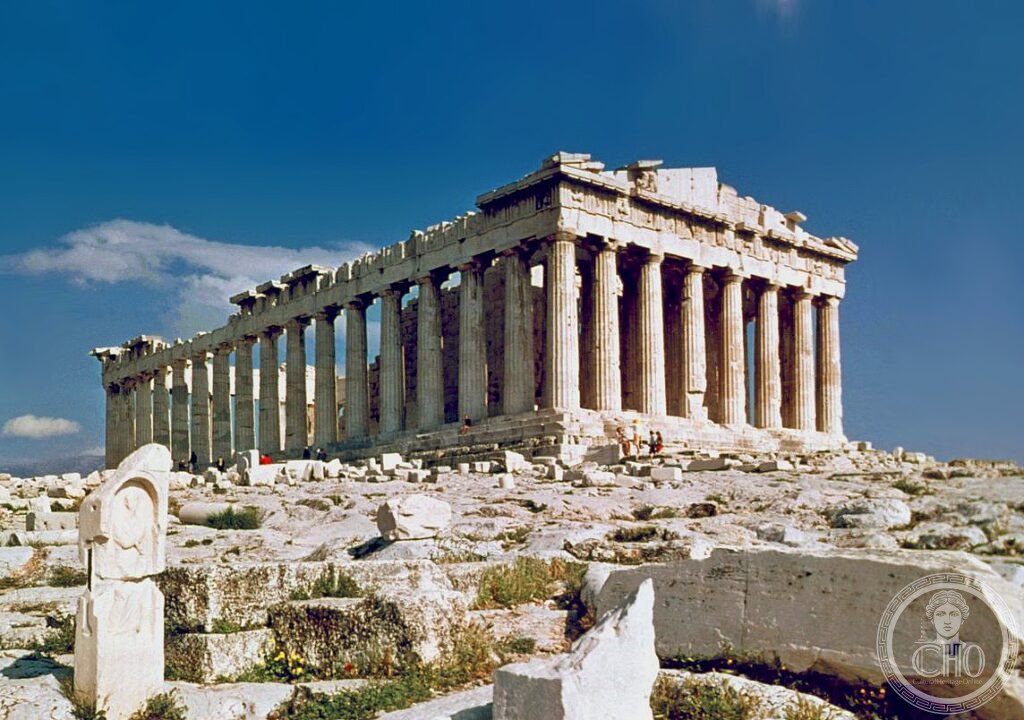
Crowning a limestone hill above Athens, the Acropolis holds the Parthenon and its companion temples, built under Pericles in the fifth century BCE. Their proportions, deliberately bent from straight lines to correct the eye, set a vocabulary of columns and pediments that architecture has returned to for two and a half thousand years.
At a glance
The Acropolis is a rocky outcrop above central Athens, visible across the whole basin of the city, crowned by the Parthenon and three smaller sanctuaries raised in the fifth century BCE. The buildings were commissioned by Pericles after the Persians destroyed the earlier Archaic temples in 480 BCE, and were paid for partly with funds from the Delian League treasury, money that Athens had collected for mutual defence and redirected to its own monuments.
The site is best understood together with the Acropolis Museum below the hill, which holds the surviving sculpture that Greece retained after the removal of much of the Parthenon frieze to London in the early nineteenth century.
Key facts
- The Parthenon: designed by the architects Ictinus and Callicrates under the sculptor Pheidias, who also made the colossal gold-and-ivory statue of Athena Parthenos for its interior; the temple has eight columns on the short ends and seventeen on the long sides, and its stylobate and columns are subtly curved to correct optical illusion.
- The frieze and the Elgin Marbles: a continuous sculpted frieze once ran around the inner chamber depicting the Panathenaic Procession; roughly half of what survives was taken to Britain by Lord Elgin in the early nineteenth century and is now in the British Museum, while the other half remains in the Acropolis Museum in Athens.
- Later history of the building: the Parthenon served in turn as a Christian church, a Byzantine church and, from 1458, an Ottoman mosque, before a Venetian shell ignited a gunpowder store inside it in 1687, destroying the roof, the interior columns and part of the frieze.
- The Erechtheion and its Caryatids: built between 421 and 406 BCE, its Porch of the Maidens is supported by six sculpted female figures; five originals stand in the Acropolis Museum, one is in the British Museum, and fibreglass copies now occupy their places on the building itself.
- The Acropolis Museum: designed by Bernard Tschumi and opened in 2009, it houses all the Parthenon sculpture owned by Greece in a glazed top-floor gallery aligned with the Parthenon itself, with empty display cases left for the sculptures still in London.
History
The hill was first used as a fortified Mycenaean palace in the thirteenth century BCE. The Archaic temples that later stood here were destroyed by the Persians in 480 BCE during Xerxes’ invasion, and the Athenians are said to have left the ruins standing deliberately as a war memorial before rebuilding began under Pericles.
The Periclean building programme raised the Parthenon, the Propylaea, the Erechtheion and the Temple of Athena Nike. The Parthenon later passed through use as a church and then, from 1458 to 1687, as an Ottoman mosque, before the 1687 explosion caused by Venetian bombardment under Francesco Morosini. In the Greek War of Independence, Greek forces took the Acropolis in 1822 and held it through a long siege between 1826 and 1827. The site was inscribed as a UNESCO World Heritage Site in 1987.
What you see
Visitors approach through the Propylaea, the monumental gateway that in antiquity took precedence over the Parthenon itself in the visitor’s experience. Beside it stands the Temple of Athena Nike, the smallest temple on the hill, which the Ottomans dismantled and which archaeologists have since rebuilt twice.
From the plateau the whole Athens basin is visible, and on clear days the Aegean Sea and the island of Aegina can be seen in the distance. Below the hill, the Acropolis Museum contains a glass floor over excavated ancient street remains, a ground-floor Caryatid gallery, and the top-floor Parthenon Gallery, glazed and aligned so that the temple is visible through the walls beside its own sculpture.
Practical information
- Opening: the site opens daily, with seasonal variation in hours; check the official Acropolis or Acropolis Museum channels before visiting.
- Best time to visit: arriving near opening time is generally recommended to avoid both crowds and the summer heat, which can be intense on the exposed rock.
- Access: the main plateau is reachable by a dedicated lift for wheelchair users, though some areas of the site remain difficult for those with mobility difficulties.
- Acropolis Museum: includes a café-restaurant, the Slype, with views towards the Parthenon.
Getting there
The Acropolis is reached on foot from the Acropoli metro station on Line 2, or from Monastiraki station on Lines 1 and 3, both a short walk from the main entrance.
Nearby
- Ancient Agora and Temple of Hephaestus — a short walk northwest; the civic heart of ancient Athens, with the best-preserved Doric temple in the city and the reconstructed Stoa of Attalos housing the Agora Museum.
- National Archaeological Museum — a walk or short metro ride north; holds a large collection of ancient Greek artefacts including the Antikythera Mechanism, Mycenaean gold from the so-called Mask of Agamemnon, and Cycladic figures.
- Cape Sounion — south of Athens by bus; the Temple of Poseidon stands on a cliff above the Aegean.
- Delphi — northwest of Athens by bus; the sanctuary of Apollo and seat of the ancient oracle, itself a UNESCO World Heritage Site.
Sources
- Wikipedia, Acropolis of Athens; Parthenon; Erechtheion; Elgin Marbles
- UNESCO, Acropolis, Athens, World Heritage Site reference 404
- Mary Beard, The Parthenon, Profile Books, 2002
Find it on the map
See this place and what’s around it →
📷 Become a Cultural Heritage Online photographer
Share your photos of places: they stay published under your name as the author. The more they're seen, the more you get noticed — and soon a contest will reward the most appreciated photos.
Log in or sign up free to add a photoIs this page about you?
This page is read by travellers and heritage enthusiasts who find it on Google. Tell us how you are connected to this place and we will take it from there.