
A Korean Buddhist ceremony re-enacting Buddha’s Lotus Sutra sermon, designed to guide the deceased toward enlightenment and the Pure Land of Ultimate Bliss.
In UNESCO’s words
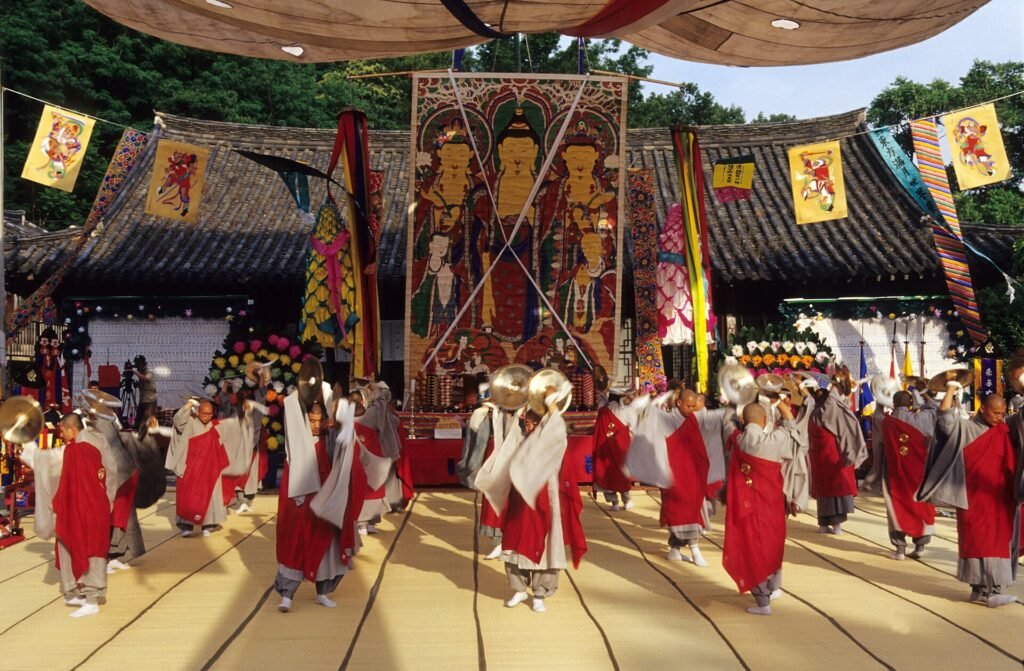
A central element of Korean Buddhist culture, Yeongsanjae is a re-enactment of Buddha’s delivery of the Lotus Sutra on the Vulture Peak in India, through which philosophical and spiritual messages of Buddhism are expressed and people in attendance develop self-discipline. Yeongsanjae begins with a ritual reception for all the saints and spirits of heaven and earth and concludes with a farewell ritual representing manners of the otherworldly realm of Buddha, with singing, ceremonial adornment and varied ritual dances such as the cymbal dance, drum dance and ceremonial robe dance. The other components include a ritual cleansing, a tea ceremony, the dedication of a rice meal to the Buddha and Bodhisattvas, a sermon inviting the audience to the door of truth and a ritual meal for the dead to congratulate them on their entry into heaven. Preserved chiefly by the Taego Order of Korean Buddhism based in Seoul, the Yeongsanjae is held in temples throughout the Republic of Korea to help all beings enter the world of truth by worshipping and admiring the Buddha and his laws and monks. The ceremony serves as an important space for transmission of values and art forms and for meditation, training and enlightenment.
Official description, UNESCO Intangible Cultural Heritage List — Yeongsanjae
At a glance
Yeongsanjae is a Korean Buddhist ceremony that re-enacts Buddha's delivery of the Lotus Sutra on Vulture Peak. Through singing, ritual dances—including cymbal dance, drum dance, and ceremonial robe dance—and ceremonial practices, the performance expresses Buddhist philosophical and spiritual messages. Attendees develop self-discipline while the ceremony helps all beings enter the world of truth through worship and admiration of the Buddha and his laws.
Origins & history
Yeongsanjae originates from the Buddhist story of Buddha delivering the Lotus Sutra. The ceremony has been preserved chiefly by the Taego Order of Korean Buddhism, which is based in Seoul. Through this re-enactment, the Taego Order transmits Buddhist teachings and values across generations of practitioners throughout the Republic of Korea.
The practice
The ceremony begins with a ritual reception for saints and spirits of heaven and earth. It includes ritual cleansing, a tea ceremony, dedication of rice to the Buddha and Bodhisattvas, and a sermon inviting the audience toward spiritual truth. Varied ritual dances—the cymbal dance, drum dance, and ceremonial robe dance—punctuate the performance. The ceremony concludes with a farewell ritual representing the otherworldly realm of Buddha, followed by a ritual meal for the dead celebrating their entry into heaven.
Cultural significance
Yeongsanjae serves as an important space for transmission of Buddhist values and art forms, enabling meditation, training, and enlightenment for those who participate. The ceremony helps communities and individuals enter the world of Buddhist truth while honoring both the living and the dead through devotional practice and structured spiritual guidance.
Key facts
- Country: Republic of Korea
- Inscribed: 2009
- UNESCO list: Representative List of the Intangible Cultural Heritage of Humanity
- UNESCO reference: 00186
- UNESCO vocabulary: Buddhism; Religious practice; Rituals
- Map: not shown — UNESCO’s official description of this element names no locality, and a living tradition is practised across a community, not at one address.
- Related World Heritage site: Sansa, Buddhist Mountain Monasteries in Korea (a different UNESCO designation, not the place of the tradition)
Where to experience it
Yeongsanjae is performed in temples throughout the Republic of Korea, where the Taego Order, which preserves the tradition, conducts ceremonies to help all beings enter the world of truth. Visitors can encounter the ritual at various temples that hold the ceremony, experiencing the ceremonial dances, singing, and ritual components that transmit Buddhist philosophy and art forms. To find current performance dates and locations, interested observers should contact local temples or the Taego Order directly, as the ceremony serves as an important space for meditation, training and enlightenment within Korean Buddhist communities.
Sources & resources
- UNESCO — official element page: Yeongsanjae
- UNESCO — open data record: Intangible Heritage List, reference 00186
- UNESCO — official video: UNESCO film on this element — embedded on this page
- UNESCO — official photograph: Photograph of this element — Seuk In-chul — National Research Institute of Cultural Heritage, 2003
- Reference — Wikipedia (secondary): Yeongsanjae — consulted as a secondary reference, not as confirmation
- Cultural Heritage Online: Our archive and city guides

Sources
- S1 — Buswell, Robert E. The Zen Monastic Experience: Buddhist Practice in Contemporary Korea. Princeton University Press, 1992. ISBN 978-0-691-07407-8.
- S2 — Howard, Keith, ed. Korean Pop Music: Riding the Wave. Global Oriental, 2006. ISBN 978-1-905246-14-4.
Spotted an error? Write to editorial@culturalheritageonline.com and we correct it the same day.