
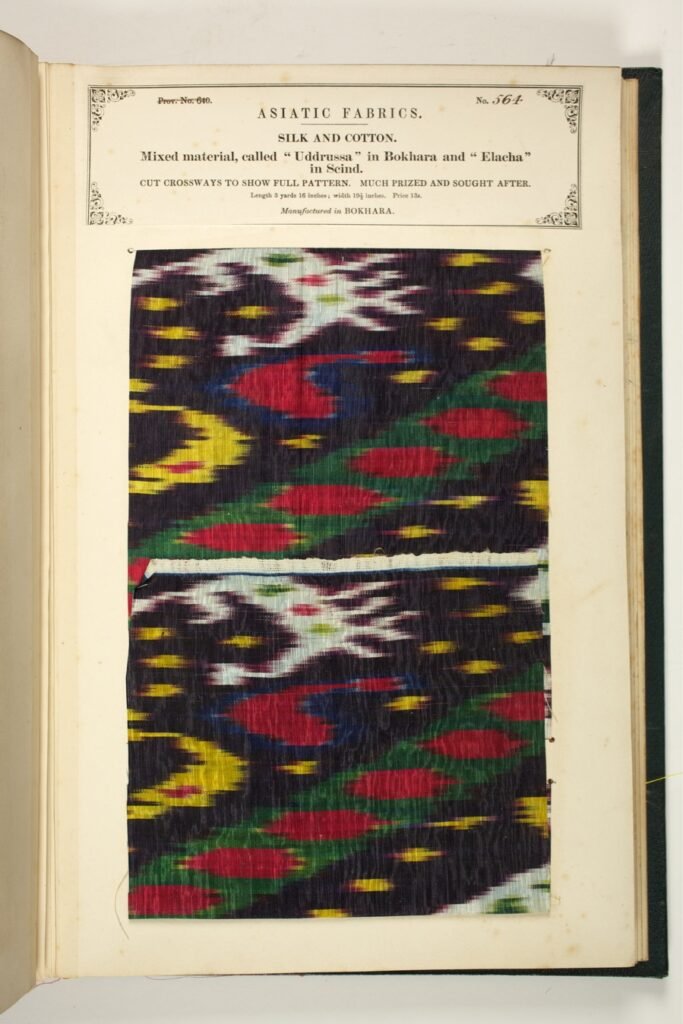
In the mountain valleys of Central Asia, master weavers create adras—a luminous silk-cotton blend prized for its strength, color saturation, and royal dignity. The fabric’s name itself, derived from words meaning “royal,” speaks to centuries of prestige.
In UNESCO’s words
Atlas and adras are two kinds of traditional woven fabrics produced in Tajikistan. Atlas is made from silk threads, and adras is woven with silk and cotton threads, but the technique of creating both cloths is similar. There are many steps in the process, from gathering cocoons and collecting cotton, to spinning, wrapping, dyeing and weaving the threads by hand. Dresses prepared from atlas and adras cloths are widely used by women and girls during celebrations, in the workplace, in schools and at home. Traditionally, the knowledge and skills related to the production of the atlas and adras are transmitted within families or in production centres. It takes three to five months to acquire the weaving skills. During this period, students practise the weaving of simple fabrics with elementary ornaments. The practice can also be transmitted formally in schools and colleges, and through participation in atlas and adras festivals. The fabrics are popular cloths among Tajik women, who consider them as part of their cultural identity. Women usually wear clothes made from atlas and adras in official ceremonies, festivals, traditional holidays, social gatherings and events. The transmission of the element to younger generations promotes unity and collaboration among people from different regions.
Official description, UNESCO Intangible Cultural Heritage List — Traditional knowledge and skills of production of the atlas and adras fabrics
At a glance
Atlas and adras are two traditional handwoven fabrics produced in Tajikistan. Atlas is made from silk threads, while adras combines silk and cotton threads. Both fabrics are created through similar techniques involving multiple steps: gathering raw materials, spinning, wrapping, dyeing, and weaving by hand. Women and girls wear dresses made from these cloths in celebrations, at work, in schools, and at home.
Origins & history
Knowledge and skills for producing atlas and adras have traditionally been passed down within families and at production centres. Formal instruction also occurs in schools and colleges, and through participation in atlas and adras festivals. Learning the weaving skills takes three to five months, during which students practise making simple fabrics with basic ornaments before advancing to more complex work.
The practice
The weaving process begins with gathering cocoons and collecting cotton, followed by hand-spinning the threads. Dyers then colour the silk and cotton before weavers work them on looms by hand. The technique for both atlas and adras follows comparable steps, producing fabrics with characteristic appearance and durability through skilled, labour-intensive work.
Cultural significance
Tajik women view atlas and adras as central to their cultural identity, wearing these fabrics at official ceremonies, festivals, traditional holidays, and social gatherings. Transmitting the knowledge to younger generations strengthens unity and collaboration among people from different regions. The practice keeps both the craft skills and the cultural values they represent alive in communities.
Key facts
- Country: Tajikistan
- Inscribed: 2023
- UNESCO list: Representative List of the Intangible Cultural Heritage of Humanity
- UNESCO reference: 01484
- UNESCO vocabulary: Costumes; Textile arts; Weaving; Women workers
- Map: not shown — UNESCO’s official description of this element names no locality, and a living tradition is practised across a community, not at one address.
Where to experience it
Atlas and adras weaving thrives throughout Tajikistan, where the tradition remains central to cultural identity. Visitors can witness the practice in production centres and at atlas and adras festivals, where both established artisans and students demonstrate the intricate hand-weaving techniques. The fabrics appear in everyday life and at official ceremonies, traditional holidays, and social gatherings, where Tajik women wear clothing made from these cloths. Family workshops and schools continue to transmit the knowledge of spinning, dyeing, and weaving to younger generations, ensuring the techniques survive across different regions.
Sources & resources
- UNESCO — official element page: Traditional knowledge and skills of production of the atlas and adras fabrics
- UNESCO — open data record: Intangible Heritage List, reference 01484
- UNESCO — official video: UNESCO film on this element — embedded on this page
- UNESCO — official photograph: The process of weaving adras in the wooden tool — Dilshod Rahimov, 2018
- Reference — Wikipedia (secondary): Adras (fabric) — consulted as a secondary reference, not as confirmation
- Cultural Heritage Online: Our archive and city guides

Sources
- S1 — Fitz Gibbon, Kate, and Andrew Hale. Ikat: Silks of Central Asia. Laurence King Publishing, 1997. ISBN 978-1-85669-101-7.
- S2 — Knobloch, Edgar. Monuments of Central Asia. I.B. Tauris, 2001. ISBN 978-1-86064-590-7.
Spotted an error? Write to editorial@culturalheritageonline.com and we correct it the same day.