
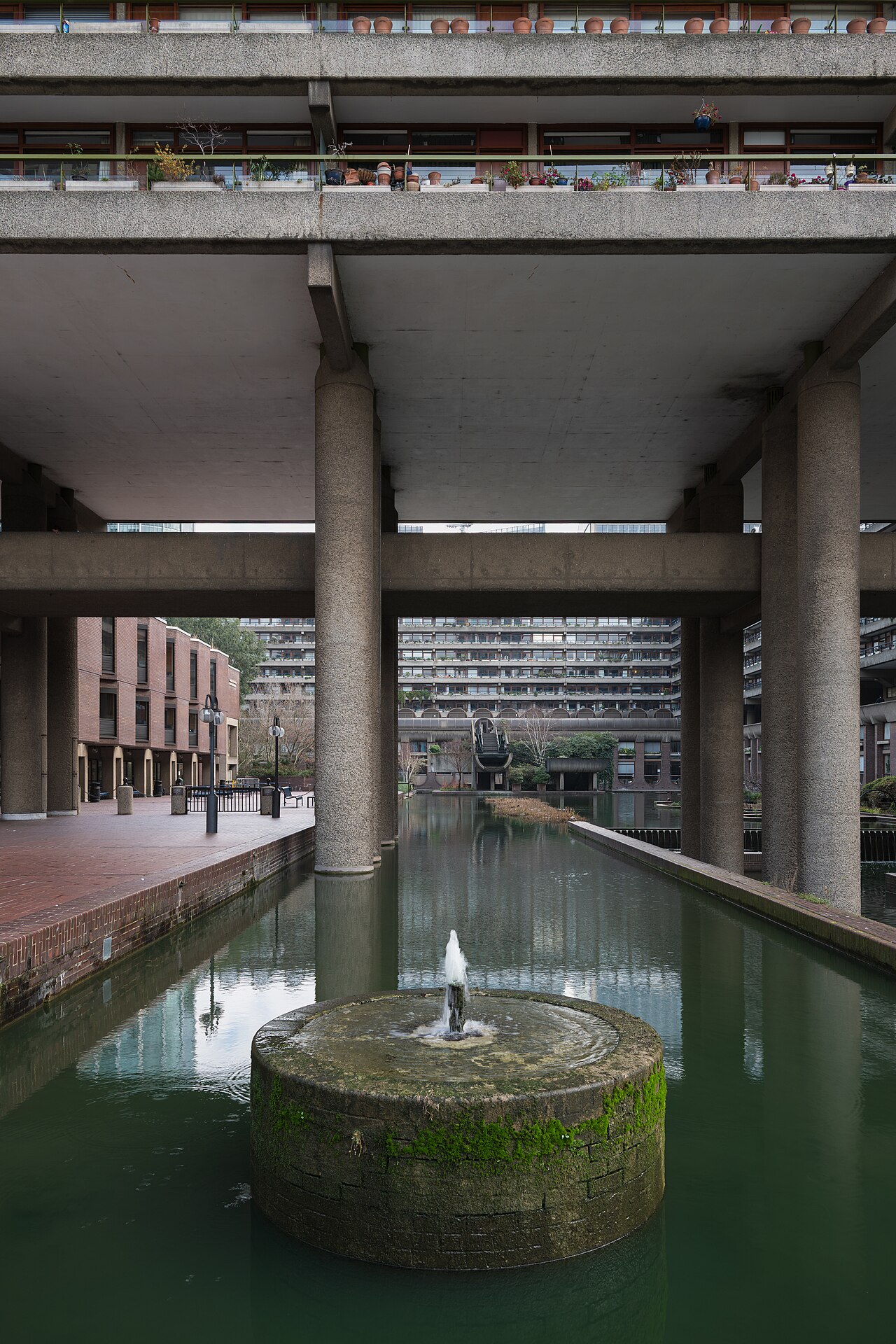
The Barbican is photographed a thousand times a day. A housing estate of the same decade, three miles east, may never have been photographed properly at all. That gap is the subject of this piece — and it is wider than most readers assume.
In July we published a guide to free-to-use images: where to find them, how to read a licence, why a credit is not permission. Writing it made something plain that we had only half-noticed while building our own pages. The free archives are deep on cathedrals and thin on everything built after roughly 1930. Public domain runs out exactly where the twentieth century begins.
Where the record thins out
The shortage is not random. Institutions photograph what is already protected, and protection tends to follow age. A Romanesque church has a listing, a conservation file and a photographic survey. A 1962 secondary school, a cinema in Bucharest, a seaside colony on the Adriatic often have none of the three.
We ran into this ourselves. Two enormous 1930s children’s colonies on the coast at Rimini — the Colonia Novarese and the Colonia Bertazzoni — appear in our editorial work, and there is not a single usable photograph of either on Wikimedia Commons. Not a poor one. None. Neither building has so much as a Wikidata entry. We checked again on 7 August 2026, in case we had missed something. We had not.
So the pages went out without a photograph, which is the honest option and a bad one. Multiply that by a continent of ordinary post-war buildings and you have the real state of the visual commons: excellent for the twelfth century, patchy for the twentieth.
The people who went and did it anyway
What exists instead is private. Over the last twenty years a small number of independent photographers and publishers built the record that institutions did not, one building at a time, usually at their own expense. Their work is worth knowing by name.
Roman Robroek photographs abandoned heritage across Europe — churches, palaces, monuments left behind — working in natural light, without staging. His book Oblivion has appeared in Dutch, English, French, German, Italian and Spanish editions, and he sells prints directly. His own site lists features by the BBC, The Guardian and others. The subject sounds romantic; the practice is the opposite, a matter of access, permission and patience.
Simon Phipps has been documenting post-war British public architecture building by building. His site is organised as case studies — well over two hundred of them — running from the Barbican, Trellick Tower and Robin Hood Gardens through the universities of Cambridge, Oxford, Sheffield, Leeds and Essex, and on to churches, fire stations, viaducts and shopping centres. It is less a portfolio than a survey, and it covers the exact category of building that gets demolished before anyone thinks to record it.
Zupagrafika, founded by David Navarro and Martyna Sobecka, is an independent publisher and design studio working on modernist and brutalist architecture. Their own catalogue runs past twenty titles — Eastern Blocks, Concrete Siberia, Panelki, Brutal East, Monotowns, The Tenants — and much of it exists because they went to the estates themselves, in cities most photographers never fly to.
BACU — the Bureau for Art and Urban Research — runs the Socialist Modernism archive, covering architecture built between 1955 and 1991 in the former East Germany, Bulgaria, Georgia, Moldova, Romania, Ukraine, Russia, Serbia and Tajikistan. It is documentation with a purpose attached: monitoring, research and preservation campaigns for buildings that are frequently one municipal decision away from disappearing.
Zsolt Hlinka works in Budapest, with fifteen years of architectural photography behind him and two fine-art series, Corner Symmetry and Urban Symmetry, that treat the city’s façades as geometry. A book followed the second series. Hungary’s twentieth-century fabric is enormous and unevenly documented; his images are among the few that treat it as art rather than record.
Darmon Richter has published Ex Utopia since 2011, first as The Bohemian Blog. Cold War sites, Yugoslav spomeniks, Chernobyl, breakaway republics: the ground where architecture, politics and folklore overlap. Every photograph on the site is his own, and he says so plainly on the page.
Why private archives are fragile
Two things follow from all of this, and they pull in opposite directions.
The first is that the record exists. For much of post-war Europe, if you want to see what a building looked like before the cladding, the fire or the bulldozer, the picture you need was probably taken by one of a few dozen people working independently.
The second is that nobody inherits it. These archives were not commissioned, are not deposited anywhere, and depend on one person continuing to pay for hard drives. When a photographer stops — retires, moves on, dies — the record stops with them. And because the images are private property, an encyclopedia cannot legally use them, so the free commons stays empty even in the places where superb photography already exists. The pictures are there; they are just not reachable.
How we handle it
We take the boring route. A photograph goes on a Cultural Heritage Online page only if the licence permits it — read at the source, not assumed — or if the person who took it has given permission in writing. When neither is true, the page ships without an image, as those two Rimini colonies did. We credit by name, we link back, and we do not use what we cannot license.
Photographers who want their work seen by an English-language heritage audience can read the terms on our photographers’ page. Nothing there is exclusive, and the credit always stays with the author.
The commons will not fill itself. It fills when someone photographs a building nobody has bothered with, and again when someone decides other people may use the picture. Those are two separate acts of generosity. This piece is about the first one.
Sources
- S1 — Curtis, William J. R. Modern Architecture Since 1900. Phaidon Press, 1996. ISBN 978-0-7148-3524-2.
- S2 — Frampton, Kenneth. Modern Architecture: A Critical History. Thames & Hudson, 1992. ISBN 978-0-500-20257-9.
Spotted an error? Write to editorial@culturalheritageonline.com and we correct it the same day.