Twyfelfontein, inscribed as Namibia’s first UNESCO World Heritage Site in 2007, preserves one of Africa’s most concentrated open-air archives of Stone Age art: at least 2,500 individual images pecked into approximately 212 sandstone slabs across a remote valley in the Kunene Region of northwestern Namibia. The engravings, created by San hunter-gatherers between roughly 6,000 and 2,000 BCE, document both the wildlife of the surrounding savanna and the spiritual world of the people who inhabited it. The site lies about 450 kilometres northwest of Windhoek, in the district historically known as Damaraland.
The engravings: animals, shamans and a distant coast Kunene Region, NW Namibia
The name Twyfelfontein is Afrikaans for “Doubtful Fountain,” a name given by early white settlers who found the spring at the base of this sandstone outcrop so intermittent that they could not rely on it. The San communities who came before them had no such doubts: the spring, the shade of the valley and the dense population of game it sustained made this place a gathering point for millennia, and the engravings are the accumulated record of that occupation.
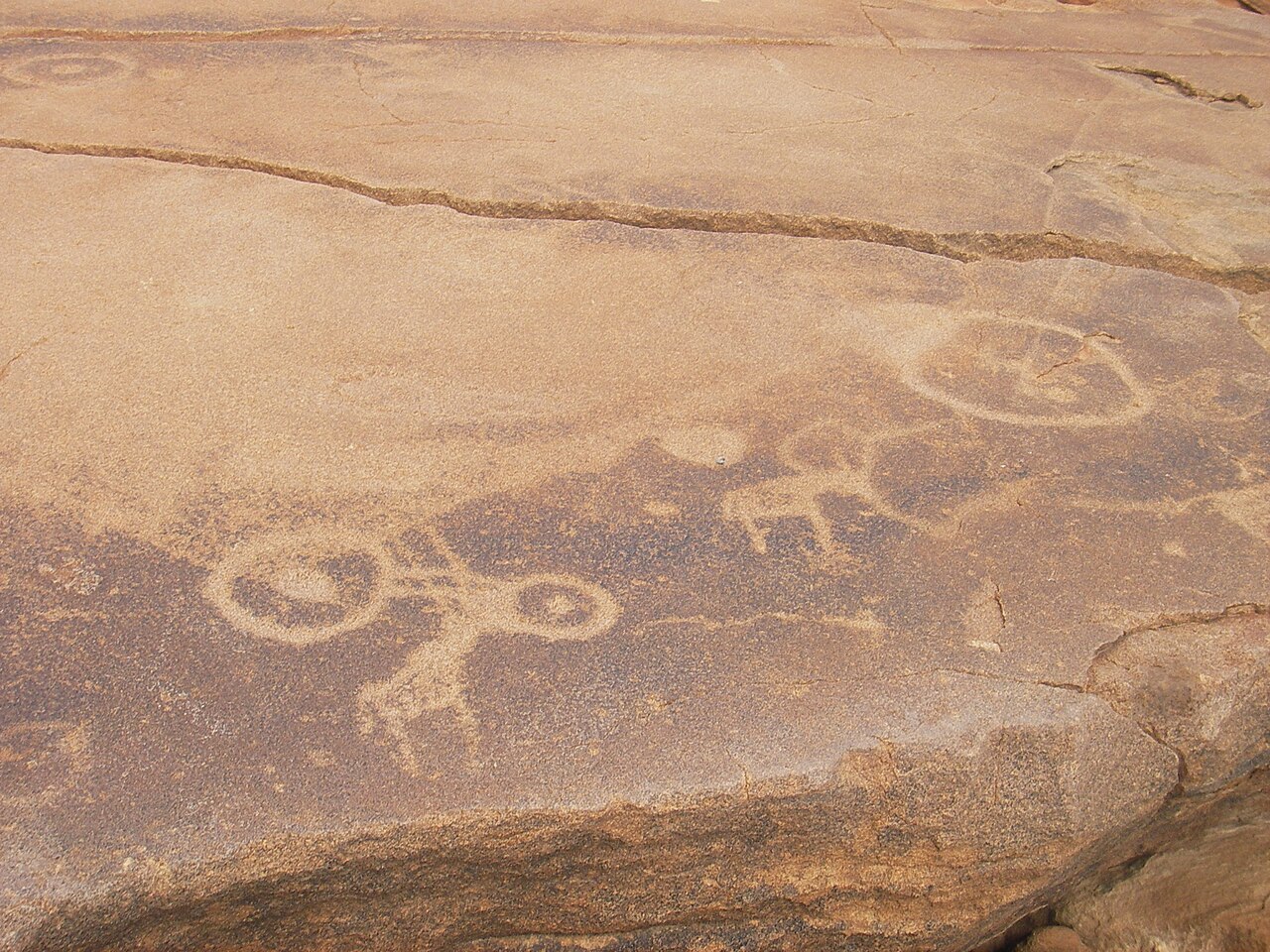
The medium is Etjo sandstone, a reddish-brown formation whose surface is coated by iron and manganese oxide — the dark “desert varnish” that forms over thousands of years in arid environments. The artists worked by pecking through this varnish with stone tools to expose the lighter rock beneath, producing images that read as pale shapes against a dark ground. The technique requires no pigment; the images are structural rather than painted, which explains why so many have survived in legible condition despite the harshness of the Namib climate.
The most immediately striking images are the large animals. Giraffe appear repeatedly, rendered with elongated necks and a confidence that suggests these were not symbolic approximations but observed records. Rhinoceros, elephant, lion, ostrich and zebra are all present. One of the most remarked-upon images is that of a seal — a marine animal whose nearest habitat is the Atlantic coast, nearly 100 kilometres to the west. The seal almost certainly reached the panel after a coastal hunting or foraging expedition, carrying with it the memory of a creature from a completely different ecological zone.
More philosophically complex are the therianthropic figures — part human, part animal — that recur across the site. The most studied is the Lion Man: a figure with a human body and the feet and lower limbs of a lion. San rock art specialists, most notably David Lewis-Williams, have interpreted such figures as representations of a shaman in the altered state of trance, during which the shaman was believed to undergo transformation into the spirit form of a power animal. The Lion with Paw Prints takes this concept further: the lion’s body has been replaced by a sequence of its own tracks, encoding the idea that the animal’s spoor carries its spiritual presence — a concept central to San hunting belief.
The landscape around the engravings includes two geological formations worth visiting independently. Burnt Mountain, a few kilometres away, is a basalt outcrop that oxidised when an adjacent dolerite intrusion subjected it to intense heat; the result is a hillside of purple, black and orange tones that shifts through the day as the light changes. The Organ Pipes, nearby, are a 100-metre field of hexagonal dolerite columns formed by slow cooling of the same intrusion — a geometry so regular it reads as deliberate even though it is entirely geological.
Visiting the site: guided access and the surrounding landscape ~450 km from Windhoek
Twyfelfontein is reached by gravel road from the D2612 near Khorixas. A 4WD vehicle is not strictly necessary in dry conditions, but the corrugated tracks reward high clearance, and the route from Windhoek — typically via Outjo and Khorixas — takes a full day of driving. Most visitors approach as part of a self-drive itinerary through Damaraland and the Skeleton Coast, combining Twyfelfontein with Etosha National Park to the east or the dune fields of the Namib Desert to the south.
Access to the engraving panels is permitted only with a licensed guide, who can be hired at the visitor centre at the site entrance. The main circuit takes roughly 45 to 75 minutes at a measured pace; a second, longer circuit reaches additional panels including the Giraffe engraving and the Lion with Paw Prints. Photography is permitted throughout. The site is managed jointly by the Namibian government and the local Damara community, with entrance fees contributing directly to community infrastructure.
Accommodation in the Twyfelfontein area ranges from community-run campsites to mid-range lodges at Aba-Huab and Mowani Mountain Camp, which sits on a rocky hillside above the valley and gives good views of the wider Damaraland landscape. The town of Khorixas, roughly 70 kilometres to the east, has fuel, basic supplies and a government guesthouse.
The best light for observing the engravings is in the morning or late afternoon, when low-angle sun rakes across the rock surface and emphasises the shallow relief of the pecked images. At midday, when the sun is overhead and the Namibian light is extremely strong, the contrast between varnish and exposed stone flattens and the images are harder to read. The valley receives very little rainfall; the dry season (April to October) is the principal visiting period, though winter nights can be cold at this altitude.
Practical information
Twyfelfontein UNESCO World Heritage Site is located in the Uis Constituency of the Kunene Region, northwestern Namibia. GPS coordinates: approximately 20°35′S 14°22′E. The visitor centre and guided tour booking point is open daily, generally from 08:00 to 17:00; hours can vary by season and should be confirmed in advance. Entrance fees apply and include the mandatory guide. The closest airport with scheduled services is Ondangwa or Windhoek (Hosea Kutako International); no public transport serves the site and a private vehicle or organised tour is required. Distances: Windhoek 450 km (gravel sections, allow 5–7 hours); Khorixas 70 km; Swakopmund 300 km. There is no mobile phone coverage across much of the route; download offline maps before departure. Fuel availability is limited outside Khorixas and Palmwag; fill up whenever possible. The Namibia Wildlife Resorts (NWR) website and Namibia Tourism Board maintain current information on access conditions after rain.
Frequently Asked Questions
Who made the engravings at Twyfelfontein, and how old are they?
The engravings at Twyfelfontein were almost certainly made by San (also called Bushmen) hunter-gatherers, the indigenous people who have inhabited southern Africa for at least 100,000 years and whose descendants still live in parts of Namibia, Botswana and South Africa today. The date range accepted by researchers spans from approximately 6,000 BCE to around 2,000 BCE — placing the bulk of the engraving activity in what archaeologists call the Late Stone Age in southern Africa. Some images may be more recent than 2,000 BCE, and the site was likely visited and added to over a very long period rather than being created in a single cultural episode. The dating of petroglyphs is inherently difficult: unlike painted pigments, which can sometimes be radiocarbon-dated if organic binders were used, pecked stone images carry no dateable material in themselves. Researchers use indirect methods — comparing the degree of re-varnishing on the engraved surfaces, stratigraphic associations with datable occupation layers in nearby deposits, and iconographic comparisons with dated painted sites — to establish the range. What is not in dispute is that the images are pre-historic in the strict sense: they predate any written record of the region’s inhabitants, and the tradition they represent had ended long before any European contact with the Namibian interior.
What does the Lion Man figure mean?
The Lion Man at Twyfelfontein — a figure with a human torso and the legs and feet of a lion — belongs to a well-documented class of images found in San rock art across southern Africa. The most widely accepted interpretation, developed principally by the South African archaeologist David Lewis-Williams from decades of ethnographic comparison with San oral tradition, is that such therianthropic figures depict a healer-shaman in the state of altered consciousness associated with the trance dance. In San spiritual belief, the trance state — induced through prolonged rhythmic dancing, hyperventilation and sensory concentration — allows the shaman to enter the spirit world, where they may take on the form of a power animal to combat illness or negotiate with supernatural forces. The lion was among the most potent of these power animals in the southern African San world, associated with strength, predatory ability and rain-making (itself a critical ritual concern in an arid environment). The replacement of the lion’s body by paw prints in the related “Lion with Paw Prints” image encodes a further metaphysical idea: that the animal’s track on the ground is a manifestation of its spirit presence, and that the track can substitute for the animal itself in a ritual context. These interpretations are supported by comparison with historically documented San oral traditions collected by 19th-century researchers working with San communities in the Cape Colony, who recorded detailed accounts of trance experience that match the visual language of the rock art.
Can you visit Twyfelfontein independently, or is a guide required?
A licensed guide is compulsory for all visits to the engraving panels at Twyfelfontein. This requirement is part of the site’s management plan and is enforced at the visitor centre, where entrance tickets are sold. Guides are employed through a community-based arrangement that ensures local Damara residents benefit directly from the site’s tourism income. The requirement is not purely administrative: the guides carry significant knowledge about individual panels and their iconographic context that would be very difficult to reconstruct independently from signage alone, and their presence helps protect the sandstone surfaces from inadvertent contact, which can damage the desert varnish and accelerate weathering of the engraved images. Two main tour circuits are available, differing in length and the panels visited; the longer circuit includes the most celebrated individual images including the Lion Man and the Giraffe engraving. Visitors who wish to spend extended time at specific panels should discuss this with the guide at the outset. There is no requirement to join a pre-booked tour group: individual visitors are paired with an available guide at the visitor centre on arrival, making walk-in visits entirely feasible during the main season.