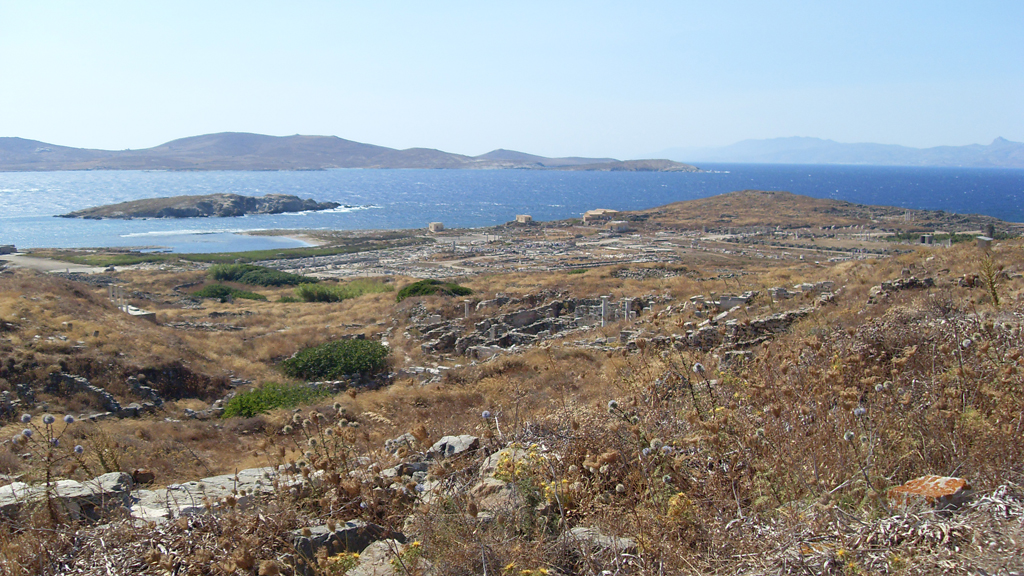
Delos, a tiny uninhabited island of 5 square kilometres at the centre of the Cyclades, has been deserted for more than two thousand years and yet remains one of the most densely layered archaeological sites in the Greek world. Inscribed on the UNESCO World Heritage List in 1990, it preserves the sanctuary of Apollo — one of the pan-Hellenic religion’s most important sacred precincts — alongside a Hellenistic commercial city whose sudden destruction in 88 BCE left entire residential quarters intact with their mosaic floors still in place. Accessible only by boat from Mykonos or Paros, the island receives no permanent inhabitants and closes at dusk.
The sanctuary of Apollo and the Terrace of the Lions 30 min by ferry from Mykonos
According to Greek mythology, Delos was the only place willing to receive Leto when she was pregnant with the twins Apollo and Artemis, whom Zeus had fathered and Hera was pursuing across the earth in jealous rage. All other islands and coastlines refused her. The floating island of Delos — unmoored from the seabed and therefore beyond the reach of Hera’s curse, in one version of the myth — accepted her, and she gave birth beneath a palm tree beside what became the Sacred Lake. The palm was still venerated in antiquity: Odysseus, in the Odyssey, tells Nausicaa that she is like the palm he saw at Delos, the most beautiful tree in the world. The myth established Delos as a sacred space of the first order. From at least the 9th century BCE, a sanctuary to Apollo grew on the island, and by the 6th century it had become one of the centres of pan-Hellenic religious life, the site of great festivals drawing pilgrims and delegations from across the Aegean world.
The Sanctuary of Apollo, at the heart of the archaeological site, comprises three successive temples to the god — the oldest elements dating to the 6th century BCE — along with the Temple of Artemis, and a series of stoai (colonnaded porticoes) that enclosed and organised the sacred precinct. The site’s most immediately striking monument, however, stands slightly apart: the Terrace of the Lions, a processional avenue of archaic Naxian marble lions, carved around 600 BCE and originally numbering between 9 and 16 figures. Set on a low ridge facing the now-drained Sacred Lake, the lions — with their compact, stylised bodies and open mouths — represent the guardian threshold between the profane world and the sanctuary. Five of the original lions survive in the island’s museum; replicas occupy the terrace positions in situ. One of the original lions was removed by Venetians in the 17th century and still stands at the Arsenal in Venice. The Sacred Lake itself, once the centre of the mythological narrative — the body of water beside which Apollo was born — was drained in the 19th century as a mosquito-control measure. A single palm tree and a marble basin now mark its site.
The Festival of the Delians, held every four years, was one of the major events in the pan-Hellenic calendar, drawing athletes, musicians, and delegations comparable to the Olympics. Athens, which claimed a special relationship with Delos through the myth of Theseus (who stopped at the island on his return from Crete), periodically “purified” the island by forbidding all births and deaths within its boundaries — removing the graves of the dead to the neighbouring island of Rheneia. The island’s sacred status made it simultaneously inviolable and economically significant: the sanctuary controlled extensive wealth and property, and the divine protection of the precinct made it a safe location for deposits and transactions.
The commercial city and the sacks that ended it Theater Quarter / site museum
The transformation of Delos from sacred island to commercial capital was one of the remarkable developments of the Hellenistic period (roughly 323–31 BCE). After Rome destroyed Corinth in 146 BCE and handed Delos to Athens as a free port, the island became the main transit point for trade between the eastern Mediterranean and the western world. Its population grew from a few thousand to an estimated 30,000 at peak — an extraordinary density for a 5 km² island — comprising Greeks, Romans, Italians, Egyptians, Syrians, and Jewish merchants, each community maintaining its own quarter, sanctuaries, and commercial associations. The island was simultaneously home to temples of Apollo and Artemis, a sanctuary of the Egyptian gods Isis and Serapis (the Serapieion), synagogue remains (among the oldest identified in the Mediterranean), and the commercial associations of Italian merchants (the Agora of the Italians).
The island also functioned as the principal slave market of the ancient Mediterranean. At its peak, Delos handled an estimated 10,000 enslaved people per day — bought, sold, and shipped onward by dealers who exploited the island’s status as a free port, its international connections, and the absence of regulatory oversight that might apply in a conventional city. The scale of this trade, documented in ancient sources and confirmed by the archaeological evidence of holding facilities, is one of the most significant and most uncomfortable aspects of Delos’s commercial history.
The destruction came in 88 BCE, when Archelaus, a general serving Mithridates VI of Pontus, attacked the island and massacred approximately 20,000 of its inhabitants — the Italian merchants being the primary targets, as Rome and Mithridates were at war. A second catastrophic raid by the pirate fleet of Athenodorus in 69 BCE completed the destruction. The island was never repopulated. What the attackers left, and what two millennia of abandonment subsequently preserved beneath windblown soil, is now the most complete Hellenistic domestic quarter surviving anywhere in the Mediterranean world. The Theater Quarter’s houses — the House of Dolphins, the House of the Masks, the House of Dionysus — retain their in-situ mosaic floors at a level of preservation extraordinary for any ancient residential context. The famous Dionysus-on-a-panther mosaic in the House of the Masks, dating to around 100 BCE, is among the finest examples of Hellenistic floor art in existence.
Practical information
Delos is accessible only by boat; there is no accommodation on the island and no overnight stay is possible. The standard departure point is Mykonos Old Port, with regular scheduled ferry services operating several crossings daily from approximately April to October (the exact schedule varies by season and operator — confirm locally on arrival in Mykonos). The crossing takes approximately 30 minutes. Day trips are also possible from Paros, with a longer crossing. A combined ticket covers the archaeological site and the on-site museum, which holds the finest sculptures, mosaics, and objects recovered from excavations. The site is extensive — allow a minimum of 3–4 hours for a thorough visit. The island has no shade beyond occasional ruins; sun protection, water, and sturdy shoes are essential. There is a small refreshment kiosk near the landing stage. The site is closed on Tuesdays. French archaeological teams under the École française d’Athènes have conducted excavations on Delos since 1873 and continue active research seasons.
Frequently Asked Questions
Why is Delos completely uninhabited today?
Delos has been uninhabited since approximately 50 BCE, a consequence of two successive violent destructions that ended its commercial and religious function. The massacre of 88 BCE, carried out by the Pontic general Archelaus in the context of the First Mithridatic War, killed most of the island’s population of around 20,000 and destroyed the commercial infrastructure that had made the island prosperous. A partial recovery was underway when the pirate fleet of Athenodorus, allied with Mithridates, raided the island again in 69 BCE, killing and enslaving the remaining inhabitants. After this second catastrophe, the island was simply not repopulated: the commercial networks had shifted, Puteoli and later Ostia had replaced Delos as the main western Mediterranean transit port, and there was no economic rationale for rebuilding a remote island sanctuary-port from scratch. The sacred precinct was maintained in a diminished way for some further decades, but eventually even ritual use ceased. The combination of early abandonment and the island’s subsequent status as protected sacred ground (which discouraged building over the ruins) is precisely what preserved the Hellenistic city so completely beneath the accumulated soil of two thousand years. When French archaeologists began systematic excavations in 1873, they found entire house floors intact, walls standing to considerable height, and objects abandoned in place at the moment of flight.
What are the best surviving mosaics in the Theater Quarter, and how accessible are they?
The Theater Quarter preserves the most concentrated group of in-situ Hellenistic floor mosaics anywhere in the ancient world. Three houses in particular are notable. The House of the Masks takes its name from a corridor mosaic depicting theater masks in a geometric frame, but its centrepiece is a large floor showing Dionysus riding a panther, his thyrsus raised, surrounded by a sophisticated polychrome composition dating to around 100 BCE — a virtuoso example of Hellenistic “opus vermiculatum” (fine tessellation following the outlines of figures). The House of Dolphins features a marine mosaic in the main room, showing dolphins ridden by Eros figures, with a border of sea creatures; the precision of the smaller tesserae in this floor is exceptional. The House of Dionysus displays a simpler but well-preserved Dionysus mosaic in its central courtyard. All three houses are accessible within the standard site ticket and clearly signposted from the main path through the Theater Quarter. The mosaics are exposed to the elements — they are in situ in open-roofed rooms — and are best viewed in morning light, which makes the colour gradations most legible. The on-site museum holds additional mosaic panels and sculptural material removed from the houses for preservation.
How did Delos function as a slave market, and what physical evidence survives?
Ancient literary sources — particularly Strabo, writing in the late 1st century BCE — make explicit reference to Delos’s role as the primary slave market of the Mediterranean, noting that the island “could admit and send away ten thousand slaves in the same day.” The scale described by Strabo has sometimes been questioned by modern scholars, but the general function of the island as a major node in the slave trade is not in doubt. Enslaved people were brought to Delos primarily from raids on the coasts of Asia Minor, Syria, and the Black Sea region — a consequence of Rome’s wars of conquest, which produced large numbers of captives, and of piracy, which supplied additional enslaved labour to meet Roman demand. The island’s status as a free port, its lack of direct Roman municipal oversight, its international merchant community with connections across the Mediterranean, and the presence of an existing commercial infrastructure all made it ideal for this trade. Physical evidence on the site for dedicated holding facilities is limited and debated among archaeologists — the scale of the daily operation may have relied largely on temporary structures and existing commercial spaces rather than purpose-built slave pens. The ethical dimension of this history is increasingly acknowledged in the presentation of the site by the Greek Ministry of Culture and the École française d’Athènes.
Sources
- S1 — Bruneau, Philippe, and Jean Ducat. Guide de Délos. École française d'Athènes, 2005. ISBN 978-2-86958-202-6.
- S2 — Roussel, Pierre. Délos: Colonie athénienne. De Boccard, 1987. ISBN 978-2-7018-0038-7.
Spotted an error? Write to editorial@culturalheritageonline.com and we correct it the same day.