Within two hours of Berlin, six UNESCO World Heritage Sites trace a sweeping arc from Prussian Rococo palaces and the birthplace of the Protestant Reformation to radical Bauhaus modernism, an Enlightenment garden realm, a Victorian red-brick port, and a medieval Hanseatic island city locked in Baltic amber. From Cultural Heritage Online.
Palaces and Parks of Potsdam and Berlin 30 min by S7
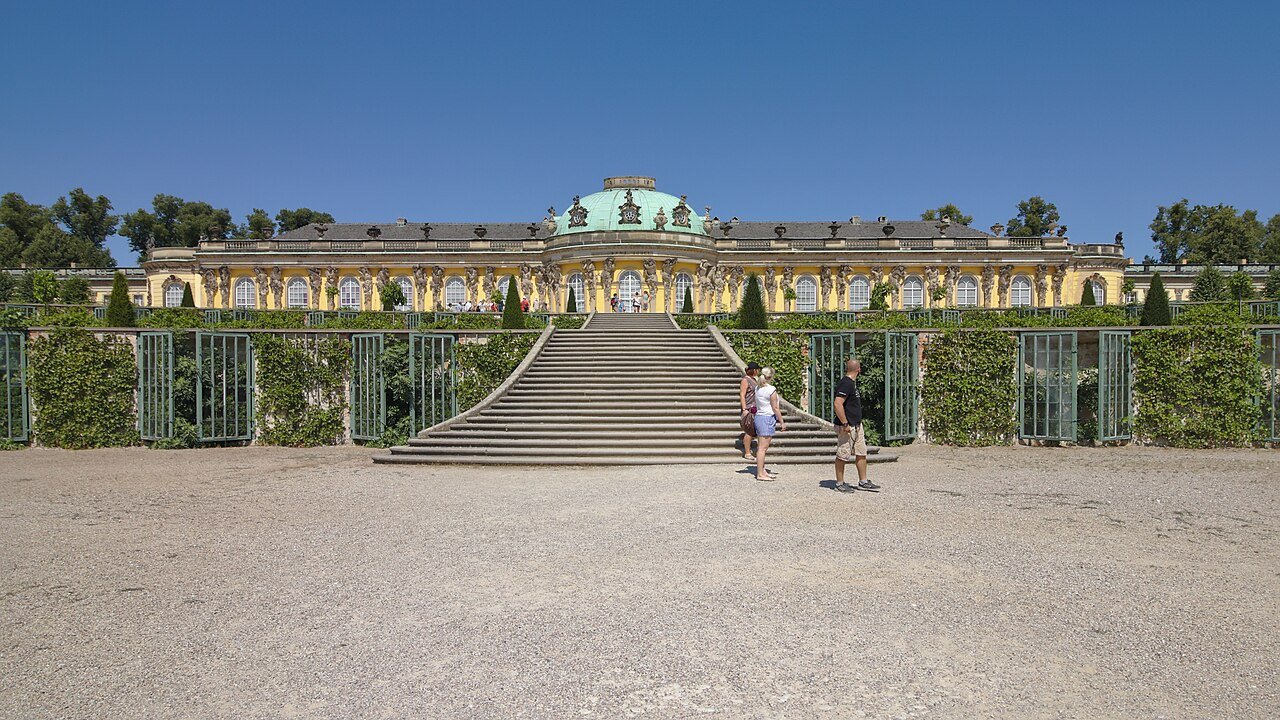
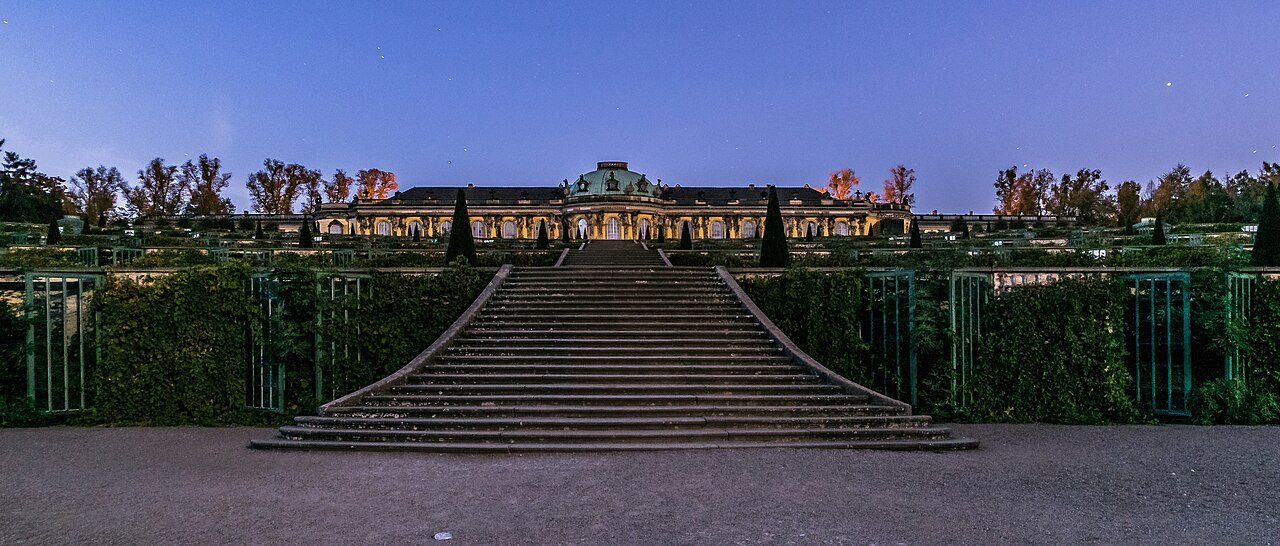
Inscribed in 1990, this 500-hectare ensemble of palaces, gardens, and parks — extended twice, in 1992 and 1999, to reach 2,064 hectares in total — represents the most concentrated expression of Prussian royal taste in Europe. The centrepiece is Sanssouci, built between 1745 and 1747 for Frederick the Great by Georg Wenzeslaus von Knobelsdorff in the Rococo style: a long, one-storey garden facade of golden sandstone unfolding above six terraced vineyard steps, its windows glinting in the Brandenburg light. The word sanssouci — French for “without a care” — captures the deliberate informality Frederick sought. The ensemble also includes the New Palace (1769), Charlottenhof, and Cecilienhof, where the 1945 Potsdam Conference reshaped postwar Europe. During the Cold War the Berlin Wall divided portions of the heritage zone; restoration after 1989 allowed the full landscape to be unified and designated again. The gardens harbour more than 150 historic structures.
Getting there: S7 from Berlin Hauptbahnhof to Potsdam Hauptbahnhof, then tram 91 to Park Sanssouci — around 30 minutes total. Allow: 3–4 hours. Best for: Baroque architecture and landscape design at a scale that rewards unhurried walking, with the palaces of Sanssouci visible from the moment you step through the park gates.
Lutherstadt Wittenberg 45 min by ICE
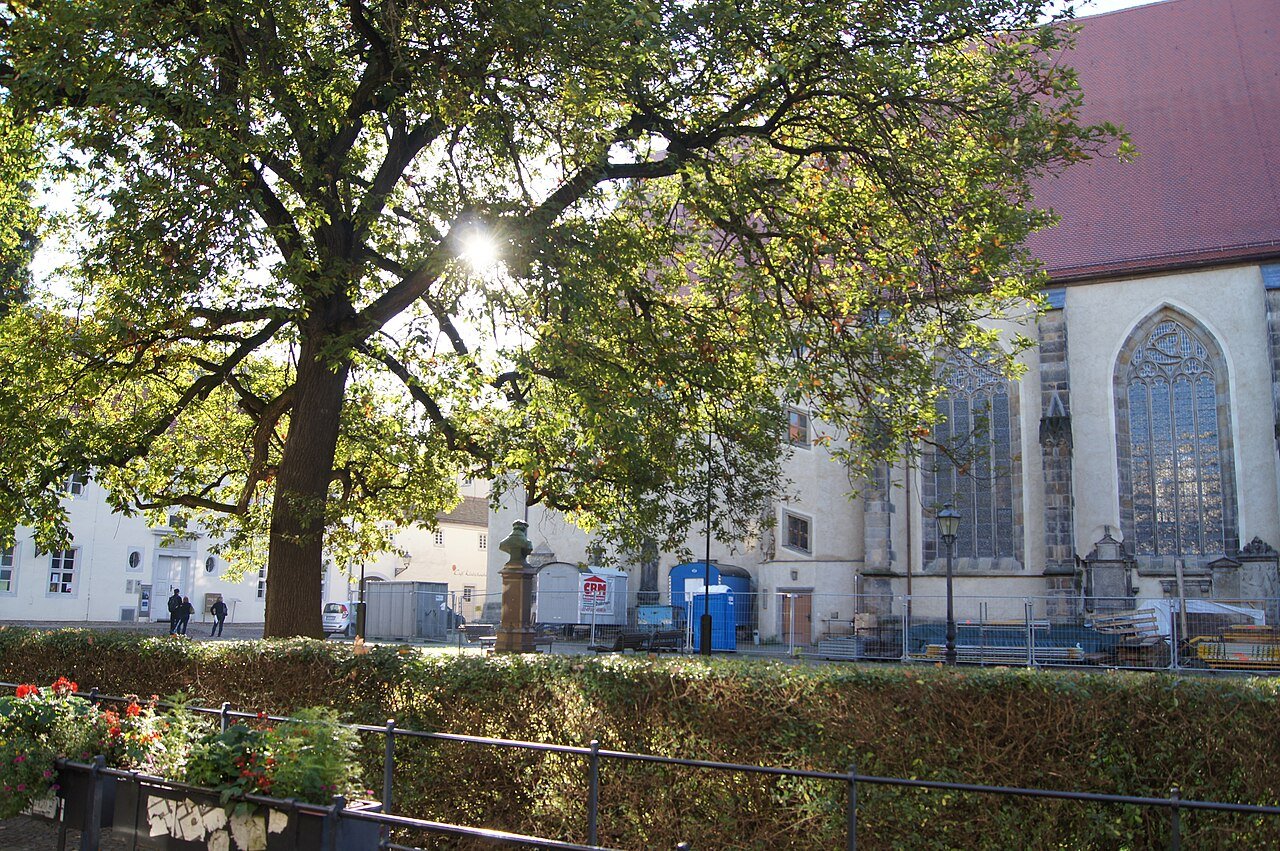
On 31 October 1517, Martin Luther reportedly fixed his Ninety-Five Theses to the door of the Schlosskirche (Castle Church) in Wittenberg, triggering the Protestant Reformation. The UNESCO inscription, awarded in 1996 under the name “Luther Memorials in Eisleben and Wittenberg,” recognises the town as the physical stage of one of the most consequential intellectual upheavals of the early modern world. The Schlosskirche itself — built 1496 to 1506 and badly damaged during the Seven Years’ War before a thorough restoration in 1883–1892 — still holds Luther’s tomb beneath its nave. The Stadtkirche St. Marien, where the first Protestant service was held in 1521, contains the Reformation Altar painted by Lucas Cranach the Elder in the 1540s, its four panels warm with earthy reds and greens. Luther’s own home, the Lutherhaus, preserves manuscripts and personal objects within the walls of the Augustinian monastery where he lived for decades.
Getting there: ICE from Berlin Hauptbahnhof to Lutherstadt Wittenberg, approximately 45 minutes. Allow: 3–4 hours. Best for: Visitors seeking the precise streets and buildings where the Protestant Reformation was conceived, argued, and launched.
Bauhaus and its Sites in Dessau 1 hr 20 min by Regional Express
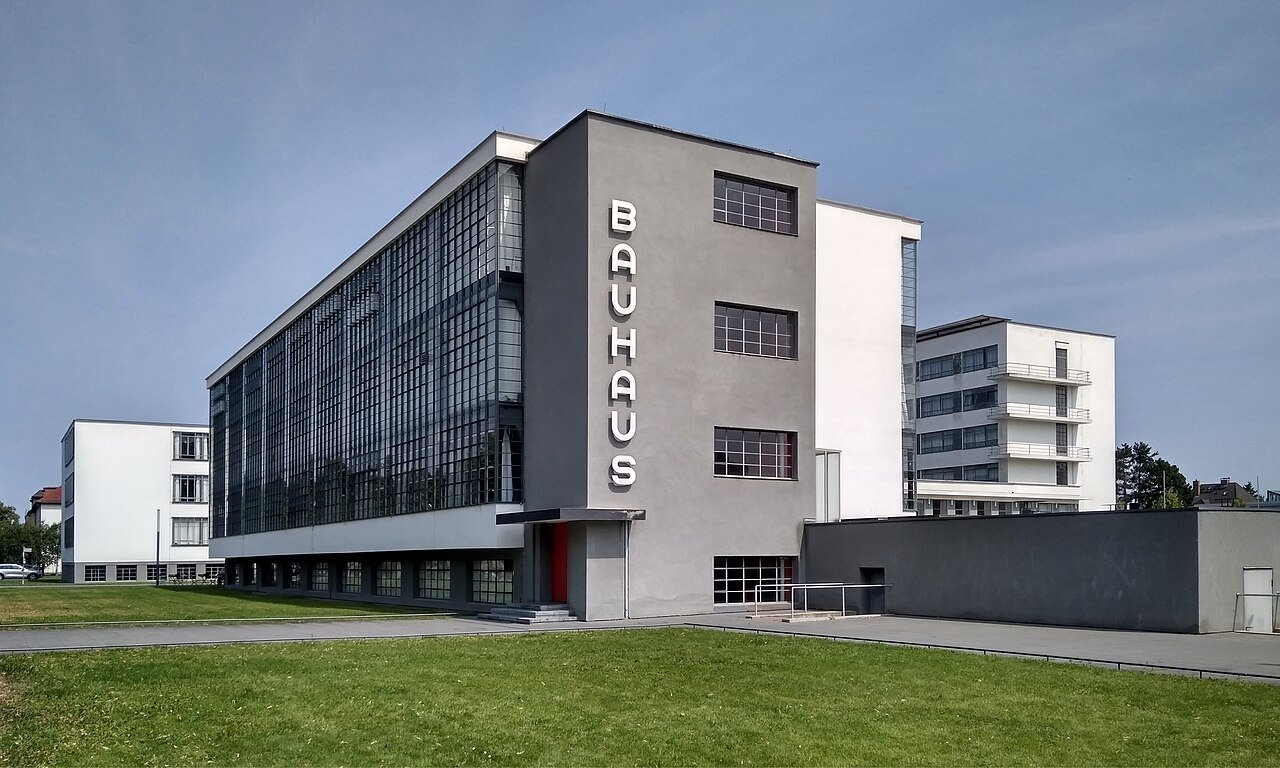
Erected between 1925 and 1926 to designs by Walter Gropius, the Bauhaus building in Dessau stands as the architectural manifesto of one of the twentieth century’s most influential schools of design. Inscribed as part of “Bauhaus and its Sites in Weimar, Dessau and Bernau” in 1996, it embodies the International Style’s core premise: that form follows function without ornament. Gropius deliberately avoided a single primary facade, instead composing five interconnected wings — workshops, studios, administration, a canteen, and dormitories — each expressing its internal use on the outside. The workshop wing’s continuous glass curtain wall, its steel columns set deliberately inward to free the glazing from any structural interruption, still startles in afternoon light. The complex was extensively restored between 1996 and 2006 for approximately 17 million euros. The Masters’ Houses nearby — a cluster of paired villas designed for Bauhaus faculty including Paul Klee and Wassily Kandinsky — complete the visit with their geometric gardens and stark white volumes.
Getting there: Regional Express RE7 or RE13 from Berlin Hauptbahnhof to Dessau-Roßlau, around 1 hour 20 minutes, then a short walk or cycle. Allow: 3–4 hours. Best for: Architecture enthusiasts wanting to experience the building that gave the modern movement its grammar, at the site where Gropius and his colleagues actually worked and taught.
Garden Kingdom of Dessau-Wörlitz 1 hr 20 min to Dessau + local bus
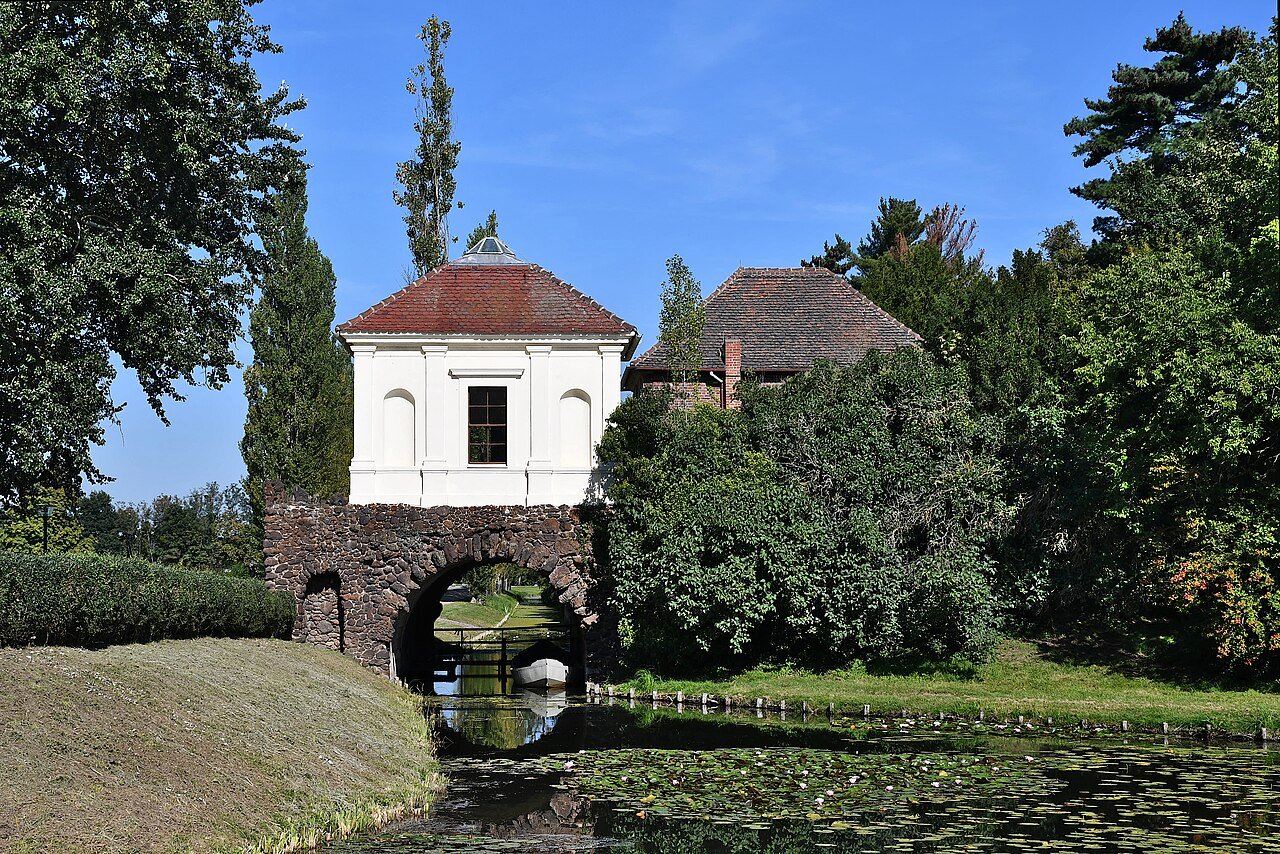
Covering 142 square kilometres of the Middle Elbe floodplain, the Garden Kingdom of Dessau-Wörlitz was inscribed in 2000 as one of the earliest and largest English landscape parks on the European continent. Duke Leopold III Friedrich Franz of Anhalt-Dessau conceived the realm in the late eighteenth century after his Grand Tours of Britain and Italy, and charged Friedrich Wilhelm von Erdmannsdorff to design its structures in the emerging Neoclassical idiom. Wörlitz Palace, completed in 1773, was the first Neoclassical building in what is now Germany. Paths wind across meadows and islets, past a working artificial volcano on the lake — constructed in 1788 as an Enlightenment-era curiosity — and through the neo-Gothic House inspired by Horace Walpole’s Strawberry Hill. Unlike contemporaneous noble parks, this one was open to the public from its founding, intended as an outdoor classroom in architecture, agriculture, and rational governance. The willows trail in the water, and the palaces appear gradually as reflections before they appear as buildings.
Getting there: Regional Express to Dessau, then local bus 304 or 308 to Wörlitz, approximately 1 hour 40 minutes in total. Allow: 2–3 hours. Best for: A day combining the Bauhaus in Dessau with the garden realm — two UNESCO sites, both in Saxony-Anhalt, separated by twenty minutes on a regional bus.
Speicherstadt and Kontorhaus District, Hamburg 1 hr 45 min by ICE
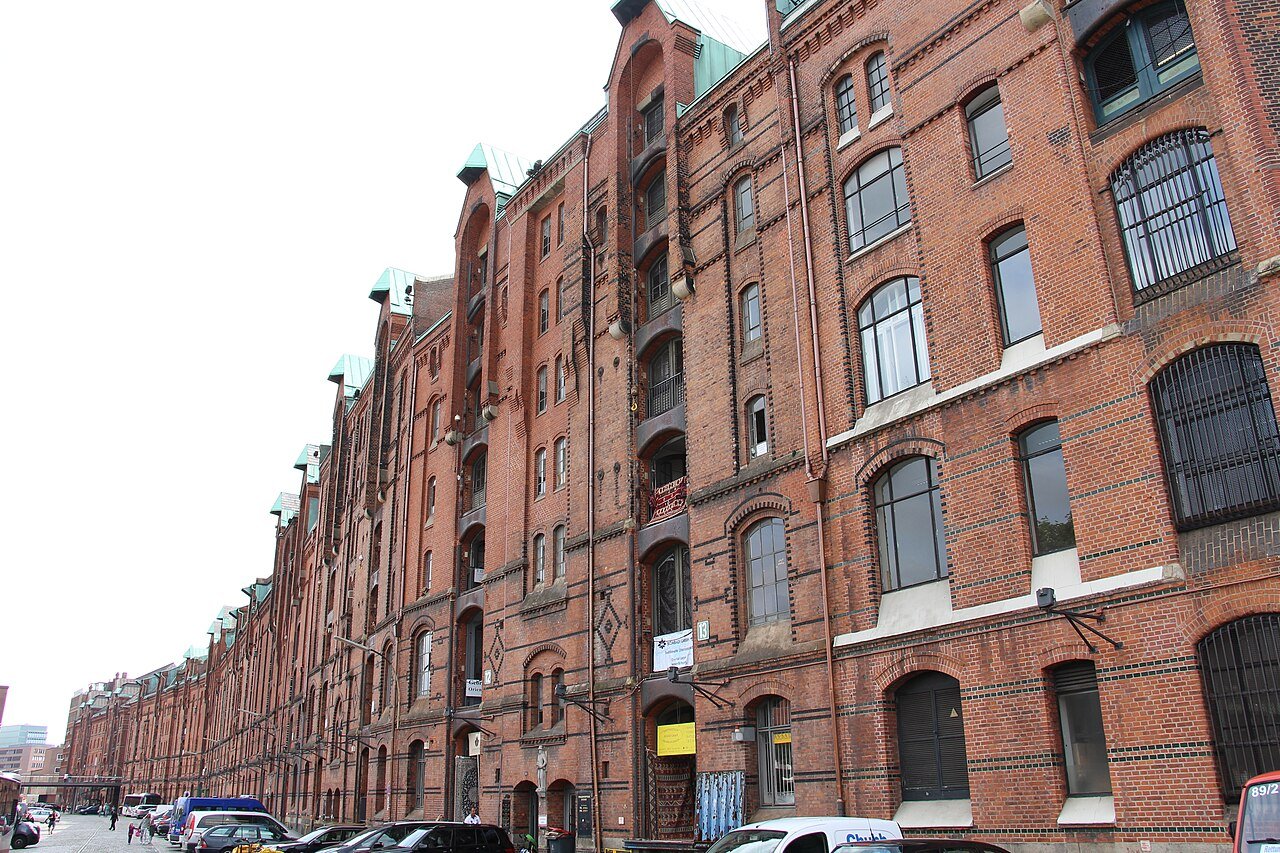
Built between 1883 and 1927 on a narrow sandbar in the Elbe, the Speicherstadt is the largest contiguous warehouse complex in the world, covering 26 hectares with approximately 630,000 square metres of floor space. It was inscribed alongside the Kontorhaus District in 2015. Architect Franz Andreas Meyer designed the red-brick facades in a Neo-Gothic register — with narrow towers, arched windows, and glazed terracotta ornaments — set on oak-pile foundations driven deep into the river bed. The whole quarter rests on water: canals run between the warehouse blocks, and the brick walls rise sheer from their stone quays. Hamburg agreed to join the German Customs Union in 1881 on condition that this zone remain a tariff-free transfer port, which drove the decision to build at industrial scale. Half the buildings were destroyed in the Second World War bombing raids, but conservative reconstruction was completed by 1967. Today the complex is partly operational and partly cultural, with Miniatur Wunderland — the world’s largest model railway — among its residents.
Getting there: ICE from Berlin Hauptbahnhof to Hamburg Hauptbahnhof, approximately 1 hour 45 minutes, then U3 to Baumwall — two stops from the station. Allow: 3 hours. Best for: The combination of industrial-scale Victorian engineering and maritime atmosphere that Hamburg alone offers, within a single afternoon’s walking circuit.
Hanseatic City of Stralsund 2 hrs 15 min by ICE
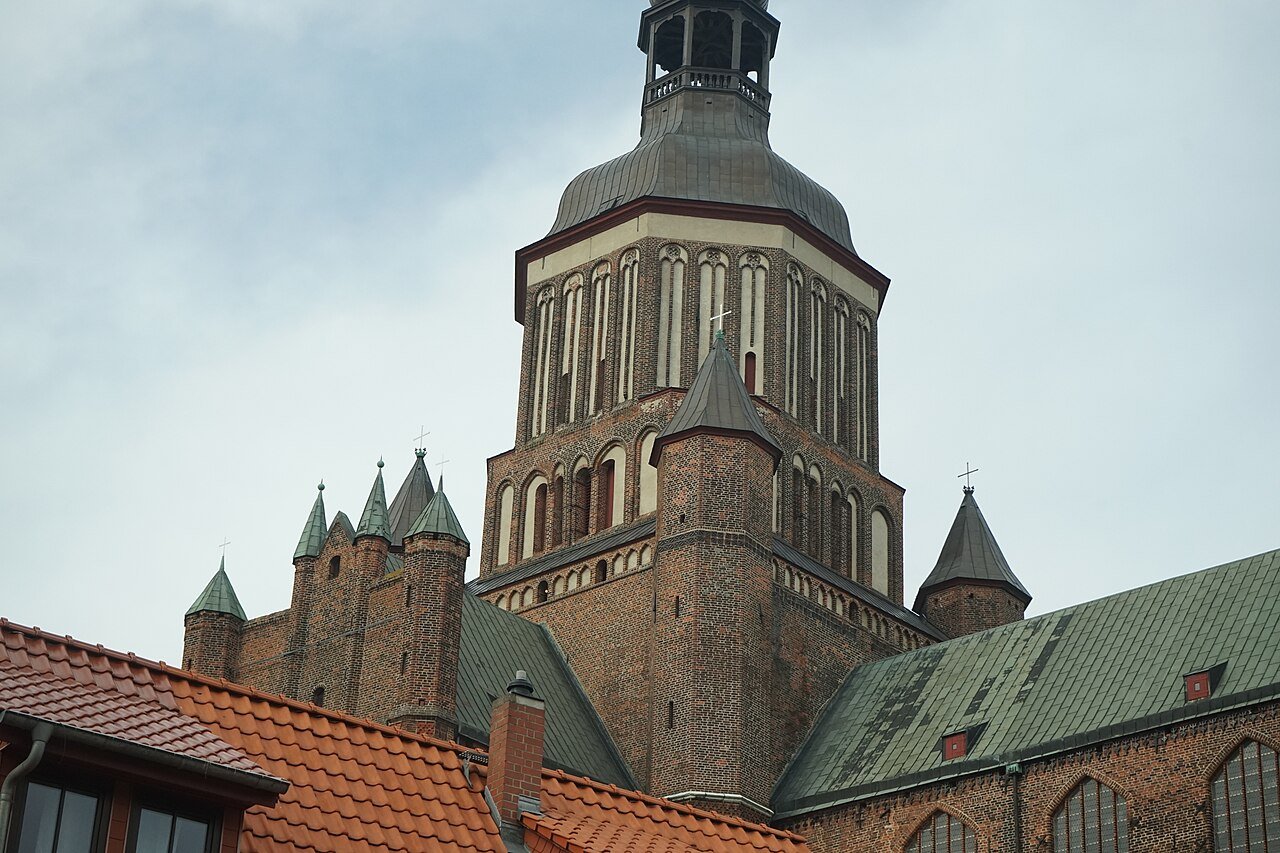
Stralsund was granted city rights in 1234, joined the Hanseatic League in 1293, and thereafter became one of the dominant trading powers of the Baltic. Inscribed in 2002 as the “Historic Centres of Stralsund and Wismar,” the old town occupies an island enclosed by the Strelasund strait — its medieval street plan intact, more than 800 buildings listed, and over 500 individually protected as monuments. The defining material is north German Brick Gothic: massive walls of hand-fired red brick, soaring without the decorative stone carving of the southern Gothic tradition. St Nicholas’ Church (built 1270–1360) and St Mary’s Church (begun 1383, completed 1473) dominate the skyline. St Mary’s octagonal tower held the distinction of being the world’s tallest structure from 1625 to 1647, reaching 104 metres. The Alter Markt — the historic market square — is flanked by a 13th-century brick city hall with its signature screen facade of blind arcades, standing as one of the most complete medieval civic spaces in northern Europe.
Getting there: ICE from Berlin Hauptbahnhof to Stralsund, approximately 2 hours 15 minutes direct. Allow: 3–4 hours. Best for: Visitors who want an entire medieval Hanseatic island city essentially to themselves — Stralsund draws a fraction of the crowds that Lübeck or Rostock receive, and its scale rewards a full afternoon on foot.
Frequently Asked Questions
How many UNESCO World Heritage Sites are near Berlin?
Six UNESCO World Heritage Sites fall within approximately two hours of Berlin by public transport or car: the Palaces and Parks of Potsdam and Berlin, Lutherstadt Wittenberg, the Bauhaus sites in Dessau, the Garden Kingdom of Dessau-Wörlitz, the Speicherstadt and Kontorhaus District in Hamburg, and the historic centre of Stralsund. Germany as a whole has 52 inscribed sites as of 2024, giving Berlin one of the densest day-trip catchments of any European capital.
What is the closest UNESCO World Heritage Site to Berlin?
The Palaces and Parks of Potsdam and Berlin is the closest, reachable in around 30 minutes on the S7 suburban rail line from Berlin Hauptbahnhof. Parts of the heritage zone — including Schloss Babelsberg — actually lie within the city limits of Berlin itself. Sanssouci Palace, the most visited element of the ensemble, is in Potsdam and takes under an hour door to door from central Berlin.
Can you combine two UNESCO sites in a single day trip from Berlin?
Yes, the most practical pairing is the Bauhaus building in Dessau with the Garden Kingdom of Dessau-Wörlitz. Both lie in Saxony-Anhalt and are connected by a short regional bus ride, making it possible to visit the Bauhaus campus in the morning and take a boat or walk through the Wörlitz landscape in the afternoon. Wittenberg can also be added to a Dessau trip by train, though three UNESCO sites in a single day is ambitious.
Do the UNESCO sites near Berlin require advance booking?
Sanssouci Palace in Potsdam sells timed-entry tickets that often sell out on summer weekends — booking online a few days ahead is strongly recommended for the interior. The Bauhaus building in Dessau offers guided tours that can reach capacity in peak season. Stralsund, Wörlitz, and the Speicherstadt in Hamburg are largely open-access outdoor or free-entry sites, though specific museums within them have their own entry requirements.
Sources used in this article
- UNESCO World Heritage Centre — World Heritage List.
- Wikipedia — Palaces and Parks of Potsdam and Berlin.
- Wikipedia — Bauhaus Dessau.
- Wikipedia — Garden Kingdom of Dessau-Wörlitz.
- Wikipedia — Speicherstadt.
- Wikipedia — Stralsund.
- CHO — Interactive heritage map.
Sources
- S1 — Large, David Clay. Berlin. Basic Books, 2000. ISBN 978-0-465-02632-6.
- S2 — Ladd, Brian. The Ghosts of Berlin: Confronting German History in the Urban Landscape. University of Chicago Press, 1997. ISBN 978-0-226-46762-7.
Spotted an error? Write to editorial@culturalheritageonline.com and we correct it the same day.