In the southwestern delta of Bangladesh, where the Sundarbans mangrove forest begins to claim the land, stands the remnant of a 15th-century Muslim city that was built, inhabited, and abandoned within a single generation. The Historic Mosque City of Bagerhat preserves what Khan Jahan Ali’s followers left behind: over 360 mosque foundations spread across a landscape now given back to palms and ponds, with the Shat Gambuj Mosque — the largest medieval mosque on the subcontinent — at its center. UNESCO inscribed the site in 1985 as an outstanding example of a planned Muslim city in South Asia.
Khan Jahan Ali and the City of Khalifatabad Khulna Division, SW Bangladesh · 50 km from Khulna
Around 1459 CE, the Sufi saint and military commander Khan Jahan Ali chose a site in the Sundarbans delta to found a new city he named Khalifatabad — “the city of the caliph’s domain.” The choice of location was deliberate and symbolic: the Sundarbans were understood as the frontier of Islam’s southward expansion across Bengal, and establishing a settled Muslim urban center here carried both religious and political weight. Khan Jahan Ali was not a scholar-saint in the withdrawing mold; he arrived with troops, administrative skill, and the practical ambition of a city planner. He oversaw the construction of roads, tanks (large artificial ponds for water storage and ritual use), and an extraordinary number of mosques in the surrounding territory — the accepted figure is over 360 structures across the broader region, though only a fraction survive in identifiable form today.
Khan Jahan Ali died in 1459 CE, the same year the city reached something like completion. His tomb, still standing in Bagerhat, is a single-domed brick structure overlooking a large pond — the Ghora Dighi — where a pair of mugger crocodiles are kept, fed, and named by the site’s caretakers. The practice is syncretic in the most direct sense: a Hindu tradition of sacred pond-dwelling animals absorbed into the rituals surrounding a Muslim saint’s shrine. Pilgrims visit the tomb from across Bangladesh, and the crocodiles have been maintained by the shrine’s custodians in an unbroken line across more than five centuries, each animal given a name when it arrives and tended until it dies.
After Khan Jahan Ali’s death, Khalifatabad declined rapidly. The city’s founding energy was personal — tied to one man’s authority and charisma — and without him the population dispersed. Within decades, the jungle began its reclamation. Colonial-era surveyors in the 19th century found the mosque foundations buried under vegetation, the tanks silting up, and the tomb still attended by a small community of caretakers. The scale of what Khan Jahan Ali had built only became clear as the undergrowth was cleared: a planned city of deliberate geometric order, its mosques oriented southwest toward Mecca with a consistency that implied a single supervising mind.
The Shat Gambuj Mosque: Architecture of a Bengali-Islamic Synthesis Bagerhat city center · walkable from Bagerhat bus stand
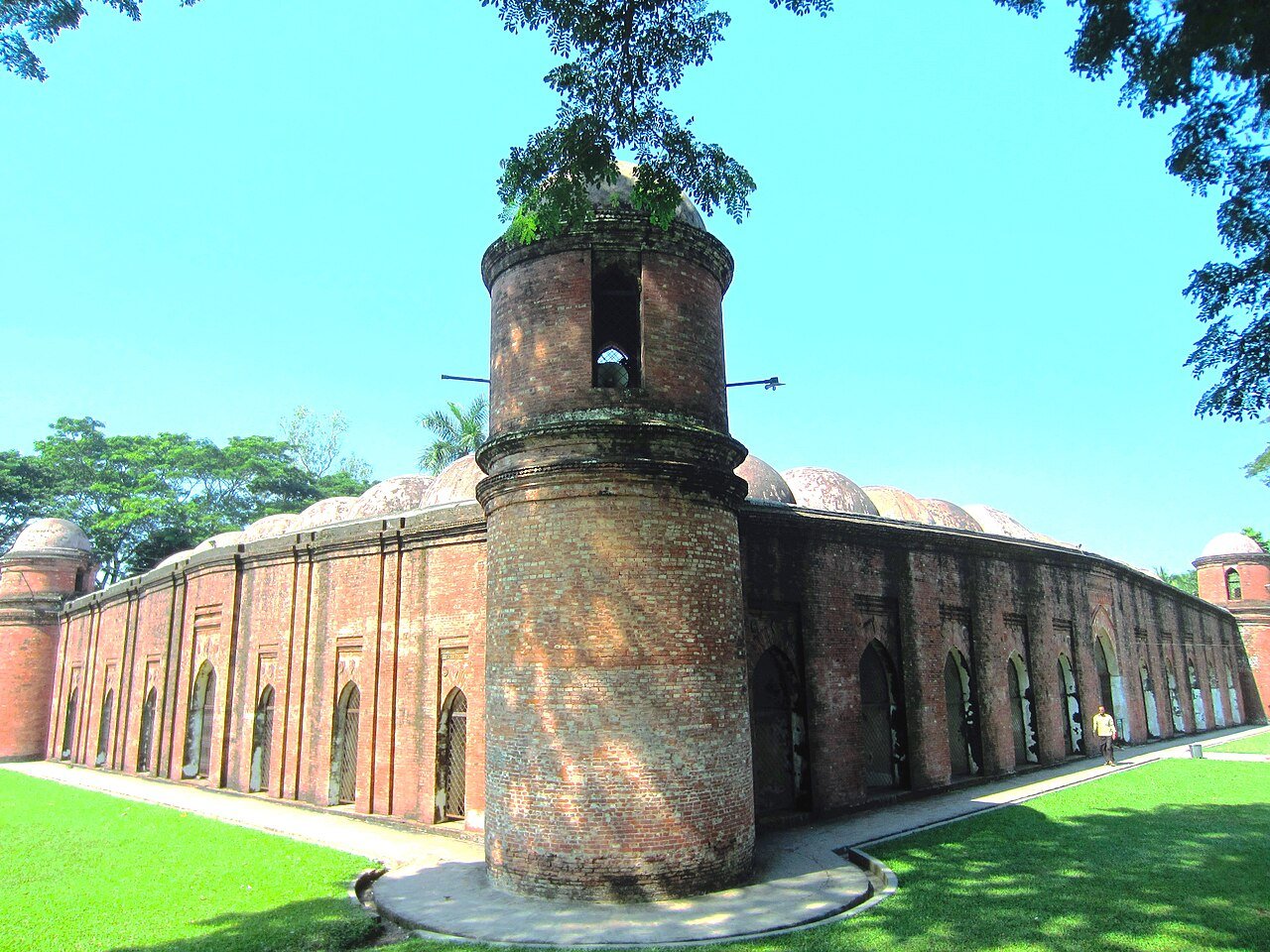
The name Shat Gambuj means “Sixty Dome” in Bengali, and it is a slight misdirection. The mosque has 77 domes — a multi-curved brick canopy that covers the entire prayer hall in a dense grid of rounded forms — and 60 interior stone pillars arranged in rows to support them. The “sixty” in the name most likely refers to the 60 doorways that open onto the prayer hall from three sides: a nine-arched central entrance on the east facade, and additional doorways along the north and south walls. Measuring approximately 50 by 25 meters, the mosque is the largest medieval mosque in Bangladesh and one of the largest on the subcontinent built before the Mughal period.
The material is brick — specifically the thin, dense brick of the Bengal Sultanate tradition — laid with terracotta ornamentation that covers the spandrels of the arches, the pilaster strips between windows, and the curved surfaces of the corner turrets. The ornamentation draws from a vocabulary that has no direct parallel in mosque architecture elsewhere: floral and geometric patterns that share certain motifs with the terracotta temple tradition of Bengal, adapted here for an Islamic program. Mosque scholars describe this as the Bengali-Islamic synthesis, a regional architectural language that emerged during the Sultanate period (13th–16th centuries) and had no time to spread before the Mughal conquest replaced it with a pan-subcontinental imperial style.
Inside, the 60 stone pillars — unusually slender, with simple carved capitals — divide the prayer hall into a forest of narrow aisles. Light enters through the doorways in bands that shift across the floor as the day moves. The mihrab (prayer niche) on the west wall is elaborately carved, its terracotta surface intact, facing the qibla with a precision the original builders achieved without modern surveying instruments. Two of the domes in the southeast corner are pierced with openings that create a slightly different acoustic: these domed chambers, separated from the main hall by screens, served as the women’s section. Standing inside, looking down the rows of pillars toward the mihrab, gives the unusual impression of a space that is simultaneously intimate and enormous — a quality produced by the low, multi-domed ceiling rather than the typical single-dome or flat-roofed mosque hall.
Practical information
Bagerhat is 50 km from Khulna, the nearest major city, and reachable by bus (roughly one to two hours depending on traffic) or private car. Khulna itself is connected to Dhaka by train — the Sundarban Express covers the route in approximately eight hours — and by air via Jessore Airport, 60 km north. The site is open daily; entry fees are charged for foreign visitors and are payable at the gate in Bangladeshi taka. The complex is best visited in the cooler dry season between November and February. March to May brings intense heat; June to October is monsoon season, and while the site remains accessible, flooding on approach roads can delay travel.
Allow two to three hours for the Shat Gambuj Mosque, the Tomb of Khan Jahan Ali, and the Ghora Dighi pond. A small site museum adjacent to the mosque holds architectural fragments and excavation finds. Light clothing is appropriate for the climate; women should bring a scarf or shawl for the mosque interior. The site is walkable for visitors with moderate mobility, but the grounds are uneven in places. Photography is permitted throughout the complex. The nearest accommodation is in Khulna; Bagerhat town has basic guesthouses but limited international-standard lodging. Those combining Bagerhat with a Sundarbans trip should coordinate transport in advance, as the mangrove forest lies immediately to the south and most Sundarbans tours depart from Khulna or Mongla.
Frequently Asked Questions
Why does the Shat Gambuj Mosque have 77 domes if the name means “Sixty Dome”?
The discrepancy between the name and the actual dome count has puzzled visitors since the colonial period, when British surveyors first catalogued the structure. The most widely accepted explanation is that the “sixty” in Shat Gambuj refers not to the domes themselves but to the 60 doorways — arched openings in the east, north, and south walls that give the prayer hall its unusual permeability to light and air. The east facade alone has nine arched entrances arranged in a triumphal screen; the flanking walls carry additional doorways in rows. The 77 domes, by contrast, are a functional and aesthetic solution to covering a large prayer hall without a single massive central dome: small domes on slender pillars distribute the structural load and avoid the engineering challenge of spanning the full 25-meter width in one vault. The result is a roof-line that reads as a dense, curved grid from outside and a low, intimate canopy from within. Some scholars have also proposed that “sixty” was used loosely as a number signifying abundance rather than a precise count — a common practice in medieval Bengali literary and administrative language — but the doorway explanation remains the consensus among architectural historians of the Bengal Sultanate period.
Who was Khan Jahan Ali, and why is he revered as a saint?
Khan Jahan Ali was a Turkish or Central Asian military commander who served the Bengal Sultanate and was appointed governor of the southwestern region in the early 15th century. He was also a Sufi Muslim — a practitioner of Islamic mysticism — and combined the roles of administrator, city-builder, and spiritual guide in a way that was common among the frontier commanders who expanded Muslim settlement across Bengal during this period. The Sufi orders played a central role in the Islamization of Bengal: saints and their followers established khanqahs (lodges) in areas with little prior Muslim settlement, and the combination of spiritual authority with practical social organization drew converts from Hindu and Buddhist communities. Khan Jahan Ali’s reputation as a saint rests on the popular tradition that he performed miracles, on his role in founding mosques and infrastructure for the community, and on the continuous veneration of his tomb since his death in 1459 CE. His shrine is a site of active pilgrimage today, visited by Muslims and, to a lesser extent, by Hindus who regard him as a figure of localized sacred power — a continuation of the syncretic religious culture of the delta that predates and partially absorbed the arriving Islamic tradition.
How does Bagerhat relate to the Sundarbans, and can both be visited together?
Bagerhat sits at the northern edge of the Sundarbans delta, the vast mangrove forest that covers approximately 10,000 square kilometers across southern Bangladesh and the Indian state of West Bengal. The Sundarbans were inscribed as a UNESCO World Heritage Site in 1997 — a separate inscription from Bagerhat’s 1985 designation — recognized for their biodiversity: Bengal tigers, Irrawaddy and Ganges river dolphins, saltwater crocodiles, and one of the world’s largest contiguous mangrove ecosystems. The two sites are geographically adjacent and often combined by visitors with limited time in southwestern Bangladesh. Most Sundarbans excursions launch from Khulna or the port town of Mongla, which is 45 km south of Bagerhat. A practical itinerary visits Bagerhat on the first day — spending three to four hours at the mosque complex and tomb — and joins a Sundarbans boat tour the following morning from Mongla. Sundarbans tours range from day trips to three- or four-night expeditions into the forest interior; the longer format is necessary to reach the core zones where tiger sightings are possible. Permits are required for Sundarbans forest zones and must be arranged in advance through registered tour operators in Khulna.
Sources
- S1 — Hasan, Perween. Sultans and Mosques: The Early Muslim Architecture of Bangladesh. I.B. Tauris, 2007. ISBN 978-1-84511-381-0.
- S2 — Ahmed, Nazimuddin. Discover the Monuments of Bangladesh. University Press Limited, 1984. ISBN 978-984-05-1059-7.
Spotted an error? Write to editorial@culturalheritageonline.com and we correct it the same day.