
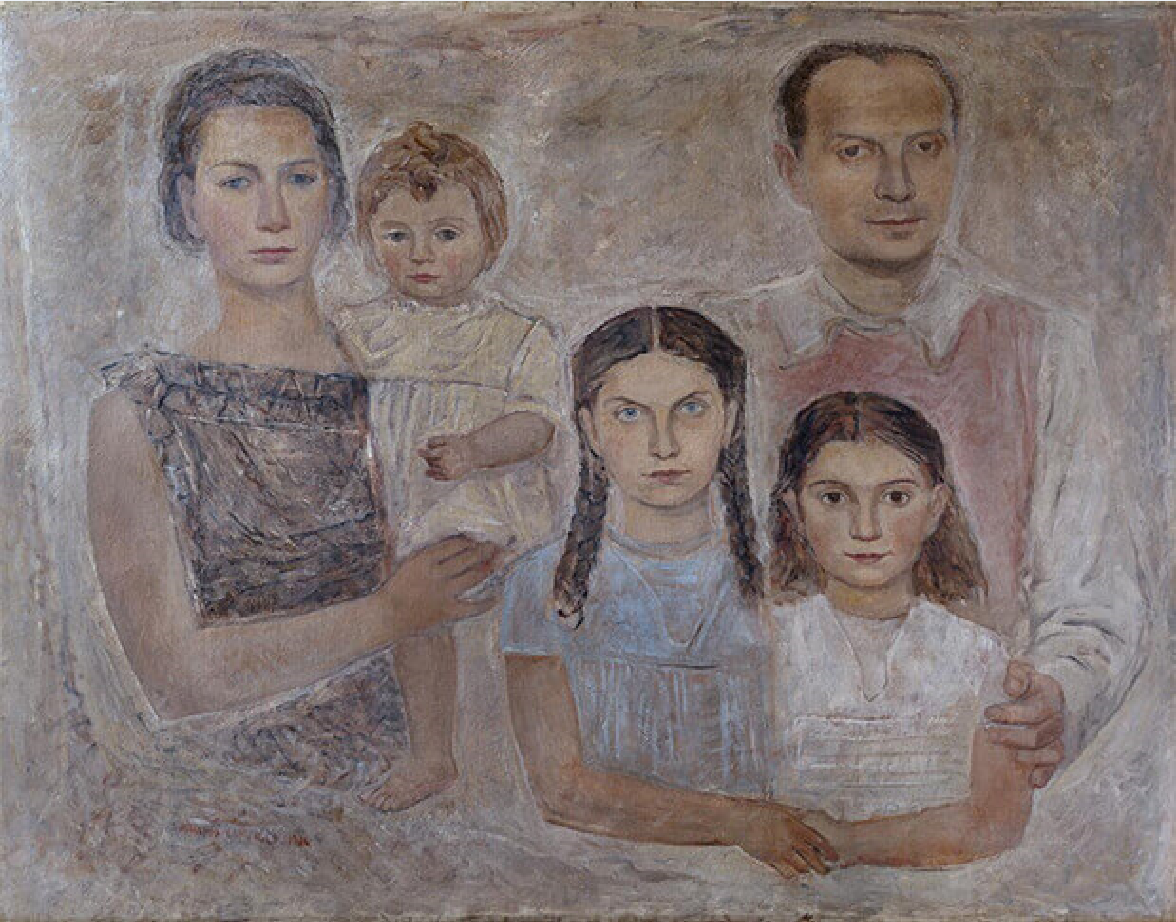
The Architect Gio Ponti’s Family is a painting by Italian artist Massimo Campigli, completed in 1934. The work depicts the family of the prominent architect Gio Ponti and exemplifies Campigli’s turn toward figurative representation during the interwar period.
Campigli, born in Berlin in 1895 and raised in Italy, was a painter and journalist whose artistic formation took place within avant-garde circles in Milan and, subsequently, Paris. His extended study of ancient Egyptian art at the Louvre became a defining influence on his practice, informing his approach to form, composition, and the rendering of the human figure. By the 1930s, Campigli had established himself as a central figure in modern Italian painting, working in a style that drew on classical and archaic sources.
This portrait sits within the broader context of Campigli’s figurative output of the era, marking his sustained interest in portraiture as a vehicle for formal investigation and as a record of contemporary cultural life in Italy.
About Massimo Campigli
Massimo Campigli (1895–1971) was an Italian painter and journalist. After early involvement with Futurism in Milan, he moved to Paris following World War I, where he worked as a foreign correspondent and began his career as a painter. His artistic development was profoundly shaped by study of ancient Egyptian art and dialogue with modernist painters of the interwar period.
Details
- Artist: Massimo Campigli
- Year: 1934
- Subject: The family of architect Gio Ponti
- Medium: Painting
On video
Frequently asked questions
Who was Massimo Campigli?
Massimo Campigli (1895–1971) was an Italian painter and journalist born in Berlin who spent most of his life in Italy and Paris. He was associated with avant-garde circles in Milan and developed a distinctive figurative style informed by his study of ancient Egyptian art.
What is the subject of this painting?
The painting depicts the family of Gio Ponti, a prominent Italian architect, rendered in Campigli’s characteristic figurative style of the 1930s.
What artistic movements influenced Campigli?
Campigli’s early work engaged with Futurism in Milan, but his mature style was shaped principally by ancient Egyptian art and his immersion in the modernist painting circles of Paris during the 1920s and 1930s.
Sources
- S1 — Pontiggia, Elena. Il Novecento Italiano. Abscondita, 2003. ISBN 978-88-8416-048-5.
- S2 — De Fusco, Renato. Storia del design. Laterza, 2002. ISBN 978-88-420-6623-1.
Spotted an error? Write to editorial@culturalheritageonline.com and we correct it the same day.


