
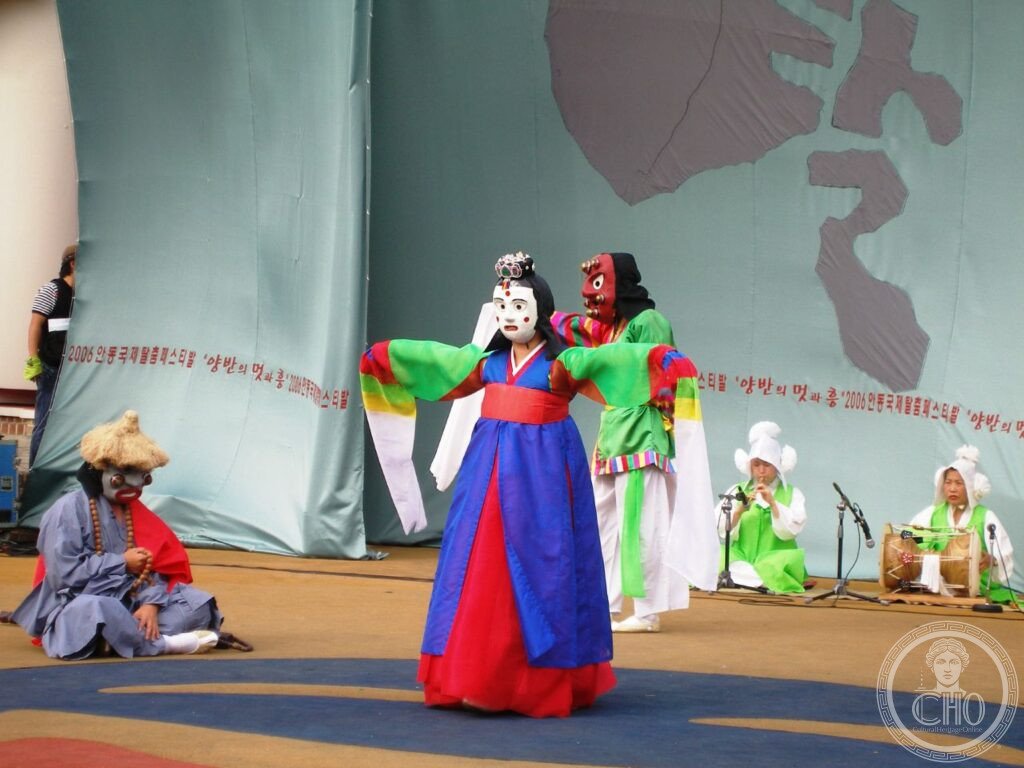
Masked dancers move across the stage in exaggerated gestures, their painted faces embodying social satire. Song and dance flow together as characters—commoners, nobles, animals, spirits—enact the frustrations and humor of everyday life, turning folk drama into a vehicle for wit and rebellion.
In UNESCO’s words
Talchum is a performing art that encompasses dance, music and theatre. An ensemble of six to ten musicians accompanies masked performers who humorously explore social issues through dramatic combinations of songs, dances, movements and dialogue. The practice uses caricatures of everyday characters to convey its underlying appeal to universal equality and criticism of social hierarchy. Talchum performances do not require a formal stage: any empty space can become a venue. The audience plays an essential role, contributing to the production with their cheers and jeers as the drama unfolds. This interaction with audiences and the focus on social criticism contributed to Talchum’s large-scale transmission in the 1970s and 1980s among young people, particularly university students. This generation continues to play a critical role in the transmission of the practice, passing on the related knowledge and skills of Talchum performance and mask-making to younger generations through local associations, clubs, camps and public schools. Initially performed by men, the practice now includes women. In addition to serving as a tool for social commentary, Talchum can promote and reinforce local cultural identities through the inclusion of local dialects and folksongs. Talchum mask dance dramas are also an important part of local festivals.
Official description, UNESCO Intangible Cultural Heritage List — Talchum, mask dance drama in the Republic of Korea
At a glance
Talchum is a masked performance combining dance, music, and theatre. An ensemble of six to ten musicians accompanies masked performers who use humorous dramatic scenes to explore social issues. The form draws on caricatured everyday characters to convey its central message: a call for universal equality and criticism of social hierarchy. Performances need no formal stage—any open space serves as a venue, and audiences actively shape the event through their cheers and jeers as the drama unfolds.
Origins & history
Talchum gained widespread transmission during the 1970s and 1980s, particularly among young people and university students, who were drawn to its focus on social criticism and audience interaction. This generation of young practitioners became essential to passing the tradition forward, transmitting knowledge and skills of performance and mask-making to younger generations through local associations, clubs, camps, and schools. The practice was initially performed by men but now includes women.
The practice
A typical Talchum performance features an ensemble of six to ten musicians providing accompaniment while masked dancers perform with songs, dances, movements, and dialogue. Performers wear carved masks and employ exaggerated physical gestures to bring characters to life. Local dialects and folksongs can be incorporated into performances, allowing communities to reinforce their own cultural identities. Mask-making itself is a valued skill transmitted as part of the tradition.
Cultural significance
Talchum serves communities as both entertainment and social commentary, offering a space to address issues of equality and hierarchy through humour. The practice can reinforce local cultural identities and remains an important part of local festivals. Its continued transmission by successive generations ensures that the form remains active and relevant to contemporary life.
Key facts
- Country: Republic of Korea
- Inscribed: 2022
- UNESCO list: Representative List of the Intangible Cultural Heritage of Humanity
- UNESCO reference: 01742
- UNESCO vocabulary: Dance; Masks; Theatre
- Map: not shown — UNESCO’s official description of this element names no locality, and a living tradition is practised across a community, not at one address.
Where to experience it
Talchum lives in the communities that practise it across South Korea, transmitted through local associations, clubs, camps and public schools. Visitors can encounter masked performances in any open space—talchum requires no formal stage—where audiences actively participate through cheers and jeers. The tradition thrives particularly among university students and young people who learn mask-making and performance skills from experienced practitioners. Local festivals feature talchum as an important cultural element, often incorporating regional dialects and folksongs to reinforce community identity. Performances blend humour, music, dance and social commentary in ways that continue to engage new generations of performers and spectators.
Sources & resources
- UNESCO — official element page: Talchum, mask dance drama in the Republic of Korea
- UNESCO — open data record: Intangible Heritage List, reference 01742
- UNESCO — official video: UNESCO film on this element — embedded on this page
- UNESCO — official photograph: Bibi's dance at the Goseong Ogwangdae performance. Bibi is an imagerinary creature that punishes hypocritical yangban nobilities by devouring them. — International Mask Arts and Culture Organization (IMACO), Republic of Korea, 2003
- Reference — Wikipedia (secondary): Talchum — consulted as a secondary reference, not as confirmation
- Cultural Heritage Online: Our archive and city guides

Sources
- S1 — Kim, Uk-dong. The Art of Peasant Theatre in Korea. Seoul National University Press, 2001. ISBN 978-89-521-0260-7.
- S2 — van Zile, Judy. Perspectives on Korean Dance. Wesleyan University Press, 2001. ISBN 978-0-8195-6494-8.
Spotted an error? Write to editorial@culturalheritageonline.com and we correct it the same day.