
A visceral Andean performance where two dancers compete in turns, executing acrobatic steps while accompanied by violin and harp, challenging each other to master increasingly daring movements.
In UNESCO’s words
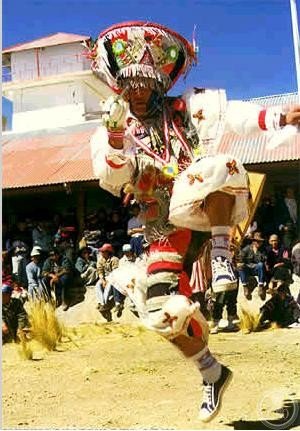
The scissors dance is performed by inhabitants of Quechua villages and communities in the south-central Andes of Peru, and now in urban settings. This competitive ritual dance is performed during dry months coinciding with the main phases of the agricultural calendar. The scissors dance takes its name from the pair of polished iron rods, resembling scissors blades, wielded by each dancer in his right hand. Together with a violinist and a harpist, a dancer forms a ''cuadrilla'' (team) that represents a given village or community. To perform, two or more ''cuadrillas'' face each other, and the dancers must strike the blades together in time to the rhythm of the accompanying musicians, while performing a choreographed duel of step-dancing, acrobatics and increasingly demanding movements. The competition or ''atipanakuy'' may last up to ten hours, and physical ability, quality of the instruments, and expertise of the accompanying musicians, are all evaluated to determine the winner. The dancers wear outfits embroidered with golden fringes, multicoloured sequins and small mirrors, but while in costume are forbidden from entering churches because of the tradition that their abilities are the result of a pact with the devil. Regardless, the scissors dance has become a popular part of Catholic festivities. The physical and spiritual knowledge implicit in the dance is passed on orally from master to student, with each ''cuadrilla'' of dancers and musicians giving pride to its village of origin.
Official description, UNESCO Intangible Cultural Heritage List — Scissors dance
At a glance
The scissors dance is a competitive ritual performed by Quechua communities in the south-central Andes of Peru and in urban settings. Each dancer wields a pair of polished iron rods resembling scissors in his right hand, striking them together in time with the music. A dancer teams with a violinist and harpist to form a cuadrilla that represents their village or community. Two or more cuadrillas face each other in a choreographed duel combining step-dancing, acrobatics, and increasingly demanding movements.
Origins & history
The scissors dance is performed during the dry months that coincide with the main phases of the agricultural calendar. The physical and spiritual knowledge of the dance is passed orally from master to student, with each cuadrilla giving pride to its village of origin. Though the tradition holds that dancers' abilities result from a pact with the devil—forbidding them to enter churches while in costume—the scissors dance has become a popular part of Catholic festivities.
The practice
Competitions, called atipanakuy, bring two or more cuadrillas to face each other. A dancer, violinist, and harpist perform together as one team. Dancers wear embroidered outfits decorated with golden fringes, multicoloured sequins, and small mirrors. A performance can last up to ten hours. The quality of the dancers' physical ability, the instruments themselves, and the expertise of the accompanying musicians are all evaluated to determine the winner.
Cultural significance
The scissors dance matters to Quechua communities as an expression of village pride and identity. The competition tests and displays the physical prowess and technical skill valued in these communities. Knowledge of the dance—its movements, music, and tradition—is passed orally from generation to generation, ensuring the practice endures within each cuadrilla and village.
Key facts
- Country: Peru
- Inscribed: 2010
- UNESCO list: Representative List of the Intangible Cultural Heritage of Humanity
- UNESCO reference: 00391
- UNESCO vocabulary: Acrobatics; Ritual dance; Rituals; Scissors
- Map: not shown — UNESCO’s official description of this element names no locality, and a living tradition is practised across a community, not at one address.
Where to experience it
The scissors dance is performed by Quechua communities throughout the south-central Andes of Peru, where it remains central to village identity and agricultural celebrations. Visitors may encounter performances during the dry months when communities stage competitive festivals, with dancers and musicians from different villages gathering to demonstrate their skill and pride. The tradition has also spread to urban settings, where it continues to draw audiences. Performances typically occur during Catholic festivities and community celebrations, offering glimpses of the intricate footwork, acrobatics, and coordination between dancer and musicians that define this demanding ritual.
Sources & resources
- UNESCO — official element page: Scissors dance
- UNESCO — open data record: Intangible Heritage List, reference 00391
- UNESCO — official photograph: Photograph of this element — Guillaume Liauzun — National Institute of Culture of Peru, 2004
- Reference — Wikipedia (secondary): Danza de tijeras — consulted as a secondary reference, not as confirmation
- Cultural Heritage Online: Our archive and city guides
