
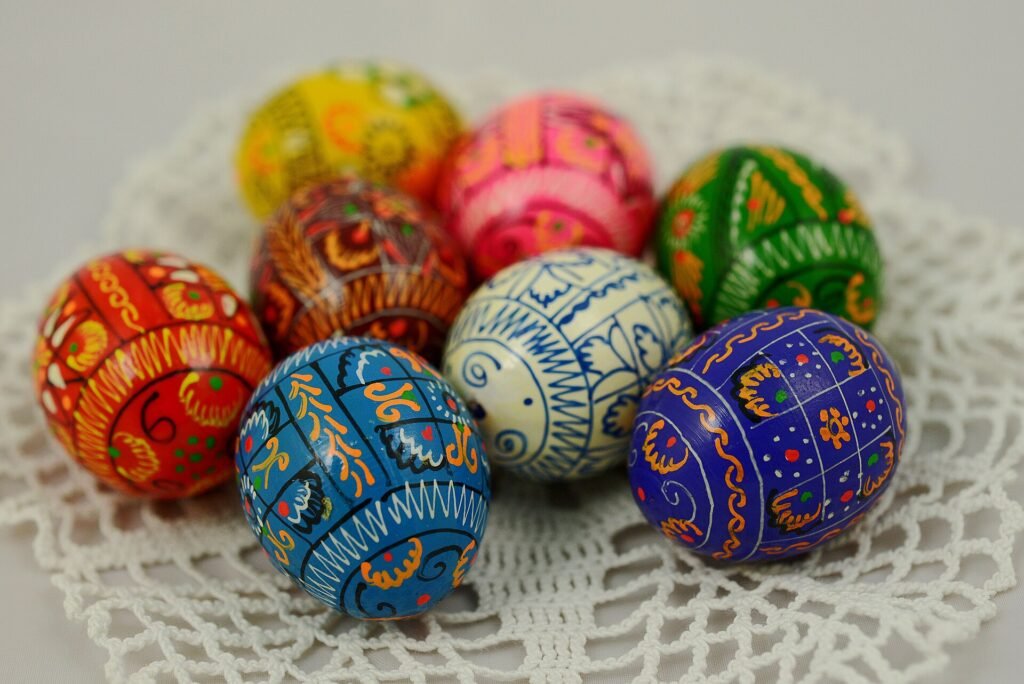
An ancient Slavic craft born in pagan times, pysanka transforms plain eggs into intricate miniature canvases through wax-resist dyeing, blending pre-Christian symbolism with Christian meaning.
In UNESCO’s words
The art of decorating eggs is a centuries-old Ukrainian tradition. Traditional patterns and symbols are applied to the egg using wax. The egg is then dipped into dye, covering all but the waxed areas. The process is repeated to achieve the desired pattern and colours. Personal wishes and messages are captured in the symbols used. Although the tradition dates back to pre-Christian times, it has become an Easter tradition over time. Nevertheless, exchanging the decorated eggs, or pysankas, as presents is very meaningful to Ukrainians, regardless of religion. Egg decoration is deeply rooted in Ukrainian identity and is still a traditional ritual among communities all over Ukraine, as well as for Ukrainians living in Estonia. The eggs are a source of family pride, as families strive to have the best-looking eggs and develop and pass on their specific traditions and associated rituals. The practice is transmitted within families as well as through classes, workshops and trainings. Pysankas hold multiple social functions, including ritual, recreational and decorative. For instance, after Easter, blessed pysankas are stored in homes as a source of protection. They can be made to honour the deceased or presented as gifts to celebrate important life-changing events such as the birth of a child, a christening, or a wedding.
Official description, UNESCO Intangible Cultural Heritage List — Pysanka, Ukrainian tradition and art of decorating eggs
At a glance
Pysanka is the Ukrainian tradition of decorating eggs with traditional patterns and symbols applied using wax. The decorated egg is dipped into dye, with the waxed areas remaining uncoloured while exposed areas absorb the colour. This process is repeated to build up desired patterns and colours. The eggs hold personal wishes and messages encoded in their symbols and serve multiple purposes—ritual, recreational, and decorative—making them meaningful gifts and treasured objects in Ukrainian life.
Origins & history
The tradition of egg decoration dates back to pre-Christian times in Ukraine. Over centuries it became associated with Easter observance, though the practice continues regardless of religious affiliation. The symbolic meanings embedded in the designs have been preserved through this transition, with families developing and passing on their specific traditions and rituals across generations.
The practice
Decorators apply traditional patterns and symbols to eggs using wax, then immerse the egg in dye baths. The waxed areas resist the dye, protecting the shell underneath, while exposed areas absorb colour. By repeating the waxing and dyeing process, decorators build layered patterns in multiple colours. Knowledge of the symbolic language—what each pattern means—is central to the practice. Egg decoration is transmitted within families as well as through classes, workshops, and trainings.
Cultural significance
Pysankas are deeply rooted in Ukrainian identity and remain a traditional ritual among communities throughout Ukraine and among Ukrainians living in Estonia. The eggs serve as sources of protection when blessed and stored in homes, can honour the deceased, and are presented to mark important life events such as births, christenings, and weddings. Families take pride in creating the best-looking eggs and maintaining their own distinctive traditions, making pysankas central to family heritage and cultural continuity.
Key facts
- Country: Ukraine, Estonia
- Inscribed: 2024
- UNESCO list: Representative List of the Intangible Cultural Heritage of Humanity
- UNESCO reference: 02134
- UNESCO vocabulary: Decorative arts; Symbols
- Map: not shown — UNESCO’s official description of this element names no locality, and a living tradition is practised across a community, not at one address.
Where to experience it
The tradition of pysanka decoration is still practised in Ukrainian communities, where families continue to pass knowledge across generations through household practice and formal workshops. Visitors can observe demonstrations and learn techniques from skilled practitioners in classes and training sessions held in various regions. Museums dedicated to the art form showcase historical and contemporary examples, while local artisans offer decorated eggs as gifts and keepsakes. The practice extends beyond Ukraine's borders to communities of Ukrainians living in Estonia, where the tradition maintains its cultural significance and ritual importance during Easter celebrations and other significant life events.
Sources & resources
- UNESCO — official element page: Pysanka, Ukrainian tradition and art of decorating eggs
- UNESCO — open data record: Intangible Heritage List, reference 02134
- UNESCO — official video: UNESCO film on this element — embedded on this page
- UNESCO — official photograph: Mistresses of egg painting (pysankarky) of the village of Kosmach — Yuriy Atamaniuk, 2023
- Reference — Wikipedia (secondary): Egg decorating in Slavic culture — consulted as a secondary reference, not as confirmation
- Cultural Heritage Online: Our archive and city guides

Sources
- S1 — Subtelny, Orest. Ukraine: A History. University of Toronto Press, 2009. ISBN 978-1-4426-0991-4.
- S2 — Hrytsak, Yaroslav. A History of Ukraine: A Global Perspective. Central European University Press, 2023. ISBN 978-963-386-630-6.
Spotted an error? Write to editorial@culturalheritageonline.com and we correct it the same day.