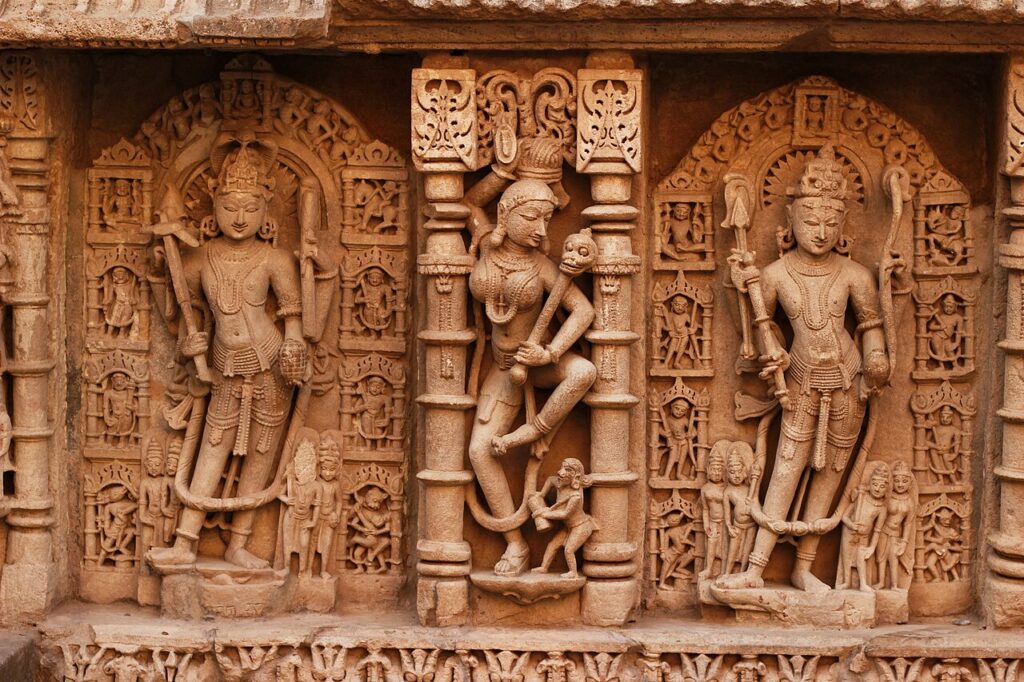
Rani ki Vav (रानी की वाव, “Queen’s Stepwell”, pronounced Rani-ki-Vaav), inscribed by UNESCO in 2014 and depicted on the Indian 100-rupee note since 2018, is a vav (stepped tank or stepwell, the specific Gujarat-Rajasthan water architecture type) at Patan in the Mehsana district of Gujarat — built in the 11th century CE (approximately 1063–1083 CE, during the reign of the Chaulukya Solanki dynasty king Karna, the son of King Bhimdev I) by Queen Udayamati, the consort of King Bhimdev I (the king who is associated with the founding of the Solanki dynasty’s golden age in Gujarat), as a memorial to her deceased husband — an architectural memorial programme that transformed the practical infrastructure of a water reservoir into the most elaborate single example of the vav type in India: a seven-storey inverted temple structure descending approximately 28 m below the ground surface of the Saraswati river flood plain, with the staircase walls and piers at every level carved with more than 500 principal sculptural panels and approximately 1,000 minor sculptures in a comprehensive programme of Vaishnava iconography (the ten avatars of Vishnu, the astha-dikpalas or eight directional guardians, apsaras, vidyadharis, and the complete programme of ritual images that would be found in a contemporary above-ground temple but here arranged in the descending layers of the stepped water structure). The stepwell was buried under silt from Saraswati river flooding at an undetermined date (estimated approximately 12th–13th century CE) and remained buried and completely forgotten for approximately 700 years before its rediscovery during Archaeological Survey of India excavations in the 1940s–1970s — the burial actually preserved the sculptures in an exceptional state (the silt covering blocked weathering and iconoclasm), making the Rani ki Vav the most intact large-scale sculptural programme of the Solanki period in India.
Rani ki Vav and the Gujarat heritage corridor — Patan’s Patola weaving and the Gujarat Solanki dynasty Patan stepwell · Patola weaving · Champaner-Pavagadh · Ahmadabad · Modhera Sun Temple — 0 to 180 km
Rani ki Vav at Patan is architecturally exceptional for the specific integration of water-infrastructure function and religious iconographic programme: the vav (stepped water reservoir) is fundamentally practical — the staircase descends through seven storey levels to the water surface, which varies seasonally with the water table of the Saraswati river, and the structure provides permanent access to the water at every level through the year. But at Rani ki Vav, every surface of the staircase walls, the piers of the pavilion colonnades at each level, and the niches and ornamental spandrels at every landing is carved with sculptural panels in the Solanki style that is the direct predecessor of the Gujarat Sultanate carved-stone tradition visible at Champaner-Pavagadh (UNESCO 2004, approximately 145 km south — see separate CHO article): the human figures are in the specific triple-flexed “tribhanga” posture of the classical Indian sculptural canon, the multiple arms of the Vishnu avatars are carved in dynamic movement suggesting action rather than the static frontality of earlier traditions, and the apsaras (celestial dancers) at multiple levels of the stepwell are in poses of remarkable naturalism — undressing, applying cosmetics, pulling a thorn from a foot — that represent the secular narrative range of the Solanki sculptural tradition alongside the divine images. The ten avatars of Vishnu (Dashavatara) programme at Rani ki Vav is particularly complete: Matsya (fish), Kurma (tortoise), Varaha (boar), Narasimha (man-lion), Vamana (dwarf), Parashurama, Rama, Krishna, Buddha (included in the Vaishnava avatar programme, demonstrating the political accommodation of Buddhism by the late Solanki dynasty), and Kalki (the future avatar, depicted prophetically) — all present in large sculptural panels on the stepwell’s uppermost levels. Patan (the city surrounding the stepwell site) was the capital of the Solanki/Chaulukya dynasty from approximately 746 to 1411 CE — one of the most important pre-Mughal cities in Gujarat — and still produces the Patola double-ikat silk fabric (a weaving tradition in which both the warp and weft threads are resist-dyed before weaving to produce an identical geometric pattern on both faces of the fabric, a technically demanding double-ikat process that only approximately a dozen weaving families in Patan are still able to execute, producing fabrics that sell for ₹1–5 lakh per sari).
The Modhera Sun Temple (approximately 25 km from Patan, not UNESCO-inscribed but nationally protected — a Solanki dynasty sun temple of approximately 1026 CE, the same period as Rani ki Vav and by the same Solanki dynasty patron tradition, with a stepped tank “kund” in the same tradition as the Rani ki Vav but above ground, providing the closest architectural comparison to the stepwell’s decorative programme in a temple context) and the Historic City of Ahmadabad (UNESCO 2017, approximately 120 km south of Patan — the Gujarat Sultanate and Mughal city that succeeded the Solanki dynasty capitals) complete the Gujarat heritage sequence.
Practical information
Rani ki Vav is in Patan city, approximately 125 km north of Ahmadabad by road (approximately 2.5 hours) and approximately 25 km from the Modhera Sun Temple. By road from Ahmadabad: state highways NH48 and SH3 via Mehsana (approximately 2.5 hours by hired car). No direct train to Patan; nearest station is Patan Railway Station (metre gauge, not all services stop) or Mahesana Junction (broad gauge, 55 km from Patan, trains from Ahmadabad approximately 1.5 hours). By bus: regular GSRTC services from Ahmadabad (ST Bus Stand) to Patan (approximately 3 hours). The Rani ki Vav is managed by the Archaeological Survey of India. Open daily 08:00–18:00 (last entry 17:30). Admission fees apply (higher foreign visitor rate). The stepwell is best visited early morning (before 10:00) or late afternoon (after 15:00) for optimal light and to avoid the midday heat in the open-to-sky structure. The seven-storey descent takes approximately 1.5–2 hours for a thorough visit with sculpture observation. Combine with the Patola Heritage Museum in Patan city (demonstration and sale of double-ikat silk; the weaving families sometimes allow observation of the complex thread-dyeing and weaving process) and the Modhera Sun Temple (25 km, 30 minutes by road — the closest architectural parallel to the Rani ki Vav’s sculptural programme in an above-ground temple context).
Frequently Asked Questions
What is a “vav” or stepwell and why did Gujarat and Rajasthan develop this specific architecture?
A “vav” (in Gujarati) or “vav” (in Sanskrit transliteration “vapi”, the formal term for a stepped water body in classical Indian architectural treatises like the Manasara Shilpa Shastra) is a water-management structure unique to the semi-arid regions of northwestern India — specifically the Gujarat and Rajasthan areas where the monsoon rainfall is concentrated in June–September and the water table is deep and variable through the dry season. The fundamental engineering problem that the vav addresses is: in an area with a water table that varies seasonally from approximately 5 m below surface in the monsoon to approximately 30 m below surface in the pre-monsoon summer, how do you build permanent, year-round access to the water? The solution is a staircase that descends through all the possible water-table levels — a stepped structure with multiple landings, so that at any season there is a landing near the current water surface that people can use to fill vessels, bathe, or conduct ritual washing. The earliest vav structures (approximately 3rd century BCE, at sites like Dhank in the Saurashtra region of Gujarat) are essentially just stairs descending to a well; the elaboration of the type over the following millennium produced the specifically architectural form — with colonnaded galleries, ornamental niches, and sculptural panels — that reaches its culmination at Rani ki Vav. The architectural distinction of Gujarat’s vav tradition from the generic “step-well” (English term covering similar structures in Rajasthan, Maharashtra, and Karnataka) is the specific integration of the staircase structure with a programme of sculptural decoration equivalent to that of a contemporary above-ground Hindu temple: the vav is simultaneously a water infrastructure and a religious monument, and the descent into the vav mirrors the pradakshina (circumambulatory path) of a temple visit. The social function of the vav in 11th-century Gujarat society was: providing water in a semi-arid region (practical); providing a cool underground shelter from the extreme Gujarat summer heat (thermal comfort — the underground galleries of the deep vav are approximately 5–8°C cooler than the surface in summer, making the deepest galleries at Rani ki Vav a refuge from the 42°C surface temperatures of the May–June pre-monsoon); and providing a prestigious public monument to the royal dynasty whose patronage built the vav (political — the name “Rani ki Vav” reflects that it was built by a queen, an unusual patron for a major public monument in 11th-century India, and the dedication to King Bhimdev I’s memory gives the structure the function of a dynastic memorial).
How was the Rani ki Vav buried and rediscovered?
The Rani ki Vav was buried under Saraswati river flood deposits at an uncertain date — the most probable timeline, based on the historical record and the archaeological stratigraphy of the silt layer above the stepwell, is that the burial occurred during the period of repeated Saraswati river flooding in approximately the 13th–14th century CE, when the city of Patan itself suffered multiple flood events that disrupted its infrastructure. The Saraswati river (which flows past Patan and was the water source for the stepwell) is a seasonal river that has experienced significant changes in its course and flood behavior over historical time; the specific flooding event that buried the Rani ki Vav deposited approximately 10–15 m of silt over the stepwell over a period that may have been a single major flood or a series of incremental deposits. The buried stepwell was effectively invisible from the surface — no architectural features projected above ground level, and the silt filling the structure was gradually cultivated as agricultural land or built over as the city continued to function around the buried monument. The rediscovery began during British colonial Archaeological Survey of India surveys in the 1940s, when the local topography (a slight depression in the land corresponding to the buried vav footprint) was identified as potentially significant. Systematic excavation began in the 1940s and continued through several phases to the 1970s, when the full extent of the stepwell was revealed. The archaeological team found the sculpture programme in a state of remarkable preservation: the silt had completely excluded weathering, biological growth, and the interventions of both Mughal-period iconoclasm (which affected above-ground Hindu temple sculptures across Gujarat in the 16th–17th centuries) and 19th-century colonial-era “restoration” (which damaged many above-ground monuments through inappropriate repair techniques). The paradoxical result is that one of the finest surviving examples of Solanki dynasty sculptural craftsmanship is the one that was buried and forgotten — the monuments that remained above ground (like the Modhera Sun Temple, 25 km from Patan) were subject to centuries of weathering, vandalism, and colonial “restoration” that damaged significant portions of their original sculpture programmes, while the buried Rani ki Vav preserves its original 11th-century surfaces with minimal intervention. The UNESCO World Heritage inscription in 2014 was filed specifically on the basis of the “unique artistic achievement” of the sculptural programme and the “outstanding testimony to civilisation” of the vav water-infrastructure type — recognising both the artisanship of the Solanki sculptors and the specific technology of the inverted-temple water-management structure.
EXCERPT: Rani ki Vav (Queen’s Stepwell), UNESCO-inscribed in 2014 and depicted on India’s 100-rupee note, is an 11th-century Solanki dynasty stepwell at Patan, Gujarat — a seven-storey underground structure with 500 sculpted Vaishnava panels, buried under Saraswati river silt for 700 years, now the most intact large sculptural programme of pre-Mughal Gujarat.
META: UNESCO World Heritage Sites near Rani-ki-Vav Patan Gujarat India: Champaner-Pavagadh Archaeological Park 145 km south (UNESCO 2004), Historic City of Ahmadabad 120 km south (UNESCO 2017) — Gujarat UNESCO heritage circuit stepwell architecture Solanki dynasty, Modhera Sun Temple 25 km, Patola double-ikat silk Patan.
Sources
- S1 — UNESCO World Heritage Centre — Rani-ki-Vav (the Queen’s Stepwell) at Patan, Gujarat (Ref. 922) — https://web.archive.org/web/20230601000000/https://whc.unesco.org/en/list/922/
- S2 — UNESCO World Heritage Centre — Statement of Outstanding Universal Value (Ref. 922) — https://whc.unesco.org/en/list/922/
Spotted an error? Write to [email protected] and we correct it the same day.