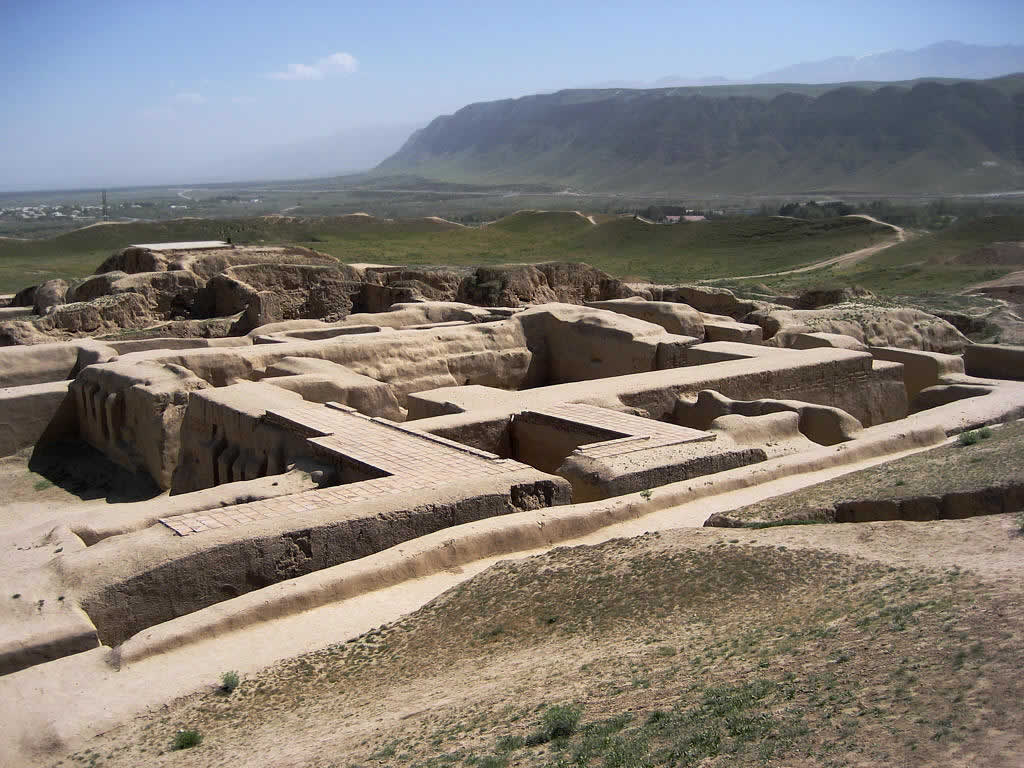
Parthian Fortresses of Nisa — inscribed by UNESCO in 2007 — preserve the twin archaeological complexes of Old Nisa (Parthaunisa, the ceremonial and religious centre of the Arsacid dynasty) and New Nisa (a residential and administrative town) in the Kopet-Dag mountain foothills approximately 18 km west of Ashgabat, Turkmenistan: the earliest known capital of the Parthian Empire (circa 247 BCE–224 CE), the power that replaced the Seleucid Greek dynasty as the dominant state of Iran and the Middle East and held the Roman Empire’s eastern frontier for nearly five centuries.
Old Nisa and the Arsacid ceremonial complex: the Round Hall, the Square Hall, and the Parthian royal treasury Old Nisa (Mithridatkirt) — pentagonal walled citadel · Round Hall (rhyton storage, circa 1st century BCE) · Square Hall (royal audience) — within the inscription
Old Nisa (Parthian Mithridatkirt, “Fortress of Mithridates”) is the better-excavated of the two Nisa complexes: a pentagonal walled citadel (approximately 14 hectares within the mud-brick defensive walls, the walls reinforced with circular towers at regular intervals, the mud-brick construction characteristic of the Iranian plateau’s building tradition in the absence of stone) that served as the dynastic sanctuary and treasury of the Arsacid dynasty (the Parthian royal family, descended from the tribal chieftain Arsaces I who founded the dynasty circa 247 BCE following his successful rebellion against the Seleucid satrap of Parthia). The principal architectural structures excavated at Old Nisa since the 1930s CE (by a series of Soviet and subsequently Turkmen archaeological missions) include the Round Hall (a circular building approximately 17 metres in internal diameter, with six radially arranged storage chambers built into the circular wall thickness, apparently used for the storage of the dynasty’s most famous artistic treasures — the rhytons, drinking horn vessels of carved ivory decorated with reliefs combining Greek mythological imagery with Eastern ceremonial iconography, approximately 40 of which were found in the storage chambers); the Square Hall (a monumental audience hall approximately 20 × 20 metres, with massive wooden columns on stone bases, interpreted as the principal throne room and reception space of the Arsacid ceremonial complex); and the Tower Building (a multi-storey administrative building with archives of ostraca — clay storage vessel labels — inscribed in Parthian Aramaic script, providing detailed records of wine and other commodity storage that allow reconstruction of the economic administration of the Arsacid treasury). The rhytons found in the Round Hall storage chambers are the masterpieces of Old Nisa’s excavated finds: approximately 40 complete or partial ivory drinking horn vessels (rhyta), each approximately 60–70 cm in length, carved from elephant ivory imported to the Parthian court, their terminal figures (the sculpted figures at the drinking end of the horn form) representing Greek mythological subjects (Dionysos and his thiasus, centaurs, nereids, victories) executed in a style that combines Hellenistic Greek sculptural technique with Eastern Iranian compositional conventions — a syncretic artistic tradition that had no parallel in either the contemporary Greek world or the contemporary Iranian world and represents the distinctive aesthetic of the Arsacid cultural synthesis. The rhytons are now housed in the National Museum of Turkmenistan in Ashgabat, where they constitute the centrepiece of the Parthian collection.
The Arsacid (Parthian) dynasty (circa 247 BCE–224 CE) was one of the most significant political powers in world history despite being chronically underrepresented in modern Western cultural memory — a consequence of the dynasty’s destruction by the Sassanid Persian revolt of 224 CE, the systematic Sassanid destruction of Parthian cultural records (Sassanid propaganda presented the Sassanids as restoring Iranian civilisation from “barbaric” Parthian decline), and the Greek and Roman sources’ hostility to the empire that defeated Crassus at Carrhae (53 BCE), reversed Mark Antony’s invasion (36 BCE), and held Rome’s eastern frontier from roughly the Euphrates to the Indus for 300 years. At its maximum extent (under Mithridates II, “the Great,” reign circa 123–88 BCE), the Parthian Empire controlled the territory from the Euphrates (bordering the Roman Empire in Syria) to the Indus River and from the Caspian Sea to the Persian Gulf — the largest empire in the world by territory during that era — and commanded the Silk Road trade routes that connected the Roman Mediterranean world to China and India via the Iranian plateau, extracting enormous transit revenues from the silk, spice, and luxury goods trade. The Nisa complexes (Old and New Nisa) represent the dynasty’s origin site: the Arsacid kings maintained Nisa as a dynastic sanctuary and burial place even after their administrative capital had moved westward to Ctesiphon (near modern Baghdad) in the 1st century BCE, and continued to invest in the Nisa ceremonial complex as a site of dynastic identity throughout the Parthian period.
Practical information
The Parthian Fortresses of Nisa are located approximately 18 km west of Ashgabat (the capital of Turkmenistan) in the Kopet-Dag mountain foothills, accessible from Ashgabat by taxi (approximately 25–30 minutes) or by organised tour from the city. Visiting Turkmenistan requires a visa (arrange in advance through a Turkmenistan-registered tour operator; an e-visa system exists but requirements change regularly — confirm before planning). The site has basic visitor infrastructure; the archaeological remains are accessible on foot within the excavated areas of Old and New Nisa. Allow 2–3 hours for the site, combined with a visit to the National Museum of Turkmenistan in Ashgabat (which holds the principal finds, including the famous ivory rhytons — the most impressive Parthian art objects in any museum collection). The Kopet-Dag mountain backdrop provides a dramatic setting, particularly in the morning light. Best season: March–May and September–November (Ashgabat summer temperatures can exceed 45°C). Combine with a visit to the Ancient Merv UNESCO site (approximately 350 km southeast, in the Karakum Desert) for a complete survey of Turkmenistan’s UNESCO World Heritage ensemble.
Frequently Asked Questions
Who were the Parthians and why is their empire relatively unknown in Western historical memory?
The Parthians (Arsacid dynasty, circa 247 BCE–224 CE) were an Iranian-speaking people — related to the Scythian and Saka nomadic cultures of the Central Asian steppe — who established one of the largest and most enduring empires in ancient history, controlling the Iranian plateau, Mesopotamia, and portions of Central Asia and the Indian subcontinent for nearly 500 years. Their relative obscurity in Western historical memory compared to the Achaemenid Persian Empire (550–330 BCE, destroyed by Alexander the Great) and the Sassanid Persian Empire (224–651 CE, destroyed by the Arab Islamic conquest) results from several overlapping factors. First, the Parthians were systematically demonised by both their successors and their opponents: the Sassanid dynasty (which overthrew the Arsacids in 224 CE) presented itself as restoring authentic Iranian-Zoroastrian civilisation against “barbaric” Arsacid cultural mixing (the Arsacids had adopted significant Greek cultural elements, including Greek names, Greek theatrical performances, and Greek artistic styles, alongside their Iranian Zoroastrian religion — a cultural hybridity that the Sassanids condemned); the Romans (who fought the Parthians for 300 years along the Euphrates frontier) consistently described their opponents in terms designed to justify both defeats and continuing military expenditure. Second, the Arsacid dynasty left relatively few readable texts in their own name: most Parthian administrative records were inscribed on perishable materials (papyrus, leather, wood) that have not survived, and the ostraca from Nisa (clay storage labels in Parthian Aramaic script) represent a rare exception. Third, the major Parthian monuments — Ctesiphon, the winter capital near Baghdad; Dura-Europos on the Euphrates; the cities of Mesopotamia — were either destroyed in subsequent periods or are located in countries with limited archaeological access. Nisa represents one of the best-preserved and best-excavated Parthian sites, making it disproportionately important for understanding the dynasty.
What are the Nisa ivory rhytons and why are they considered masterpieces of ancient art?
The ivory rhytons found in the Round Hall of Old Nisa (approximately 40 complete or partial vessels, excavated by Soviet archaeological missions in the 1940s–1970s CE, now in the National Museum of Turkmenistan in Ashgabat) are considered masterpieces of ancient art for the extraordinary technical skill of their carving, the syncretic iconographic programme that combines Hellenistic Greek mythology with Iranian ritual function, and their status as the largest single assemblage of carved ivory vessels surviving from the ancient world. A rhyton (Greek “rhyton,” from “rhein” = “to flow,” a drinking horn through which liquid flowed or was poured from the tip rather than drunk from the open top) was a prestigious ritual drinking vessel in the ancient Iranian world, combining the symbolic power of the horn form (associated with abundance and divine gift) with the prestige of carved ivory (elephant ivory imported from India via the trade routes of the Mauryan Empire or from Africa via the Red Sea trade) and the decorative programme that identified the vessel with specific divine protections and royal ceremonies. Each Nisa rhyton terminates in a sculpted figure (the “terminal figure” at the drinking end of the horn form) representing a subject from Greek mythology: Dionysos and his thiasus (the company of maenads, satyrs, and centaurs associated with the wine god), nereids (sea nymphs), victories (winged victory figures), centaurs, and winged divine figures appear across the assemblage, executed in a sculptural style that uses Hellenistic Greek anatomical naturalism (the modelling of muscle, drapery folds, and facial features follows the technical conventions of Hellenistic sculpture contemporary with the vessels’ production, circa 2nd–1st century BCE) while organising the composition in the hierarchical registers and frontal presentation conventions of Eastern Iranian court art. The combination is unique: no other ancient assemblage uses Greek iconography in this way within an Iranian court ritual context, and the rhytons document the Arsacid court’s conscious adoption of Hellenistic aesthetic culture alongside their Iranian Zoroastrian religious identity — a cultural synthesis that characterised the Parthian Empire’s management of the diverse Greek, Iranian, Mesopotamian, and Central Asian populations within its borders.
How does Nisa fit into the broader Silk Road heritage of Turkmenistan?
Turkmenistan’s three UNESCO World Heritage Sites — the Parthian Fortresses of Nisa (UNESCO 2007), the State Historical and Cultural Park Ancient Merv (UNESCO 1999), and Kunya-Urgench (UNESCO 2005) — together represent approximately 2,500 years of the cultural history of the Central Asian Silk Road, from the Arsacid (Parthian) period (247 BCE–224 CE, represented by Nisa) through the Seljuk and Khwarazmian medieval period (10th–14th centuries CE, represented by Merv and Kunya-Urgench). Nisa’s role in the Silk Road heritage is specifically as the origin point of the Arsacid dynasty that created and managed the first organised long-distance trade network between China and the Mediterranean world: while the “Silk Road” name is a 19th-century European coinage (von Richthofen, 1877 CE), the network of caravan routes it describes was deliberately organised and taxed by the Parthian Empire from approximately 115 BCE (when the Han Chinese ambassador Zhang Qian opened diplomatic contact with the Parthian court and established the first direct Chinese-Parthian trade relations) until 224 CE. The Parthian empire’s control of the Iranian plateau — the geographic bottleneck through which all overland trade between East and West had to pass — gave the Arsacid dynasty a monopoly on Silk Road transit revenues that financed their court culture (as represented by the Nisa rhytons and architectural complexes) and their military capacity to resist Roman expansion. The three Turkmenistan UNESCO sites are practically combinable in a 4–5 day itinerary: Nisa is accessible as a half-day excursion from Ashgabat (18 km); Merv requires an overnight in Mary or a long day from Ashgabat (350 km); Kunya-Urgench requires a separate 2-day journey to northern Turkmenistan (approximately 550 km from Ashgabat) or can be approached from Uzbekistan via the Khiva border crossing.
EXCERPT: Parthian Fortresses of Nisa (UNESCO 2007) — the dynastic sanctuary of the Arsacid empire (247 BCE–224 CE) 18 km from Ashgabat, Turkmenistan, with Old Nisa’s Round Hall containing 40 carved ivory rhytons combining Hellenistic imagery with Iranian court ritual, the Square Hall audience complex, and ostraca archives of the Parthian royal treasury.
META: UNESCO World Heritage Sites near Nisa Turkmenistan: Ancient Merv 350 km southeast, Kunya-Urgench 550 km north — Turkmenistan Silk Road circuit from the Parthian dynastic origin sanctuary to the Seljuk oasis capital and the medieval Khwarazmian citadel.
Sources
- S1 — UNESCO World Heritage Centre — Parthian Fortresses of Nisa (Ref. 1242) — https://web.archive.org/web/20230601000000/https://whc.unesco.org/en/list/1242/
- S2 — UNESCO World Heritage Centre — Statement of Outstanding Universal Value (Ref. 1242) — https://whc.unesco.org/en/list/1242/
Spotted an error? Write to the editors and we correct it the same day.