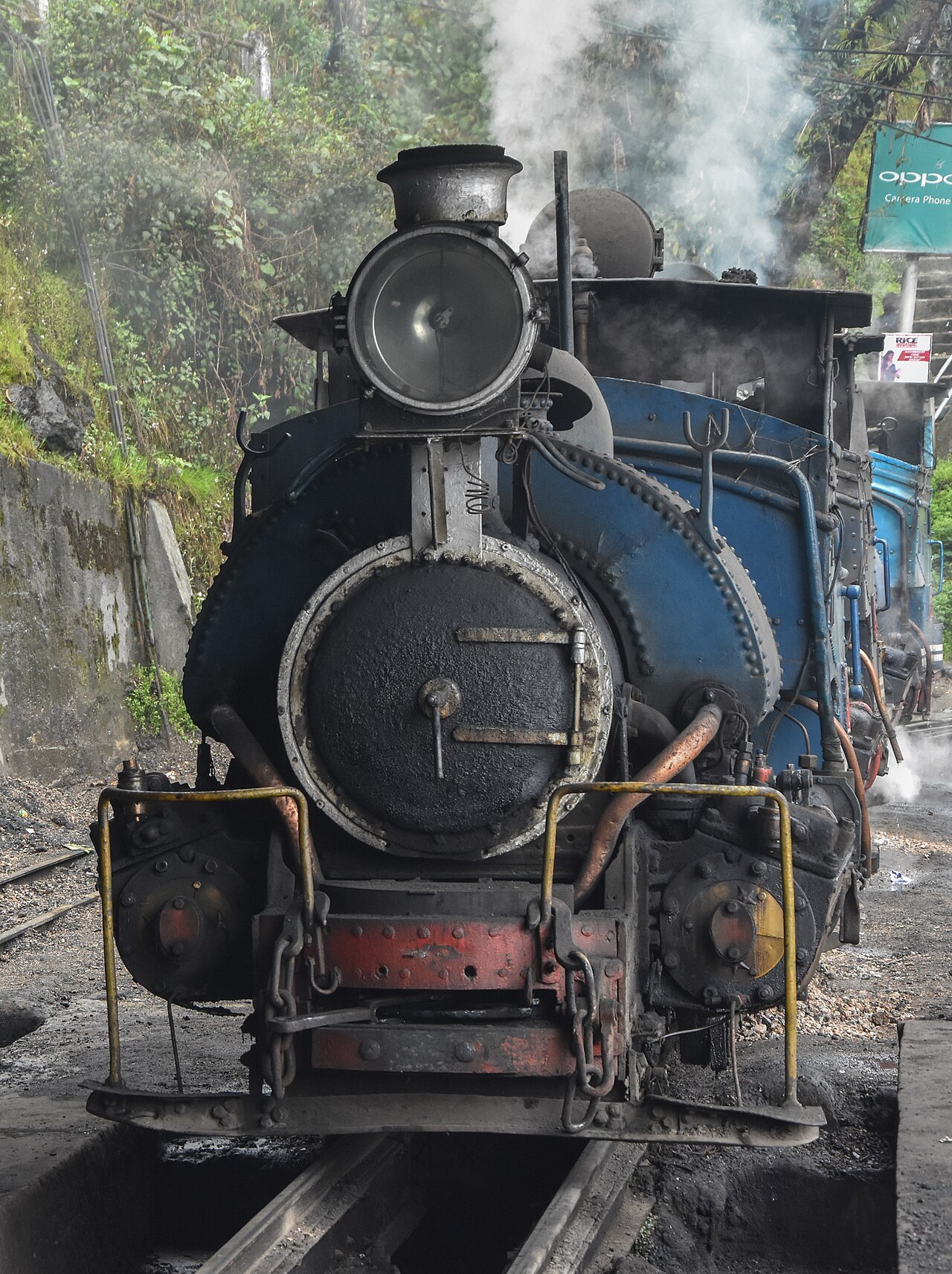
The Indian Mountain Railways — a UNESCO World Heritage serial inscription comprising the Darjeeling Himalayan Railway (inscribed 1999), the Nilgiri Mountain Railway (inscribed 2005), and the Kalka–Shimla Railway (inscribed 2008) — are three narrow-gauge mountain railways in India built by British colonial engineers between 1881 and 1906 CE to connect the Himalayan and Nilgiri hill stations with the Indian railway network, each representing extraordinary feats of 19th-century mountain railway engineering (steep gradients, hairpin curves, Z-reverses, loops, viaducts, and tunnels on terrain where no conventional rail technology could operate) and the unique travel experience of ascending from the Indian plains to altitudes of 1,700–2,207 m on lines where the gradient and curves limit maximum speed to approximately 20–30 km/h, creating a journey through changing landscape, climate, and vegetation zones at the pace of a brisk walk. The Darjeeling Himalayan Railway (78 km, 610 mm gauge, Siliguri Junction to Darjeeling at 2,042 m, opened 1881, with 6 Z-reversal points and 5 loops — the “batasia loop” near Ghum station being the most spectacular, a full 360° loop to gain altitude) operates the famous steam-hauled “toy train” service (the B-class steam locomotive, manufactured from the 1880s to 1927 CE and still in operational use on the heritage steam services, burning coal and producing a visible steam plume through the tea gardens and hill towns of the Darjeeling Himalayan area). The Nilgiri Mountain Railway (46 km, 1,000 mm gauge, Mettupalayam to Ooty/Udagamandalam at 2,203 m, the steepest regular-service railway in India — the Mettupalayam–Coonoor section achieves gradients up to 1 in 12.28, operated by rack-and-pinion mechanism, the only rack railway in India) and the Kalka–Shimla Railway (96 km, 762 mm gauge, Kalka to Shimla at 2,076 m, with 102 tunnels and 864 bridges) complete the serial inscription.
The three Mountain Railways and their hill station heritage contexts Darjeeling DHR · Nilgiri NMR · Kalka–Shimla KSR · Shimla · Darjeeling · Ooty — 0 to 350 km
The Darjeeling Himalayan Railway (the most internationally famous of the three railways, the “toy train” of the Darjeeling area that Rudyard Kipling referenced in his writings and that has been the defining image of Darjeeling for 140 years) operates two parallel services: the heritage steam service (the “toy train”, 78 km, approximately 7–8 hours, the full journey with the steam locomotives; operating heritage sections from Darjeeling to Ghum — 7 km — as a joyride service for tourists, and the longer full-route journeys with less frequent operation) and the diesel service (the daily scheduled passenger service for local commuters and longer-distance travellers). The railway runs on a 610 mm gauge (narrow gauge, approximately 2 feet — the standard for the “toy train” type mountain railways globally) through tea gardens, mountain towns, Himalayan viewpoints (the Kanchenjunga range visible on clear mornings from Darjeeling station area), and the high-altitude forest of the Darjeeling hills. The Kalka–Shimla Railway (the most architecturally significant of the three for its engineering infrastructure — 102 tunnels in 96 km, the most tunnel-dense narrow-gauge line in the world on a scheduled passenger service; 864 bridges and viaducts including the Arki Viaduct; the journey is through the Shivalik foothills terrain of Himachal Pradesh in a rail line that was the connection between British India’s summer capital at Shimla and the main Indian railway network at Kalka near Ambala) is the least romantically “toy-train” of the three — diesel multiple units operate the scheduled service — but its engineering density and the Shimla destination are significant heritage context. The Nilgiri Mountain Railway (the steepest of the three — the rack-and-pinion section from Mettupalayam to Coonoor handles a maximum gradient of 1 in 12.28, steeper than any other scheduled railway service in Asia) operates with steam traction on the Mettupalayam–Coonoor rack section (the steam locomotives are required for the rack section, which diesel locomotives cannot safely operate on the steep downhill without the specific braking characteristics of the steam rack-and-pinion system).
Darjeeling (the hill station context of the DHR, at 2,042 m in the Darjeeling district of West Bengal, the world capital of Darjeeling tea — the Makaibari, Castleton, and Margaret’s Hope tea gardens visible from the DHR train line) and Shimla (the context of the KSR, the former summer capital of British India where the Viceroy moved his administration to escape the Delhi summer heat, with the colonial Viceregal Lodge — now the Indian Institute of Advanced Study — and Christ Church among the surviving British colonial heritage buildings) are the heritage destinations that the railway journeys were built to reach. Kangchendzonga National Park (UNESCO 2016, approximately 350 km northwest of Darjeeling, accessible from Gangtok in Sikkim) is the major natural UNESCO site in the Darjeeling DHR’s geographic region.
Practical information
Darjeeling Himalayan Railway: Toy train from Darjeeling to Ghum (joyride, daily, approximately 2 hours return, booking at Darjeeling station). Full-route diesel service from New Jalpaiguri (NJP) to Darjeeling (approximately 4–5 hours by diesel; the toy train full journey is 7–8 hours). New Jalpaiguri is the transfer station from the broad-gauge Indian Railway network (direct trains from Kolkata, approximately 10 hours; or flights to Bagdogra airport, 12 km from NJP). Darjeeling is on the West Bengal–Sikkim border, approximately 70 km from Gangtok. Kalka–Shimla Railway: The train departs from Kalka station (accessible from Delhi Chandigarh road, approximately 65 km from Chandigarh, 260 km from Delhi). The 5–6 hour journey to Shimla departs early morning. Shimla has a domestic airport with seasonal flights from Delhi. Nilgiri Mountain Railway: Departs Mettupalayam (junction with the main Chennai–Coimbatore rail line, trains from Chennai approximately 7 hours). The rack section from Mettupalayam to Coonoor (approximately 3 hours) is the most spectacular. Onward to Ooty/Udagamandalam (approximately 1.5 more hours from Coonoor). Booking for all three railways: via IRCTC (Indian Railway Catering and Tourism Corporation) website or app, or at the stations. Heritage steam journeys on the DHR are particularly popular and should be booked weeks in advance. All three railways operate year-round; the monsoon season (June–September) brings beautiful green landscapes but fog and rain reduce mountain views.
Frequently Asked Questions
How was the Darjeeling Himalayan Railway engineered to climb 2,000 metres in 78 km?
The Darjeeling Himalayan Railway (DHR) achieves the climb from Siliguri Junction (approximately 100 m altitude) to Darjeeling station (2,042 m) in 78 km of 610 mm gauge track — a height gain of approximately 1,942 m — through a combination of five different engineering strategies that were each innovations or adaptations of existing railway engineering practice for the specific terrain of the Darjeeling Himalayan piedmont. The line was engineered by Franklin Prestage and built by the Eastern Bengal Railway (subsequently incorporated into the DHR company) between 1879 and 1881 CE. The engineering strategies include: (1) the “horseshoe curve” or loop (where the railway gains altitude by looping 360° or more around a hilltop in a continuous curve, gaining elevation equivalent to the vertical height of the hill the loop encircles — the Agony Point loop at Tindharia, 5 complete loops at different points along the route, are the most dramatic); (2) the “Z-reversal” or zig-zag (where the train travels forward to the end of a siding, reverses direction to a higher track level on the opposite side, then travels forward again — gaining altitude through a sequence of switchback moves, each reversal gaining approximately 15–30 m of altitude; the 6 Z-reversals on the DHR route at points including Batasia and Sonada are the technical heart of the line’s altitude-climbing strategy); (3) the extremely tight minimum curve radius (the DHR operates on curves as tight as 18 m radius — the inner wheel of a carriage on such a curve travels approximately 60% less distance per revolution than the outer wheel, a differential that standard railway track cannot accommodate but that the 610 mm narrow gauge and the DHR’s specific locomotive and carriage design handle through flexibility in the wheel sets); (4) the maximum permitted gradient of 1 in 29 (approximately 3.4%, steep enough to require the B-class steam locomotives to be specifically designed with front and rear bogies to maintain contact on curves and to use sand-boxes to improve traction on the steep gradients); and (5) the route alignment that consistently follows the contour of the existing mountain ridges and valleys (the DHR alignment from Ghum to Darjeeling follows a ridge that provided a relatively straight route at the cost of a dramatic zigzag at Batasia). The entire engineering problem was solved without the rack-and-pinion mechanism used on the Nilgiri Mountain Railway for its steepest section — the DHR relies entirely on adhesion (the friction between steel wheel and steel rail, improved by sand application) rather than a toothed rack, which means that the steepest sections of the DHR are at the limit of what adhesion-only narrow-gauge railways can achieve.
What were the hill stations served by the Indian Mountain Railways and why were they built?
The hill stations served by the Indian Mountain Railways (Darjeeling for the DHR, Shimla for the KSR, and Ooty/Udagamandalam for the NMR) were created by British colonial administrators, military officers, and tea planters as refuges from the extreme heat and disease environment of the Indian plains in summer — the colonial hill station tradition that transformed selected Himalayan and peninsular Indian mountain towns into specifically British-built colonial communities with bungalows, churches, clubs, public gardens, and all the institutional infrastructure of a British provincial town, at altitudes of 1,700–2,200 m where summer temperatures were 15–22°C rather than the 35–45°C of the plains. Shimla was the most institutionally important — from approximately 1864 CE onward, the Government of India moved its administrative capital from Calcutta to Shimla every summer (May–October), so that Shimla was effectively the British Indian capital for approximately 6 months per year for 80 years, and the entire administrative machinery of empire (the Viceroy’s Council, the Commander-in-Chief of the Indian Army, the Foreign and Home Departments, the various specialist commissions) moved northward in the pre-railway era by road, creating a spectacular and impractical logistical challenge that the Kalka–Shimla Railway (1906) resolved by reducing the Shimla journey to 5–6 hours from the overnight coach journey of the pre-railway era. Darjeeling (established as a hill station in 1835 CE, when the Raja of Sikkim ceded the Darjeeling area to the British East India Company) became the summer seat of the Bengal government, the centre of Darjeeling tea cultivation (the first tea experiments at Darjeeling began in 1841 CE under the direction of Dr. Archibald Campbell, the British Political Agent at Darjeeling), and a major centre of Tibetan Buddhist culture and commercial activity on the Tibet–Bengal trade route (the Darjeeling hills are inhabited by a majority Gorkha/Nepali community alongside Tibetan and Lepcha communities, making it one of the most ethnically diverse hill regions in India). Ooty (Ootacamund, the British Nilgiri hill station established in 1821 CE, which became the summer capital of the Madras Presidency) shares the hill-station institutional character of Darjeeling and Shimla — a world created specifically by British colonialism that has been culturally absorbed into Indian modernity as a distinctive architectural and social heritage type.
EXCERPT: Indian Mountain Railways, UNESCO serial inscription 1999–2008, comprises the Darjeeling Himalayan Railway (steam toy train, 78 km, 6 Z-reverses, 2,042 m altitude), the Nilgiri Mountain Railway (rack-and-pinion, steepest railway in India), and the Kalka–Shimla Railway (102 tunnels, 96 km) — three Victorian engineering masterpieces climbing to the British colonial hill stations.
META: UNESCO World Heritage Sites near Indian Mountain Railways India: Nanda Devi National Park (Darjeeling region, near Uttarakhand), Khangchendzonga National Park Sikkim (near Darjeeling, UNESCO 2016) — Darjeeling Himalayan Railway toy train heritage, Kalka Shimla Railway Himachal Pradesh, Nilgiri Mountain Railway Tamil Nadu, British colonial hill station heritage India.
Sources
- S1 — UNESCO World Heritage Centre — Mountain Railways of India (Ref. 944) — https://web.archive.org/web/20230601000000/https://whc.unesco.org/en/list/944/
- S2 — UNESCO World Heritage Centre — Statement of Outstanding Universal Value (Ref. 944) — https://whc.unesco.org/en/list/944/
Spotted an error? Write to [email protected] and we correct it the same day.