Hopewell Ceremonial Earthworks — inscribed by UNESCO in 2023 (the most recently inscribed US World Heritage Site) — preserves eight geometric earthen enclosures built by the Hopewell culture in the Ohio Valley approximately 100 BCE to 500 CE: the largest set of geometric earthen monuments ever built by any culture in world history, covering thousands of hectares of Ohio’s river valleys in precisely engineered circles, squares, octagons, and irregular polygons connected by parallel-walled causeways, aligned to solar and lunar astronomical phenomena, and representing the most complex ceremonial landscape in North America outside of Mexico — the central expression of a religious and cultural system that extended its influence across an enormous swathe of eastern North America, from the Gulf of Mexico to the Great Lakes and from Kansas to Florida, through an exchange network of rare materials (obsidian from the Rocky Mountains, copper from Lake Superior, mica from the Appalachians, shark teeth from the Gulf of Mexico, silver from Ontario) that archaeologists call the “Hopewell Interaction Sphere.”
The Newark Earthworks, Mound City, and the Hopewell Interaction Sphere Newark Earthworks — Great Circle Earthworks (Heath, Ohio — the largest circular earthwork in the world at 0.6 km diameter, now the site of the Moundbuilders State Memorial and a golf course) · Octagon Earthworks (Newark, Ohio — now a golf course; interior open to public on certain days) · Hopewell Culture National Historical Park — Mound City (Chillicothe, Ohio — the primary visitor centre and best-preserved site) · Fort Ancient Earthworks (Foster, Ohio) · Seip Earthworks · Stubbs Earthworks — Licking, Ross, Warren, and Greene Counties, Ohio
The Hopewell culture (a broad term coined by archaeologists in the late 19th century CE to describe the people who built the earthworks — named after Mordecai Hopewell, on whose land the most extensively excavated mound group in Ross County, Ohio was located) was not a single tribe or political unit but a complex of interacting communities sharing a ceremonial tradition and participating in a long-distance exchange network of unprecedented scope: between approximately 100 BCE and 500 CE, Native American communities across approximately half the continental United States regularly deposited rare, exotic materials at burial and ceremonial sites that archaeologists identify as Hopewell — materials that could only have arrived through sustained, long-distance trade, including: Pacific Coast obsidian (volcanic glass from the Obsidian Cliff site in what is now Yellowstone National Park, Wyoming, approximately 2,500 km from the Ohio heartland); copper sheets and beads (primarily from the Keweenaw Peninsula of Michigan’s Upper Peninsula, where native copper — metallic copper found in pure form without smelting — occurs in surface deposits, approximately 800 km from Ohio); mica sheets (from the Appalachian Mountains of North Carolina and Georgia, approximately 600–800 km from Ohio); silver (from the Cobalt region of Ontario, Canada); galena (lead sulphide, used as a pigment, from deposits in Missouri and Illinois); and marine shells (Busycon whelk and Marginella shells from the Gulf of Mexico or Atlantic coast, approximately 1,000+ km from Ohio). This Hopewell Interaction Sphere (the term coined by Joseph Caldwell in 1964 CE to describe the network that distributed these materials) represents the most extensive long-distance exchange network in North American prehistory and demonstrates a level of inter-regional organisation and relationship-building that challenges simple narratives about “prehistoric” society. The geometric earthworks (the defining physical legacy of the Hopewell tradition, built in the Ohio Valley from approximately 100 BCE to 500 CE) are the largest such monuments in world history: the Newark Earthworks (in Licking County, Ohio, on the flat terraces of the Licking River and its tributaries) originally covered approximately 16 km² of carefully levelled and graded earth embankments — an area larger than the centre of most modern American cities — and comprised the largest geometric earthwork complex ever constructed. The surviving elements: the Great Circle (a near-perfect circle of earth walls approximately 0.6 km in diameter, with a single entrance on the west side, and an interior central mound and Eagle Mound — the largest intact portion of the Newark Earthworks, now the site of the Moundbuilders Country Club golf course and the Ohio History Connection’s Moundbuilders State Memorial Museum); the Octagon (an octagonal enclosure approximately 0.5 km in diameter, connected to a circular enclosure — the Observatory Circle — by a narrow neck of earthworks, the ensemble aligned to mark the rising and setting points of the moon at the 18.6-year lunar standstill cycle with extraordinary precision); the Great Hopewell Road (a set of parallel-walled earthwork causeways approximately 60 metres wide, extending approximately 95 km from Newark toward Chillicothe, the other major Ohio Hopewell centre — one of the longest earthwork alignments ever discovered, apparently connecting the two primary ceremonial centres of the Ohio Hopewell world). The astronomical alignments of the Newark Earthworks (first documented by Ray Hively and Robert Horn in a 1982 CE paper that is now considered the foundational work in Hopewell astronomy) are as precise as those of Stonehenge: the major axis of the Octagon-Circle combination is oriented to the northernmost rising point of the moon at the minor lunar standstill (the most northern moonrise in the 18.6-year lunar cycle, an alignment achievable only through careful observation of the moon’s 18.6-year cycle over many years or decades); the secondary axis is oriented to the southernmost moonrise at the major lunar standstill; and the four corners of the Octagon mark four additional lunar rising and setting points across the two standstill cycles. Mound City (the primary component of Hopewell Culture National Historical Park in Chillicothe, Ross County — approximately 100 km south of Newark) contains 23 burial mounds within a square earthwork enclosure approximately 13.7 acres in area, the mounds arranged in a pattern without obvious axial organisation but containing the most extraordinary assemblage of Hopewell ceremonial objects ever excavated: thousands of copper objects (earspools, breastplates, headdresses, effigies of birds and other animals), thousands of obsidian blades, mica cutouts (geometric shapes and animal figures cut from large thin sheets of mica), pan pipes and other musical instruments, and elaborate ceramic vessels. The Hopewell Mound Group (approximately 10 km from Mound City, on the farm where Mordecai Hopewell allowed excavation in 1891 CE — the excavation that effectively defined the Hopewell tradition for subsequent archaeology) originally contained approximately 38 burial mounds within a large rectangular enclosure; the site is now largely unexcavated, with surface traces visible in the farm fields.
Practical information
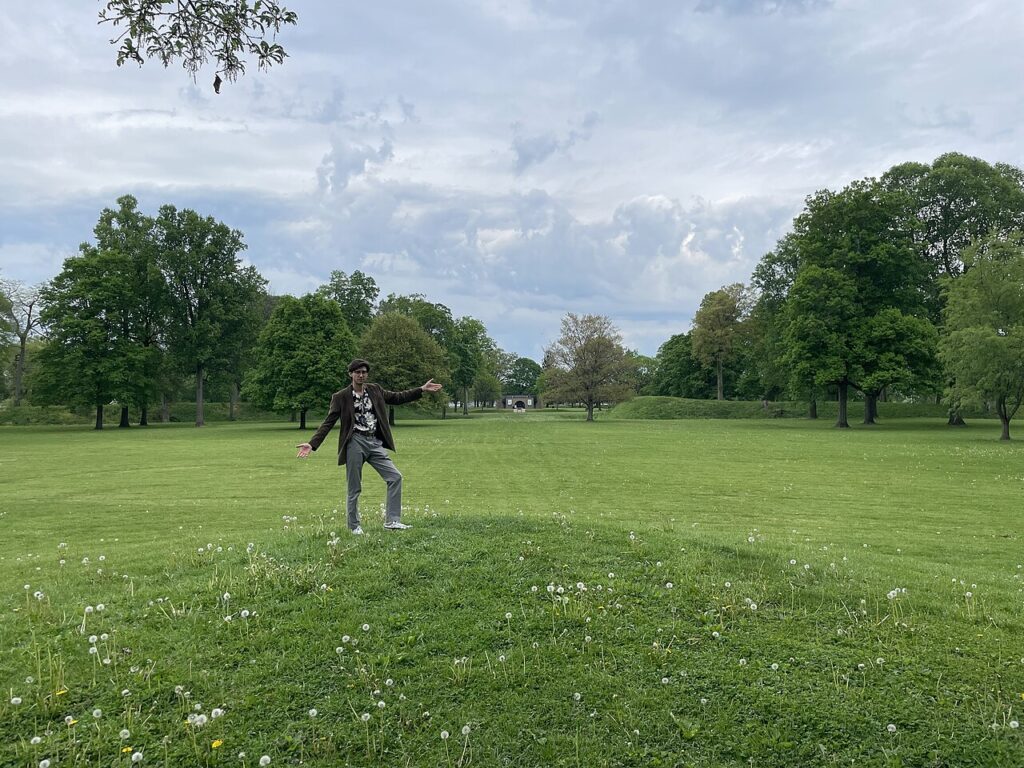
The Hopewell Ceremonial Earthworks inscription covers eight separate sites across four Ohio counties, administered by a combination of the National Park Service (Hopewell Culture National Historical Park), the Ohio History Connection, and private landowners. The most accessible visitor experience: Hopewell Culture National Historical Park (Mound City Group Visitor Center, 16062 OH-104, Chillicothe, Ohio — free admission) has the best-preserved visible earthworks, an excellent introductory film and museum, and self-guided trail access to the Mound City enclosure and mounds. Open daily. The Moundbuilders State Memorial (50 Cooper Ave, Newark, Ohio — approximately 1 hour northeast of Chillicothe) is the most dramatic single site: the Great Circle with its interior earthworks is the most visually imposing surviving section of the Newark Earthworks. The adjacent museum contains the famous “Newark Earthworks Decalogue Stone” and other finds. The Octagon and Observatory Circle (approximately 1 km north of the Great Circle) are now the grounds of the Moundbuilders Country Club golf course; the interior is open to the public on four specific dates per year (announced at ohiohistory.org) and on evenings when the club is closed. Fort Ancient Earthworks (6123 OH-350, Oregonia, Ohio — approximately 50 km south of Dayton) is a hilltop enclosure of approximately 6 km of earthen walls, with an excellent state memorial museum. The nearest major airports are Columbus (CMH, approximately 80 km from Newark), Cincinnati (CVG, approximately 100 km from Fort Ancient), and Dayton (DAY, approximately 80 km from Fort Ancient). No public transportation serves any of these sites; a car is required. Best season: spring and autumn for comfortable temperatures; the Newark Earthworks are particularly beautiful when the Great Circle’s interior is accessible during the periodic public open days. Allow a minimum of a half-day for each major site; a comprehensive multi-site visit requires 2–3 days.
Frequently Asked Questions
What was the Hopewell Interaction Sphere and how did communities 2,500 km apart maintain contact?
The Hopewell Interaction Sphere (the term coined by archaeologist Joseph Caldwell in 1964 CE to describe the network of long-distance exchange relationships that characterised the Hopewell tradition, approximately 100 BCE to 500 CE) is the most extensive and most archaeologically well-documented pre-Columbian exchange network in eastern North America — a system that distributed materials from their geological sources across distances of 1,000–2,500 km with sufficient regularity and volume to suggest sustained, deliberate, and institutionalised exchange relationships rather than casual trade. The materials in the Interaction Sphere are almost exclusively “prestige goods” — materials used in ceremonial contexts, deposited in high-status burials, and manufactured into objects of social and religious importance — rather than food, utilitarian tools, or other subsistence goods. The distinctive character of Hopewell exchange: the obsidian from Yellowstone’s Obsidian Cliff (identified by its chemical “fingerprint” using X-ray fluorescence analysis — each obsidian deposit has a distinctive trace element composition that allows its geological source to be identified precisely) appears at Hopewell sites throughout Ohio and the surrounding region; native copper from the Keweenaw Peninsula appears worked into ceremonial objects at sites from Ohio to Kansas; the specific geographic origin of each material type can be established with scientific precision, confirming that these are not locally available substitutes but the genuine article transported from distant sources. The mechanisms of exchange: anthropologists and archaeologists have proposed several non-exclusive models — ceremonial gift exchange at periodic inter-community gatherings (an analogy with the potlatch of the Pacific Northwest, in which prestige was built by giving, not accumulating); reciprocal exchange between communities that had established long-distance kinship or alliance relationships; specialist traders who maintained exchange routes across the region; and pilgrimage to major ceremonial centres such as Newark and Chillicothe, where participants brought exotic materials as offerings and received prestige objects in return. The physical infrastructure that enabled this exchange — the ceremonial earthworks, the burial mounds, the Great Hopewell Road — suggests that the Ohio heartland was a central node in a network that communities across eastern North America had reason to maintain contact with, for reasons we can only partially reconstruct from the archaeological evidence. The collapse of the Hopewell Interaction Sphere (approximately 400–500 CE) was as sudden and widespread as its florescence: the long-distance exchange network appears to have contracted rapidly, the construction of elaborate geometric earthworks ceased, and the ceremonial tradition associated with the Hopewell burial mounds was replaced by different forms of community organisation. The causes of this collapse are debated among archaeologists but may include climatic cooling (the cooler, drier climate of 400–600 CE, which would have stressed the agricultural communities of the Midwest), political fragmentation of the exchange network, or shifts in the ceremonial and religious beliefs that had motivated the enormous investments of labour in the earthworks and exchange system.
How were the Hopewell earthworks built and what labour was required?
The engineering of the Hopewell geometric earthworks (particularly the Newark Earthworks and the related complex at High Bank Works, approximately 100 km south near Chillicothe, which shares the same octagon-circle motif with Newark but is smaller) required a level of planning, surveying, and organised labour that has been a subject of scientific investigation since the 19th century CE. The earthworks were built entirely without metal tools, draft animals, wheeled vehicles, or a writing system — using wooden digging tools (sharpened sticks and flat wooden paddles), woven baskets (for carrying earth), and stone-headed adzes for cutting sod and compacting earth — by communities whose primary subsistence was a combination of agriculture (Eastern Agricultural Complex — sunflower, goosefoot, knotweed, and wild rice, supplemented by maize that appears to have been adopted by Ohio Hopewell communities relatively late in the tradition) and intensive hunting and gathering. The soil used for the earthworks was excavated from borrow pits (still visible as depressions within the earthwork enclosures) and carried in baskets to the construction areas, where it was carefully graded and compacted in horizontal layers — a construction technique visible in the cross-sections of excavated earthwork walls that reveals the careful layering used to achieve a stable, water-resistant structure. The volume of earth in the Newark Earthworks alone is estimated at approximately 7 million cubic metres — the equivalent of building the Great Pyramid of Giza, though distributed across a much larger area in walls of only 3–10 metres height rather than a single massive structure. Computer-aided survey of the Newark Earthworks using differential GPS and LIDAR remote sensing (conducted by Timothy Dodd and Brad Lepper in the 2000s and 2010s CE) demonstrated that the earthwork walls were constructed with remarkable precision: the Great Circle is a near-perfect circle with a diameter of 1,054 feet (321 metres) accurate to within approximately 1%; the Octagon’s walls are perpendicular and parallel within approximately 0.1%; and the astronomical alignments (the axis of the Octagon-Circle directed to the lunar maximum rising point) are accurate to within approximately 0.5°. This precision required surveying methods equivalent in accuracy to those available to ancient Egypt or Bronze Age Britain, achieved without writing or metal tools by a community that left no evidence of specialised architectural planning texts. The human energy investment suggests that the earthworks were built not by enslaved labour or by a coerced workforce under hierarchical control, but by large, willing, motivated work parties — likely the periodic assembly of communities from across the Hopewell exchange network at the ceremonial centres, whose shared investment in the sacred landscape was the basis of the social cohesion that maintained the exchange network.
Why are the Hopewell Earthworks just now receiving UNESCO recognition in 2023 CE?
The Hopewell Ceremonial Earthworks were inscribed on the UNESCO World Heritage List in September 2023 — the most recently inscribed US World Heritage Site as of 2024 CE — after a nomination process that took over 25 years from the initial preparation of the US Tentative List (the list of sites considered for potential UNESCO nomination that the US government submitted to UNESCO in the 1990s CE). The delay reflects several complex factors in the management and politics of US World Heritage nominations. The administrative complexity of the nomination was considerable: the eight-site inscription required coordination between the National Park Service (which manages Hopewell Culture National Historical Park), the Ohio History Connection (which manages the Newark Earthworks and Fort Ancient), the Licking County government (which co-manages some of the Newark Earthworks), and the Moundbuilders Country Club (which has operated a golf course on the Octagon Earthworks since the 1930s CE under a lease from the Ohio History Connection — a lease that has been the subject of controversy and ongoing legal dispute). The golf course on the Octagon is perhaps the most contentious issue: critics (including members of the United Tribes of Ohio and Ohio Valley archaeological community) have argued for decades that operating a golf course on a sacred Native American ceremonial monument is inappropriate, while the Country Club (whose 18-hole course winds through the earthwork walls and whose clubhouse sits on one of the earthwork enclosures) has maintained that its use is compatible with preservation. A 2020 CE Ohio Supreme Court ruling upheld the Ohio History Connection’s right to terminate the Country Club’s lease, and legal proceedings to remove the golf course are ongoing. The UNESCO inscription process also required demonstrating that the Outstanding Universal Value criteria were met across all eight sites — a challenging task for a nomination that includes sites in varying states of preservation (some well-preserved within state memorials, others partially destroyed by farming, residential development, and golf course construction) and on a landscape that looks unremarkable to the untrained eye (the earthworks are low walls, mostly grass-covered, that require prior knowledge and active imagination to appreciate, unlike the visually dramatic geological and architectural sites that make up most of the US UNESCO list). The 2023 inscription coincided with a broader shift in UNESCO’s practice toward recognising Indigenous cultural landscapes rather than only monumental architecture, driven by the inclusion of more member states from Africa, Asia, and the Americas in the World Heritage Committee’s deliberations.
EXCERPT: Hopewell Ceremonial Earthworks Ohio (UNESCO 2023) — the largest geometric earthen monuments ever built: the Newark Earthworks (16 km² original extent, aligned to the 18.6-year lunar cycle), Mound City (23 burial mounds with extraordinary copper, obsidian, and mica ceremonial objects), and evidence of the most extensive pre-Columbian long-distance exchange network in eastern North American history (100 BCE – 500 CE).
META: UNESCO World Heritage Sites near Hopewell Ceremonial Earthworks Ohio USA: Cahokia Mounds 600 km west, Great Smoky Mountains National Park 700 km south — Eastern North America Indigenous earthwork heritage circuit from the Ohio Hopewell geometric monuments to the Mississippian platform mounds of Cahokia.
Sources
- S1 — UNESCO World Heritage Centre — Hopewell Ceremonial Earthworks (Ref. 1689) — https://web.archive.org/web/20230601000000/https://whc.unesco.org/en/list/1689/
- S2 — National Park Service — Hopewell Culture National Historical Park — https://www.nps.gov/hocu/
Spotted an error? Write to the editors and we correct it the same day.