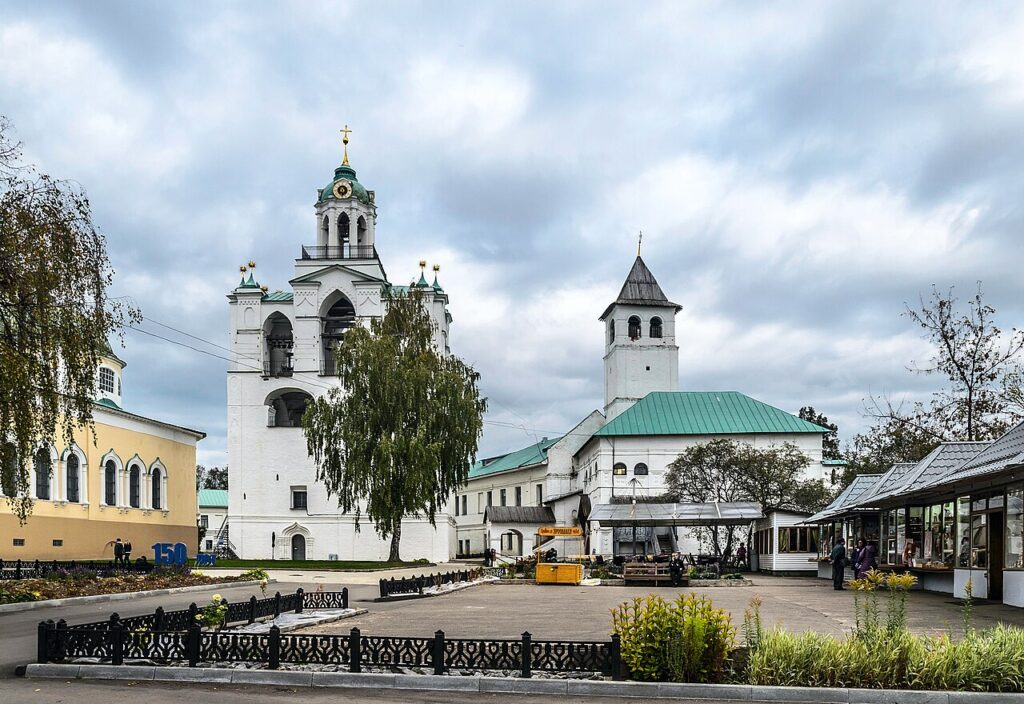
The Historic Centre of the City of Yaroslavl — inscribed by UNESCO in 2005 — preserves one of the most remarkable collections of 17th-century Russian urban church architecture: a historic urban core at the confluence of the Volga and Kotorosl rivers, in a city founded approximately 1010 CE by Yaroslav the Wise (Grand Prince of Kiev), that contains over 140 historic buildings from the 13th to 19th centuries, among them six churches with complete interior fresco cycles representing the Yaroslavl School of painting — a distinctive regional tradition of the 17th century characterised by rich, narrative fresco cycles in warm earth colours, complex iconographic programmes, and a decorative exuberance that has no parallel in contemporary Russian religious painting.
The Yaroslavl School of church architecture and fresco painting Church of Elijah the Prophet (1647–1650) · Church of St John the Baptist at Tolchkovo (1671–1687) · Spaso-Preobrazhensky Monastery — within the inscription
The “Yaroslavl School” is the historiographic term for the distinctive architectural and artistic tradition that flourished in Yaroslavl between approximately 1620 and 1700 CE, driven by the extraordinary prosperity of the city’s merchant community — the Yaroslavl linen and textile trade (yaroslavka linen was the principal export fabric of early modern Russia, sold in the European markets through Arkhangelsk and the Muscovy Company English trading concession) produced a class of wealthy merchants (the Yaroslavl kupechestvo) who competed with each other and with the Moscow court in commissioning increasingly elaborate and large parish churches. The resulting building boom of the Yaroslavl mid-17th century — approximately 50 major brick churches built in Yaroslavl between 1620 and 1680 CE, a rate of construction approximately one major church per year over six decades — created an urban religious landscape of exceptional density. The churches follow a recognisable typology: a large, often five-domed main church body on a raised vaulted undercroft (the lower floor used for storage of the merchant patron’s goods in winter, creating a direct economic substratum for the spiritual donation), surrounded by an open gallery (galereya) of Italianate arcade form, flanked by symmetrical tent-roofed chapel towers, with a separately standing bell tower (kolokolnya) of tent or onion-dome type completing the ensemble. The decorative vocabulary of the exterior — elaborate kokoshniki (corbelled arch ornaments), ceramic tiles (raznotsvetnye izrazets) in blue, green, and yellow set into the brick fabric, carved limestone ornamental panels — reflects the wealth of the merchant patrons and the availability of skilled craft workers that Yaroslavl’s trading connections made possible. The fresco cycles within these churches are the Yaroslavl tradition’s most significant artistic legacy: beginning with the Church of Elijah the Prophet (1647–1650 CE), whose frescoes were executed in 1680–1681 CE by a team led by the master Gury Nikitin (one of the most important documented names in medieval Russian fresco painting), the Yaroslavl church interiors developed a programme of narrative frescoes organised in multiple horizontal registers running continuously around the church walls — typically 4–6 registers of scenes from the New Testament, Old Testament, the lives of the patron saints, and the Apocalypse — with a density of narrative content and a warmth of colour (red ochre, golden yellow, deep blue, green) that the Moscow contemporaries did not match.
The Church of Elijah the Prophet (Tserkva Ilyi Proroka, 1647–1650 CE) is the most celebrated monument of the Yaroslavl School: commissioned by the brothers Ananiy and Nazariy Skripins, major linen merchants who also funded the construction of other Yaroslavl churches, it is the only Yaroslavl School church that has preserved its complete fresco cycle in the state applied by the original 17th-century workshop (the 1680–1681 frescoes by Gury Nikitin’s workshop cover the entire interior surface of approximately 500 m²). Its location at the centre of the historic urban area (its forecourt opens directly onto Ilinskaya Square, formerly the commercial market square of historic Yaroslavl) and the exceptional quality of its exterior ensemble (five onion domes, tent-topped side chapel towers, elaborate ceramic tile and carved stone exterior ornament) make it the compositional centrepiece of the UNESCO inscription. The Church of St John the Baptist at Tolchkovo (Tserkva Ioanna Predtechi v Tolchkove, 1671–1687 CE) — in the textile workers’ district on the opposite bank of the Kotorosl River from the historic centre — is arguable the more spectacular monument: 15 domes (five on the main church body, ten on the two flanking symmetrical chapels), the richest exterior ceramic tile ornament of any Yaroslavl church, and a fresco cycle covering approximately 1,700 m² of interior surface (the largest fresco programme in the entire Yaroslavl School, including the most comprehensive surviving Apocalypse cycle in Russian medieval art, with 45 scenes from the Book of Revelation). The church’s exterior tiled ornament — intricately patterned blue-green-yellow ceramic tiles produced in the Yaroslavl tile workshops — has been partially restored and is the finest visible example of the Yaroslavl ceramic tile tradition.
The Volga trading city, the Tale of Igor, and the Yaroslavl heritage setting Volga Embankment (Naberezhnaya) · Spaso-Preobrazhensky Monastery manuscript collection · Moscow-Yaroslavl historic railway — within and adjacent
Yaroslavl’s historical importance as a Volga trading city provides the economic context for understanding the wealth that funded the 17th-century church building boom. The city was founded approximately 1010 CE (according to the Russian Primary Chronicle) by Yaroslav the Wise, Grand Prince of Kiev (978–1054 CE), at a strategic point where the Kotorosl River flows into the Volga — a position controlling the trade route from the upper Volga (Moscow, Tver, and the Russian central plateau) downstream to Nizh Novgorod and the Caspian Sea. The Spaso-Preobrazhensky (Transfiguration) Monastery — founded approximately 12th century and rebuilt in stone in the 16th century CE, when its walls were constructed to the scale of a major fortress — houses the collection in which the sole manuscript of the “Song of Igor’s Campaign” (Slovo o polku Igoreve) was discovered by Count Alexei Musin-Pushkin in approximately 1795 CE: the Slovo, a 12th-century Russian epic poem describing the failed campaign of Prince Igor Svyatoslavich of Novgorod-Seversky against the Polovtsian (Cuman) nomads in 1185 CE, is the most celebrated text of medieval Russian literature, comparable in its cultural status to the Chanson de Roland in French literature or the Nibelungenlied in German literature. The original manuscript perished in the Moscow fire of 1812 CE (during the Napoleonic occupation), but the text had been published in 1800 CE and a hand copy existed, allowing subsequent scholarship. The discovery of the Slovo in the Yaroslavl monastery is commemorated in the Yaroslavl Regional Museum of History, Architecture and Art (housed in the Spaso-Preobrazhensky Monastery complex), which also holds the finest collection of Yaroslavl icon painting and silver craft outside Moscow and St Petersburg.
The Yaroslavl Volga embankment (Naberezhnaya) — a landscaped promenade approximately 3 km long along the right bank of the Volga, with views across the broad river to the meadows of the opposite bank — is one of the most pleasant urban waterfront ensembles in Russia, lined with 18th–19th century neoclassical merchants’ houses, churches, and public buildings that reflect Yaroslavl’s status as one of the wealthiest provincial cities of the Russian Empire. The regular urban grid of the historic centre — laid out in 1778 CE under Catherine the Great’s comprehensive provincial planning reform (the Regulirnyy Plan), which replaced the medieval organic street network of many Russian provincial cities with a rational geometric grid — created the framework within which the earlier 17th-century churches are now embedded, giving Yaroslavl’s historic centre an unusual character: medieval churches in baroque and neoclassical urban settings, creating a layered visual and historical experience unique among the Golden Ring towns. The Yaroslavl-Main railway station (1870 CE) is the terminus of Russia’s first planned provincial railway (the Yaroslavl Railway, now the Yaroslavskoye Napravleniye of the Moscow commuter rail network), which connects Yaroslavl directly to Moscow’s Yaroslavsky Station and, via the Trans-Siberian Railway, to the entire breadth of Russia.
Practical information
Yaroslavl is located approximately 260 km northeast of Moscow on the Volga River, accessible by high-speed Sapsan or regular express train from Moscow’s Yaroslavsky Station (approximately 3.5–4 hours), by road via the M8 Yaroslavl Highway (approximately 4 hours), or by Volga riverboat (seasonal May–October, a scenic but slow option from the Rechnoy Vokzal river terminal). The city is well-served by hotels across all price categories and is a natural overnight stop for the Golden Ring circuit (Yaroslavl – Kostroma – Rostov Veliky – Sergiev Posad circuit, 3–5 days). Key sites: Church of Elijah the Prophet (Ilinskaya Square, city centre; open May–October, closed Tuesday; entry approximately 200–400 RUB; guided tours available in English by advance booking); Spaso-Preobrazhensky Monastery Museum (open daily; entry approximately 200–300 RUB for the museum exhibitions, separate tickets for the monastery territory); Church of St John the Baptist at Tolchkovo (Krasny Perekop District, approximately 2 km southeast of the city centre; accessible by tram or taxi; open limited hours — check in advance). The Yaroslavl Art Museum (housed in a 19th-century Governor’s House on the Volga embankment) holds significant collections of Russian 18th–20th century painting. Best season for fresco viewing: May–September (the churches are climate-controlled in winter, but opening hours are reduced in cold months and summer provides the best interior light conditions). Note: most Yaroslavl School churches charge entry fees for interior access even when exterior viewing is free.
Frequently Asked Questions
What is the “Song of Igor’s Campaign” (Slovo o polku Igoreve) and why is its connection to Yaroslavl significant?
The “Song of Igor’s Campaign” (Slovo o polku Igoreve in Russian, “The Lay of Igor’s Host”) is an anonymous Old East Slavic epic poem of approximately 7,000 words, believed to have been written shortly after the events it describes (the 1185 CE campaign of Prince Igor Svyatoslavich of Novgorod-Seversky against the Polovtsian/Cuman nomads of the steppe south of the Seversky Donets River), though some scholars have proposed later dates. The poem describes Igor’s campaign, initial victory, subsequent defeat and capture by the Polovtsian khan Konchak, his captivity, and eventual escape — interspersed with laments by his wife Yaroslavna (the archetypal figure of the waiting Russian woman in subsequent literary tradition) and calls for unity among the fragmented Russian princes against the steppe threat. Its literary qualities — the use of personification of natural forces (the wind, the Don River, the sun), the complex poetic imagery drawing on pagan and Christian symbolism simultaneously, the irregular rhythmic structure (neither purely metric nor purely prose) — have made it the most analysed text in Russian medieval literary studies. The sole manuscript was discovered approximately 1795 CE by Count Alexei Musin-Pushkin (a collector of Russian antiquities, Imperial Procurator of the Holy Synod) among manuscripts acquired from the Spaso-Preobrazhensky Monastery in Yaroslavl — the exact circumstances of discovery and the exact date of the manuscript’s composition have been debated since the 19th century, with some scholars (notably the French Slavicist André Mazon in the 1940s) proposing that the text was an 18th-century forgery. The forgery hypothesis was comprehensively rejected by the Russian scholars Dmitry Likhachev and Roman Jakobson, and is currently not accepted by the mainstream of Slavic studies, though it resurfaces periodically. The destruction of the manuscript in the 1812 Moscow fire made textual authentication impossible from physical evidence alone; all subsequent scholarship works from the 1800 publication and the surviving handwritten copy made by Catherine the Great’s court. The connection to Yaroslavl is commemorated at the Spaso-Preobrazhensky Monastery’s museum with an exhibition devoted to the discovery and the manuscript’s reception history.
What made the Yaroslavl merchant community so wealthy that they could fund 50 major churches in 60 years?
Yaroslavl’s merchant wealth in the 17th century derived primarily from its position as the principal textile production centre and transit point of the early modern Russian economy’s most significant export commodity: Yaroslavl linen (polotno) — unbleached and bleached flax linen cloth woven in the small towns and villages of the Yaroslavl, Kostroma, and Ivanovo regions — was Russia’s most important non-fur export product from the late 16th through mid-18th centuries, sold primarily in the English and Dutch markets through the Muscovy Company’s concession at Arkhangelsk (the only open-sea port available to Russia before Peter the Great’s acquisition of the Baltic coast in 1721 CE). English records from the Muscovy Company in the 1580s–1630s document enormous quantities of Yaroslavl linen arriving at Arkhangelsk for purchase by Company agents; the quantities involved — tens of thousands of pieces annually — imply a production infrastructure of many thousands of weaving households organised and financed by the Yaroslavl kupechestvo (merchant class). The Yaroslavl merchants were also the primary middlemen of the Volga trade route: the downstream Volga connected Yaroslavl to Nizhny Novgorod (the primary annual fair of the Russian economy, where Asian goods from the Caspian route met western European goods from the upper Volga) and to Astrakhan (the terminus of the Caspian Sea route, through which Persian silk, Indian spices and gems, and Central Asian goods entered the Russian market). The capital accumulated through these trade flows made the Yaroslavl merchant community extraordinarily wealthy by Russian provincial standards — capable of funding individual church construction projects that cost the equivalent of several years’ income of a provincial peasant household — and also capable of attracting the best available fresco painters from Moscow and from the Kostroma workshops. The competitive dimension of church patronage — the desire to outdo neighbours in the scale and quality of one’s parish church — drove the technical ambition of the Yaroslavl fresco workshops, who developed increasingly complex iconographic programmes and more sophisticated compositional techniques in response to the merchants’ expectations.
How does Yaroslavl’s 1778 town plan by Catherine the Great’s provincial reform differ from other Russian historic cities?
The 1778 regular plan (Regulirnyy Plan) of Yaroslavl — one of approximately 400 provincial town plans commissioned by Catherine the Great’s Commission on the Stone Construction of St Petersburg and Moscow (established 1762 CE and expanded throughout the empire under the general supervision of the architect Ivan Lemm and later the State Architect Karl Blank) — was applied to Yaroslavl as part of a comprehensive rationalist programme for rebuilding Russia’s provincial cities along Enlightenment urban planning principles. The Yaroslavl plan, one of the most thoroughly implemented in Russia (most other provincial plans were applied only partially, with the medieval street network surviving in many cities), replaced the organic radial-and-ring street pattern typical of Russian medieval cities (a pattern arising from natural expansion around a central kremlin or monastery) with a regular fan-shaped grid of streets radiating from the confluence of the Volga and Kotorosl rivers. The result is a historic city plan in which the 17th-century churches — built before the rationalist grid — stand at positions that do not align with the subsequent street network, creating the architecturally characteristic situation of Yaroslavl where churches appear in the middle of blocks, at odd angles to the surrounding streets, or set back from the street in their own enclosed courtyards in a way that would seem planned if the churches had not all predated the street grid. This spatial dislocation gives Yaroslavl’s historic centre a visual richness not found in cities whose church placement and street network evolved together organically (like Novgorod or Pskov) or were planned together at a single moment (like St Petersburg). The neoclassical merchants’ houses and commercial buildings of the late 18th–early 19th century that fill the regular grid blocks between the 17th-century churches constitute Russia’s most complete surviving example of the Catherine-era provincial building programme — a standardised architectural vocabulary (two or three-storey stuccoed masonry buildings with classical window surrounds, pilastered facades, and mansard roofs) that was applied consistently enough in Yaroslavl to create a coherent urban ensemble, unlike most Russian provincial cities where only scattered individual examples of the Catherine-era style survive.
EXCERPT: Historic Centre of the City of Yaroslavl (UNESCO 2005) — Russia’s most complete collection of 17th-century merchant-funded Yaroslavl School fresco churches, founded 1010 CE by Yaroslav the Wise at the Volga-Kotorosl confluence, where the sole manuscript of the medieval epic Song of Igor’s Campaign was discovered in a monastery archive in 1795.
META: UNESCO World Heritage Sites near Historic Centre Yaroslavl Russia: Trinity Lavra Sergiev Posad 200 km southwest, White Monuments Vladimir-Suzdal 260 km south — Golden Ring of Russia heritage circuit from Yaroslavl’s 1,700 m² Apocalypse fresco cycle to the linen merchant culture that made it Russia’s second city in the 17th century.
Sources
- S1 — UNESCO World Heritage Centre — Historical Centre of the City of Yaroslavl (Ref. 1170) — https://web.archive.org/web/20230601000000/https://whc.unesco.org/en/list/1170/
- S2 — UNESCO World Heritage Centre — Statement of Outstanding Universal Value (Ref. 1170) — https://whc.unesco.org/en/list/1170/
Spotted an error? Write to the editors and we correct it the same day.