
A full-body Indonesian martial art blending strikes, grappling, throws, and weaponry—practiced for physical defense and psychological development across hundreds of distinct regional styles.
In UNESCO’s words
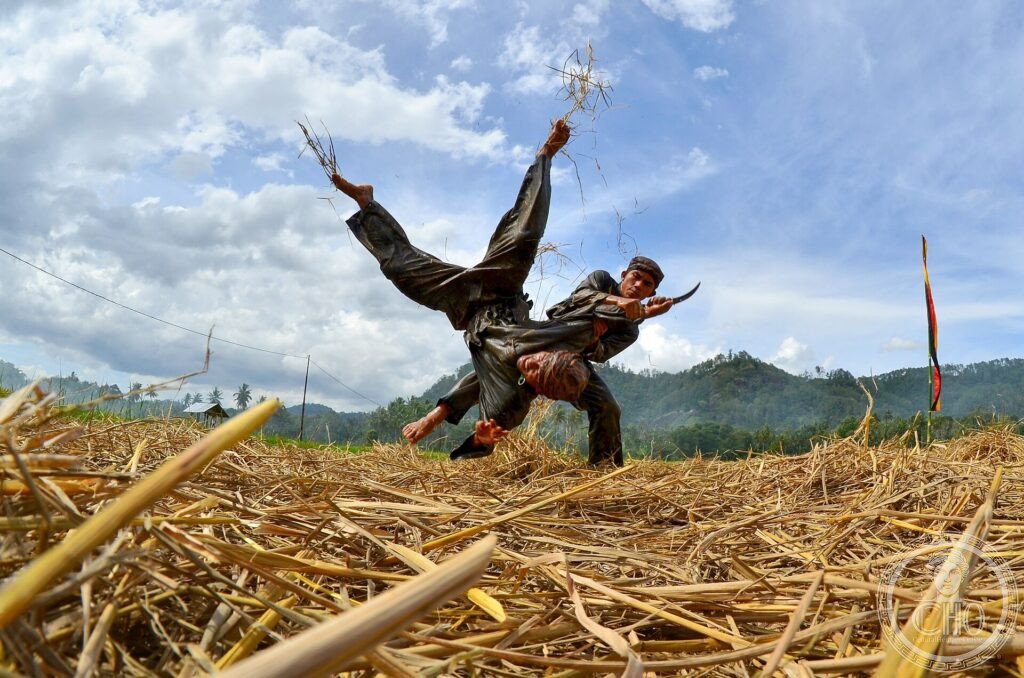
In addition to their sporting element, Traditions of Pencak Silat also encompass mental-spiritual, self-defence and artistic aspects. The moves and styles of Pencak Silat are strongly influenced by various elements of art, involving a unity of body and movement fitting the accompanying music. The term ‘pencak’ is better known in Java, while the term ‘silat’ is better known in West Sumatra, describing a group of martial arts with many similarities. In addition to local terms, each region has its own moves, styles, accompaniments, music, and supporting equipment, which includes costumes, musical instruments, and traditional weapons. Pencak Silat practitioners are taught to maintain their relationship with God, human beings, and nature, and are trained in various techniques to deal with attacks or other dangerous situations based on principles to protect themselves as well as others, avoid harming the offender and build comradeship. The practice strengthens comradeship, maintains social order, and provides entertainment for ritual ceremonies. Related knowledge and skills are commonly taught in non-formal schools and include oral traditions and expressions such as greetings, philosophical phrases, rhymed poems, advice, as well as songs and techniques to play the instruments.
Official description, UNESCO Intangible Cultural Heritage List — Traditions of Pencak Silat
At a glance
Pencak Silat is a martial art that combines sporting, mental-spiritual, self-defence and artistic elements. The moves and styles flow with accompanying music, creating a unity of body and movement. Practitioners in different regions use their own distinct styles, music, costumes, musical instruments and traditional weapons. The term 'pencak' is more common in Java, while 'silat' is better known in West Sumatra, though both describe closely related martial arts traditions found across the region.
Origins & history
Pencak silat emerged across the Indonesian archipelago as a martial tradition rooted in practical defense and spiritual cultivation. The practice spread to neighboring regions—Malaysia, Brunei, and Singapore—where it evolved into competitive forms. Professional silat now dominates neighboring countries’ terminology and competitions.
The practice
Training teaches practitioners various techniques to handle attacks and dangerous situations, grounded in principles that emphasize self-protection, protecting others, and avoiding harm to an attacker. Each region maintains its own characteristic moves, styles and musical accompaniments. Knowledge is passed on through non-formal schools using oral traditions, including greetings, philosophical phrases, rhymed poems, advice, and songs. Practitioners also learn to play traditional musical instruments that support the practice.
Cultural significance
Pencak Silat practitioners are taught to maintain relationships with God, human beings and nature. The practice strengthens comradeship, maintains social order and provides entertainment at ritual ceremonies. Related knowledge and skills are commonly transmitted through oral traditions and expressions passed between generations, ensuring the martial art remains woven into community life.
Key facts
- Country: Indonesia
- Inscribed: 2019
- UNESCO list: Representative List of the Intangible Cultural Heritage of Humanity
- UNESCO reference: 01391
- UNESCO vocabulary: Instrument making; Martial arts; Sports competitions
- Map: not shown — UNESCO’s official description of this element names no locality, and a living tradition is practised across a community, not at one address.
Where to experience it
Pencak silat thrives throughout Indonesia, where the martial art is taught in local perguruan (martial schools) through non-formal education that blends physical training with spiritual and philosophical instruction. Java favours the term 'pencak' while West Sumatra uses 'silat', each region developing distinct moves, styles, and musical accompaniments. Visitors can witness the tradition at competitive events like the Southeast Asian Games and Asian Games, where elite practitioners demonstrate the art's sporting dimensions, or observe performances during ritual ceremonies that showcase pencak silat's role in entertainment and community life.
Sources & resources
- UNESCO — official element page: Traditions of Pencak Silat
- UNESCO — open data record: Intangible Heritage List, reference 01391
- UNESCO — official video: UNESCO film on this element — embedded on this page
- UNESCO — official photograph: The social function of Pencak Silat is to strengthen comradeship among school members, maintain social order and provide entertainment for ritual ceremonies. — Dede Priana — Directorate Heritage and Cultural Diplomacy, Indonesia, 2017
- Reference — Wikipedia (secondary): Pencak silat — consulted as a secondary reference, not as confirmation
- Cultural Heritage Online: Our archive and city guides

Sources
- S1 — Draeger, Donn F. The Weapons and Fighting Arts of Indonesia. Tuttle Publishing, 1972. ISBN 978-0-8048-1716-5.
- S2 — Wilson, Lee. Martial Arts and the Body Politic in Indonesia. KITLV Press, 2015. ISBN 978-90-04-28935-2.
Spotted an error? Write to editorial@culturalheritageonline.com and we correct it the same day.