
A Korean singer and drummer perform an epic story that can last eight hours or more, blending vocal music, body movement, and rhythmic percussion into a form once dismissed by elites and now celebrated as a national treasure.
In UNESCO’s words
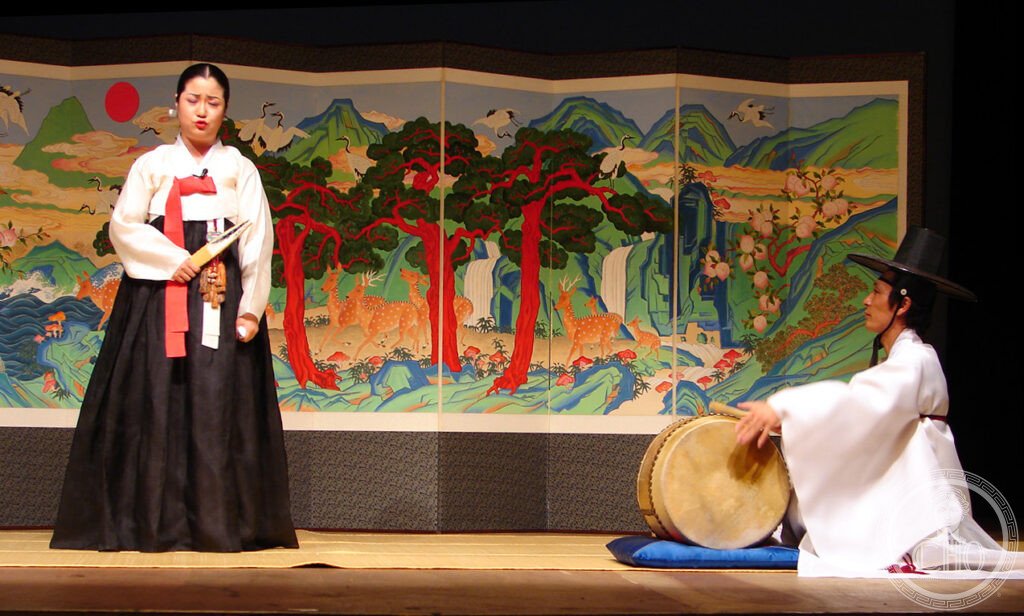
Pansori is a genre of musical storytelling performed by a vocalist and a drummer.This popular tradition, characterized by expressive singing, stylized speech, a repertory of narratives and gesture, embraces both elite and folk culture. During performances lasting up to eight hours, a male or female singer, accompanied by a single barrel drum, improvises on texts that combine rural and erudite literary expressions. The term Pansori is derived from the Korean words pan, meaning “a place where many people gather”, and sori meaning “song”. Pansori originated in south-west Korea in the seventeenth century, probably as a new expression of the narrative songs of shamans. It remained an oral tradition among the common people until the late nineteenth century, by which time it acquired more sophisticated literary content and enjoyed considerable popularity among the urban elite. The settings, characters and situations that make up the Pansori universe are rooted in the Korea of the Joseon period (1392-1910). Pansori singers undergo long and rigorous training to master the wide range of distinct vocal timbres and to memorize the complex repertories. Many virtuosos have developed personal interpretive styles and are renowned for their particular manner of performing specific episodes. Threatened by Korea’s rapid modernization, Pansori was designated a National Intangible Cultural Property in 1964. This measure spurred generous institutional support, which in turn fostered the revival of this tradition. Although Pansori remains one of the most prominent genres among traditional stage arts, it has lost much of its original spontaneous character. Ironically, this recent evolution is a direct result of the preservation process itself, for improvisation is tending to be stifled by the increasing number of written texts. Indeed, few singers nowadays can successfully improvise, and contemporary audiences are less receptive to the impromptu creativity and language of traditional Pansori.
Official description, UNESCO Intangible Cultural Heritage List — Pansori epic chant
At a glance
Pansori is a genre of musical storytelling performed by a vocalist accompanied by a single barrel drummer. Characterized by expressive singing, stylized speech, gesture, and a repertory of narratives, the tradition bridges elite and folk culture. Performances can last up to eight hours, during which the singer—male or female—improvises on texts combining rural and erudite literary expressions.
Origins & history
Pansori originated in south-west Korea in the seventeenth century, likely emerging as a new form of shamanic narrative songs. It remained an oral tradition among common people until the late nineteenth century, when it acquired more sophisticated literary content and gained considerable popularity among the urban elite. In 1964, facing threats from rapid modernization, Pansori was designated a National Intangible Cultural Property, a designation that sparked institutional support and a revival of the tradition.
The practice
Singers undergo long and rigorous training to master the wide range of distinct vocal timbres and memorize complex repertories. Many virtuosos have developed personal interpretive styles and are renowned for their particular manner of performing specific episodes. The singer is accompanied by a drummer playing a barrel drum, with the drummer anchoring the vocalist's line as it shifts in expression and intensity.
Cultural significance
Pansori holds deep meaning for its community as a repository of narrative and vocal artistry. However, the tradition now faces an ironic challenge: preservation efforts have increasingly stifled the improvisation that once defined it. As written texts have multiplied, fewer singers can successfully improvise, and contemporary audiences have become less receptive to the spontaneous creativity and language traditional to Pansori.
Key facts
- Country: Republic of Korea
- Inscribed: 2008
- UNESCO list: Representative List of the Intangible Cultural Heritage of Humanity
- UNESCO reference: 00070
- UNESCO vocabulary: Epic poetry; Story telling; Vocal music
- Map: not shown — UNESCO’s official description of this element names no locality, and a living tradition is practised across a community, not at one address.
Where to experience it
Pansori survives today through Korea's system of designated living national treasures, master performers who continue to teach and train new singers in this demanding art form. Visitors can encounter pansori through performances and workshops supported by South Korean cultural institutions, which have sustained the tradition since its designation as a National Intangible Cultural Property in 1964. Information about specific performances, venues, and master classes can be found through South Korean cultural organizations and UNESCO's intangible heritage documentation, allowing audiences to experience this eight-hour narrative tradition in its contemporary context.
Sources & resources
- UNESCO — official element page: Pansori epic chant
- UNESCO — open data record: Intangible Heritage List, reference 00070
- UNESCO — official video: UNESCO film on this element — embedded on this page
- UNESCO — official photograph: Pansori 1 — Cultural Properties Administration of Korea
- Reference — Wikipedia (secondary): Pansori — consulted as a secondary reference, not as confirmation
- Cultural Heritage Online: Our archive and city guides
Sources
- S1 — Pihl, Marshall R. The Korean Singer's Word: The Story of Chunhyang and the Traditional Art of P'ansori. Harvard University Press, 1994. ISBN 978-0-674-50564-3.
- S2 — Park, Chan E. Voices from the Straw Mat: Toward an Ethnography of Korean Story Singing. University of Hawaii Press, 2003. ISBN 978-0-8248-2511-9.
Spotted an error? Write to editorial@culturalheritageonline.com and we correct it the same day.