
A Yoruba spectacle of masked performance that honors the spiritual power of women—ancestors, deities, and elders—through dance, costume, and ritual celebration.

In UNESCO’s words
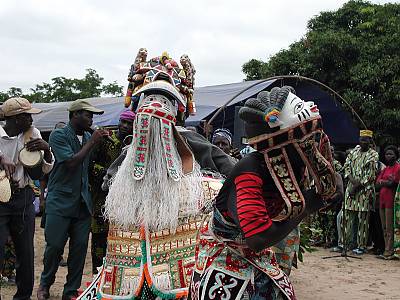
The Gelede is performed by the Yoruba-Nago community that is spread over Benin, Nigeria and Togo. For more than a century, this ceremony has been performed to pay tribute to the primordial mother Iyà Nlà and to the role women play in the process of social organization and development of Yoruba society. The Gelede takes place every year after the harvests, at important events and during drought or epidemics and is characterized by carved masks, dances and chants, sung in the Yoruba language and retracing the history and myths of the Yoruba-Nago people. The ceremony usually takes place at night on a public square and the dancers prepare in a nearby house. The singers and the drummers are the first to appear. They are accompanied by an orchestra and followed by the masked dancers wearing splendid costumes. There is a great deal of preparatory craftwork involved, especially mask carving and costume making. The performances convey an oral heritage that blends epic and lyric verses, which employ a good deal of irony and mockery, supported by satirical masks. Figures of animals are often used, such as the serpent, a symbol of power, or the bird, the messenger of the “mothers”. The community is divided into groups of men and women led by a male and a female head. It is the only known masked society, which is also governed by women. Although the Gelede has nowadays adapted to a more patriarchal society, the oral heritage and dances can be considered as a testimony of the former matriarchal order. Technical development is resulting in a gradual loss of traditional know-how, and tourism is jeopardizing the Gelede by turning it into a folklore product. Nevertheless, the Gelede community shows great awareness of the value of their intangible heritage, which is reflected in the efforts put into the preparation work and in the growing number of participants.
Official description, UNESCO Intangible Cultural Heritage List — Oral heritage of Gelede
At a glance
Gelede is a masked ceremony performed by the Yoruba-Nago community across Benin, Nigeria and Togo. It combines carved masks, dances, and chants sung in the Yoruba language to honour the primordial mother Iyà Nlà and acknowledge women's role in Yoruba social organization and development. The performance takes place at night on a public square, with singers and drummers appearing first, followed by masked dancers in splendid costumes.
Origins & history
Gelede has been performed for more than a century as a tribute to women's place in Yoruba society. The oral heritage conveyed through the ceremony—blending epic and lyric verses—recounts the history and myths of the Yoruba-Nago people. Though the tradition has adapted to a more patriarchal society in recent times, the dances and oral heritage testify to a former matriarchal order.
The practice
Performances require extensive preparatory craftwork, particularly mask carving and costume making. Dancers prepare in a nearby house before the night-time ceremony. Singers and drummers lead, supported by an orchestra, followed by masked dancers. Animal figures appear frequently in masks, such as serpents symbolizing power or birds as messengers of the 'mothers'. The community organizes into groups led by male and female heads, making Gelede the only known masked society governed by women.
Cultural significance
The ceremony affirms women's essential role in social organization and community welfare. Technical development has gradually eroded traditional knowledge, and tourism threatens to reduce Gelede to a folklore product. The community nonetheless demonstrates strong awareness of their intangible heritage's value, evident in continuing preparation efforts and growing participation.
Key facts
- Country: Benin, Nigeria, Togo
- Inscribed: 2008
- UNESCO list: Representative List of the Intangible Cultural Heritage of Humanity
- UNESCO reference: 00002
- UNESCO vocabulary: Costumes; Masks; Oral tradition; Rituals
- Map: not shown — UNESCO’s official description of this element names no locality, and a living tradition is practised across a community, not at one address.
- Related World Heritage site: Osun-Osogbo Sacred Grove (a different UNESCO designation, not the place of the tradition)
Where to experience it
Gelede is performed by Yoruba-Nago communities spread across Benin, Nigeria, and Togo. Performances take place annually after the harvest, at important events, and during times of drought or epidemic, typically at night in a public square. Visitors may encounter the tradition through its distinctive masked dancers, elaborate costumes, and orchestral accompaniment featuring singers and drummers. The ceremony reflects deep community involvement, with preparatory craftwork including mask carving and costume making. Though the practice has adapted to contemporary society, it remains a vital expression of Yoruba-Nago heritage, maintained by communities who recognize its cultural significance.
Sources & resources
- UNESCO — official element page: Oral heritage of Gelede
- UNESCO — open data record: Intangible Heritage List, reference 00002
- UNESCO — official video: UNESCO film on this element — embedded on this page
- UNESCO — official photograph: Photograph of this element — UNESCO/ Yoshihiro Higuchi
- Reference — Wikipedia (secondary): G%E1%BA%B9l%E1%BA%B9d%E1%BA%B9 — consulted as a secondary reference, not as confirmation
- Cultural Heritage Online: Our archive and city guides
Sources
- S1 — Drewal, Henry John, and Margaret Thompson Drewal. Gelede: Art and Female Power Among the Yoruba. Indiana University Press, 1983. ISBN 978-0-253-32569-3.
- S2 — Lawal, Babatunde. The Gèlèdé Spectacle: Art, Gender, and Social Harmony in an African Culture. University of Washington Press, 1996. ISBN 978-0-295-97599-3.
Spotted an error? Write to editorial@culturalheritageonline.com and we correct it the same day.