
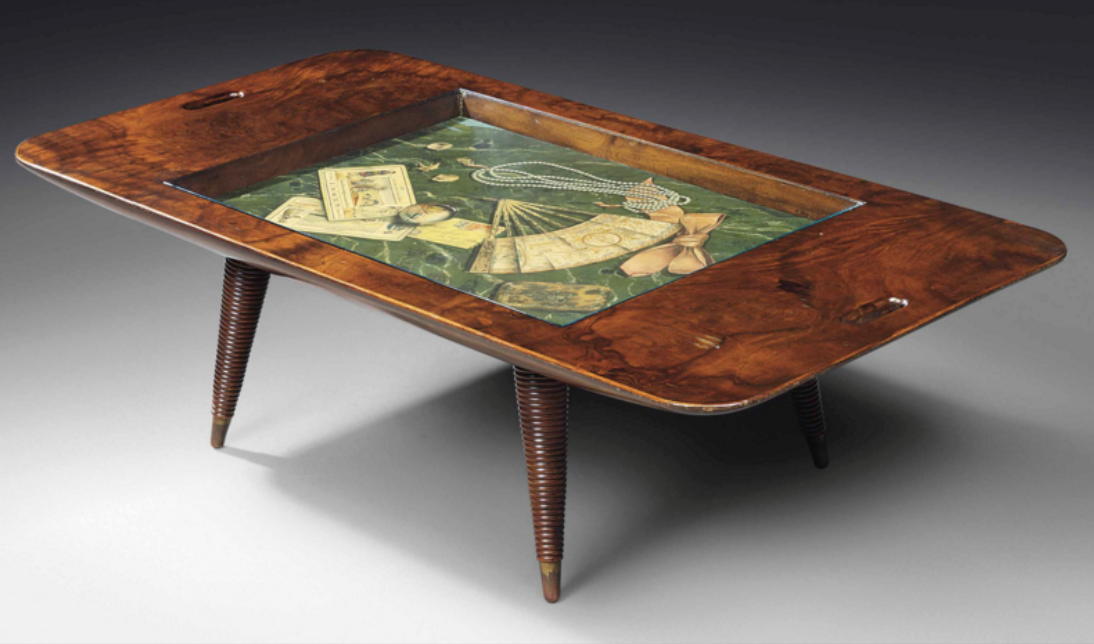
An occasional table from the late 1940s, designed by Gio Ponti with a painted panel by Edina Altara, the work combines walnut and glass with an oil-painted trompe-l’oeil composition on wood.
The table’s distinguishing feature is its painted panel, executed by Altara, which depicts a letter addressed to “Architetto Gio Ponti, via Gaffi 24 Milano (Italia).” The trompe-l’oeil technique creates the illusion of depth and realism, transforming the functional surface into a coded correspondence between the two artists. The work stands as a collaborative gesture in the language of postwar Italian design, where utility and artistic gesture converge.
About the Designers
Gio Ponti (1891–1979) was a dominant figure in twentieth-century Italian architecture and design, working across furniture, interiors, ceramics, and building design. Edina Altara (1898–1983) was a painter and designer active in the Italian cultural sphere, whose work often explored illusionistic and decorative traditions.
Details
- Materials: Walnut, glass, oil paint on panel
- Dimensions: 38 cm high × 136 cm wide × 70 cm deep
- Date: Late 1940s
- Designers: Gio Ponti and Edina Altara
- Location: Designed for Milan
Frequently asked questions
Who designed this table?
Gio Ponti designed the table structure, while Edina Altara painted the trompe-l’oeil panel in oil.
What is depicted on the painted panel?
The panel shows a letter addressed to Architetto Gio Ponti at via Gaffi 24 in Milano, rendered in trompe-l’oeil style to create an illusion of three-dimensional depth.
When was it made?
The table dates to the late 1940s, a period of experimentation and renewal in Italian postwar design.


