
A ring-shaped Maltese bread tradition, ftira brings together leavened dough, local fillings, and regional craft into a dish eaten fresh and shared across generations.
In UNESCO’s words
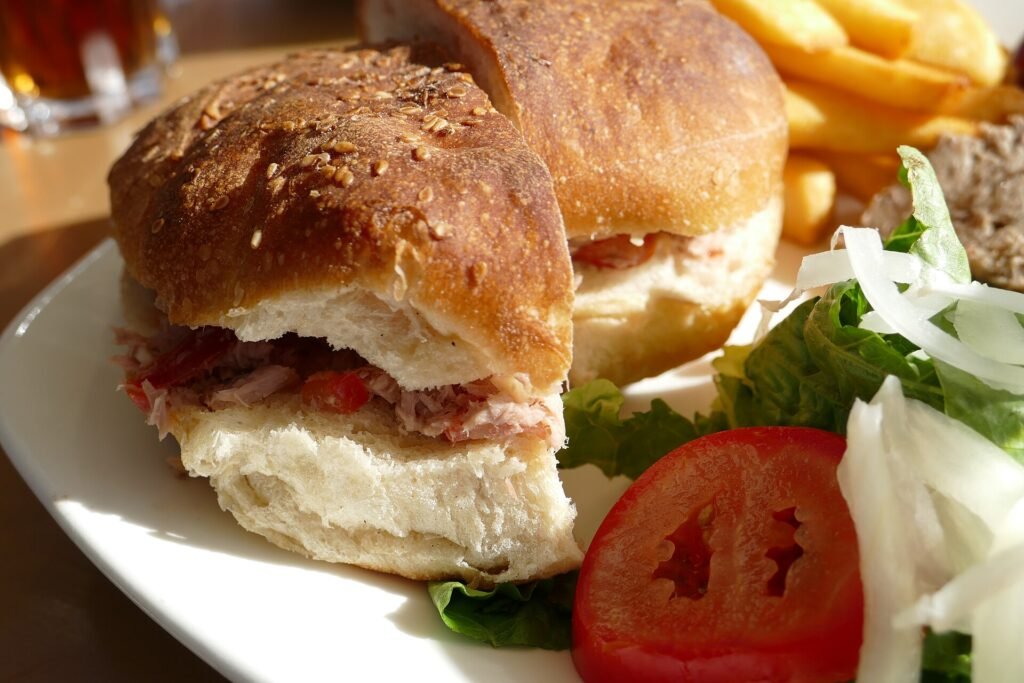
Il-Ftira, culinary art and culture of flattened sourdough bread in Malta, is a key part of the cultural heritage of the inhabitants of the Maltese archipelago. Ftira has a thick crust and light internal texture, characterized by large, irregular holes (an open crumb). It is flatter than other Maltese breads and has a hotter baking temperature. The halved loaf is filled with Mediterranean-type ingredients such as olive oil and tomato, tuna, capers and olives. Seasonal variants and inventive twists can also be added. With a name derived from Arabic (fatir, meaning unleavened bread), ftira culture reflects the continuity of intercultural exchange in Malta’s history. Although other kinds of Maltese bread can be made with a mechanized process, skilled bakers are still needed to shape ftira by hand. In the bakery, apprentices learn by watching and doing, and various training programmes also exist. The skills of choosing compatible ingredients and filling ftira are passed down informally in homes, as well as through other channels such as social media and cooking blogs. Eating ftira as a filled snack or appetiser fosters a shared identity in Malta, bringing people together. A wide variety of people, including marginalized groups, can enter the baking profession as apprentices, and Ftira Days in schools help inform students about healthy eating.
Official description, UNESCO Intangible Cultural Heritage List — Il-Ftira, culinary art and culture of flattened sourdough bread in Malta
At a glance
Il-Ftira is a flattened sourdough bread that forms a key part of Maltese cultural heritage. It has a thick crust and light, open interior marked by large irregular holes. The halved loaf is filled with Mediterranean ingredients such as olive oil, tomato, tuna, capers, and olives, with seasonal variants and creative additions also common. Eating ftira as a filled snack brings people together and fosters shared identity across Malta.
Origins & history
The name ftira derives from the Arabic word fatir, meaning unleavened bread, reflecting Malta's long history of intercultural exchange. This culinary tradition demonstrates the continuity of cultural interaction that has shaped the Maltese archipelago over time.
The practice
Skilled bakers still shape ftira by hand, despite mechanization of other Maltese breads. The dough is baked at a higher temperature than other breads and achieves its characteristic flattened form. In bakeries, apprentices learn through watching and doing, while ingredient selection and filling techniques are passed down informally in homes and through social media and cooking blogs. The baking profession welcomes a wide variety of people, including marginalized groups, as apprentices.
Cultural significance
Ftira culture strengthens community bonds by bringing people together through shared meals. The tradition supports accessible entry into the baking profession for diverse groups. Educational initiatives like Ftira Days in schools help inform students about healthy eating while maintaining knowledge of this cultural practice for future generations.
Key facts
- Country: Malta
- Inscribed: 2020
- UNESCO list: Representative List of the Intangible Cultural Heritage of Humanity
- UNESCO reference: 01580
- UNESCO vocabulary: Bread; Flour; Food preparation
- Map: not shown — UNESCO’s official description of this element names no locality, and a living tradition is practised across a community, not at one address.
Where to experience it
Ftira is made and eaten throughout the Maltese archipelago, from family kitchens and local bakeries to street stalls where it remains a daily staple. The tradition brings together people of all backgrounds—skilled bakers shape loaves by hand while apprentices learn through watching and doing in bakeries. Seasonal variants and inventive fillings reflect each community's preferences, and the filled snack fosters shared identity across Malta. Ftira Days in schools offer visitors insight into the craft and its role in healthy eating, while cooking blogs and social media document both traditional techniques and modern twists on this beloved bread.
Sources & resources
- UNESCO — official element page: Il-Ftira, culinary art and culture of flattened sourdough bread in Malta
- UNESCO — open data record: Intangible Heritage List, reference 01580
- UNESCO — official video: UNESCO film on this element — embedded on this page
- UNESCO — official photograph: Baker adding wood to the wood-fired artisan oven. Wood used is to be in it’s natural state as possible — Kevin Sciberras, 2019
- Reference — Wikipedia (secondary): Ftira — consulted as a secondary reference, not as confirmation
- Cultural Heritage Online: Our archive and city guides

Sources
- S1 — Cassar, Carmel. A Concise History of Malta. Mireva Publications, 2000. ISBN 978-1-870579-52-0.
- S2 — Lanfranco, Guido. L-Istorja tal-Ħobż f'Malta u Għawdex. BDL Publishing, 2003. ISBN 978-99932-17-05-3.
Spotted an error? Write to editorial@culturalheritageonline.com and we correct it the same day.