
In the town of Uniejów and beyond, Polish communities create intricate designs on the ground using flowers and petals, transforming streets into temporary works of art for the sacred Corpus Christi procession.
In UNESCO’s words
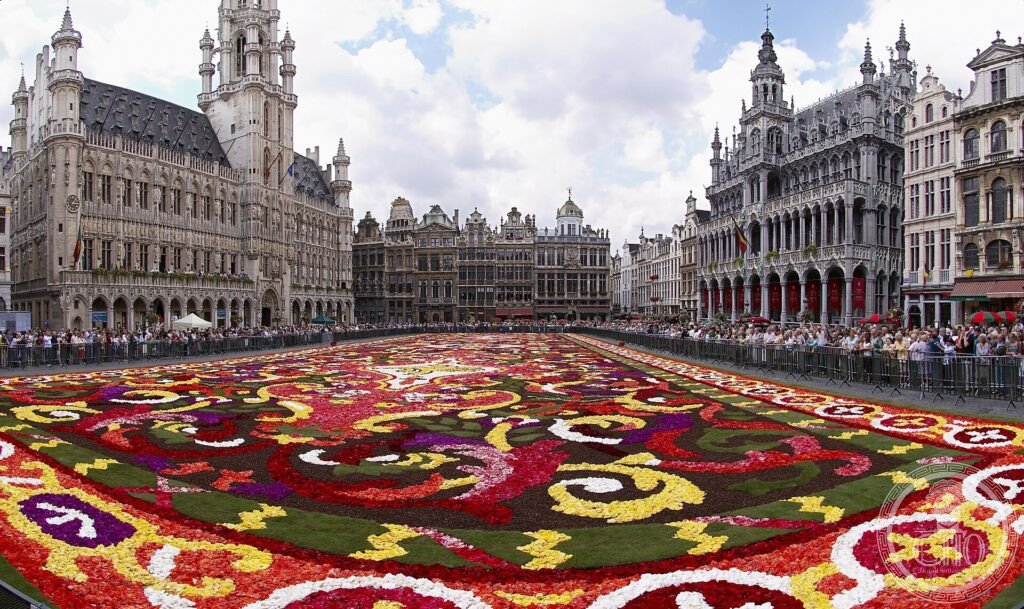
The tradition of arranging flower carpets is inherently linked to the feast of Corpus Christi in Poland. For the feast, which typically involves a mass followed by a joyful procession from the church to the streets, families in several villages use flowers to arrange colourful and symbolic carpets on the route of the procession, usually on the road section in front of their homes. The flower carpets cover the road running from the church through the village and can reach almost two kilometres in length. The flowers used are picked from the surrounding fields or from family gardens. Soil, sand, tree bark and freshly cut grass or calamus leaves may also be used. Families start collecting flowers a few days before the celebration and begin the process of arranging the carpets early on the morning of Corpus Christi. The preparation lasts several hours, and the end result is an ephemeral and collective art piece meant to express religiosity, creativity and an appreciation of the beauty of nature. The tradition unites the entire community and has shaped local identity. The practice has been passed on for generations, especially within families. Pattern-making workshops are also regularly held in schools, with support from the parish and non-governmental organizations.
Official description, UNESCO Intangible Cultural Heritage List — Flower carpets tradition for Corpus Christi processions
At a glance
Flower carpets are colorful arrangements of flowers and other natural materials laid on roads in Polish villages during the Corpus Christi feast. Families create these designs on the processional route, typically in front of their homes, as an expression of faith, creativity, and appreciation for nature's beauty.
Origins & history
The tradition of flower carpets is linked to the Corpus Christi celebration in Poland, where it has been passed down through generations, especially within families. Pattern-making knowledge continues to be shared through workshops held in schools with support from the parish and community organizations.
The practice
Families collect flowers from surrounding fields and gardens in the days before Corpus Christi, beginning to arrange them early on the feast morning. The carpets use fresh flowers along with soil, sand, tree bark, grass, and calamus leaves. The work takes several hours and creates a collective art piece that can stretch almost two kilometers across the road from the church through the village.
Cultural significance
The flower carpets unite the entire community and have shaped local identity over generations. They represent a shared act of religiosity and creativity that strengthens communal bonds. The ephemeral nature of the carpets—designed to be temporary and fade after the procession passes—emphasizes the tradition's spiritual meaning as an offering.
Key facts
- Country: Poland
- Inscribed: 2021
- UNESCO list: Representative List of the Intangible Cultural Heritage of Humanity
- UNESCO reference: 01743
- UNESCO vocabulary: Catholicism; Procession
- Map: not shown — UNESCO’s official description of this element names no locality, and a living tradition is practised across a community, not at one address.
Where to experience it
Several villages across Poland preserve this tradition for the feast of Corpus Christi, typically celebrated in late May or June. On the morning of the feast, families gather to arrange colourful flower carpets along the procession route, transforming the road from church through their communities into ephemeral works of art. Visitors present during Corpus Christi can witness families collecting flowers from surrounding fields and gardens in the days before, then arranging them alongside soil, sand, and fresh grass in intricate patterns that may stretch nearly two kilometres. The procession itself, which begins with mass at the church, allows observers to see these collective creations while experiencing the celebration that has united these communities for generations.
Sources & resources
- UNESCO — official element page: Flower carpets tradition for Corpus Christi processions
- UNESCO — open data record: Intangible Heritage List, reference 01743
- UNESCO — official photograph: Residents of the Spycimierz parish collect flowers that they will use to arrange flower carpets for the Corpus Christi procession — Janusz Tatarkiewicz, Poland, 2018
- Reference — Wikipedia (secondary): Flower carpet — consulted as a secondary reference, not as confirmation
- Cultural Heritage Online: Our archive and city guides

Sources
- S1 — Davies, Norman. Heart of Europe: The Past in Poland's Present. Oxford University Press, 2001. ISBN 978-0-19-280126-5.
- S2 — Zamoyski, Adam. The Polish Way: A Thousand-Year History of the Poles and Their Culture. John Murray, 1987. ISBN 978-0-7195-4674-7.
Spotted an error? Write to editorial@culturalheritageonline.com and we correct it the same day.