
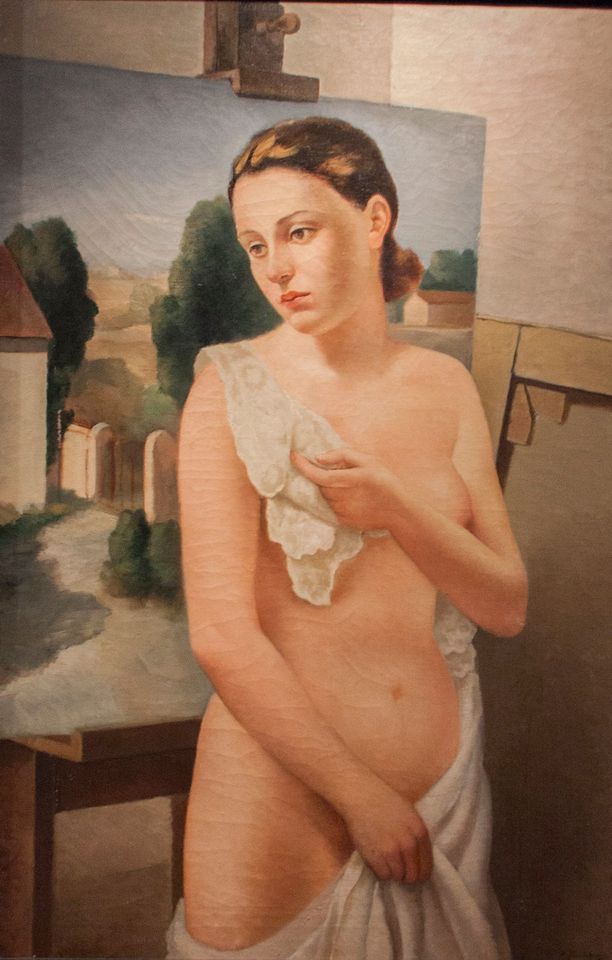
Fanciulla nuda (Nude Girl) is a 1934 painting by Francesco Trombadori, an Italian artist born in Syracuse and active in Rome.
Trombadori developed his artistic practice across several decades of the twentieth century, working primarily in figurative modes. His early career was shaped by divisionist influences and engagement with Rome’s cultural institutions, including the Accademia di Belle Arti and the Roman Secession exhibitions. Following service in the First World War, he pursued portraiture and other figurative subjects that characterised his mature work.
About Francesco Trombadori
Trombadori (1886–1961) was a Sicilian-born painter who moved to Rome in 1907 to study at the Academy of Fine Arts. He exhibited internationally, including at the II International Exhibition of the Roman Secession in 1914, and became known for his innovative approaches to figurative representation. His work bridged early modernist movements with sustained engagement in portraiture and the representation of the human figure.
Details
- Creator: Francesco Trombadori
- Year: 1934
- Medium: Painting
- Subject: Figurative art
On video
Frequently asked questions
Who was Francesco Trombadori?
Francesco Trombadori (1886–1961) was an Italian painter born in Syracuse, Sicily, who studied at the Accademia di Belle Arti in Rome and became known for figurative and portrait work throughout the twentieth century.
What artistic movements influenced Trombadori’s work?
Early in his career, Trombadori was influenced by divisionism and engaged with Rome’s avant-garde circles, including the Roman Secession; he later developed innovative approaches to portraiture and figurative representation.
Where did Trombadori spend most of his career?
After relocating from Sicily to Rome in 1907, Trombadori remained based in Rome, where he studied, exhibited, and produced the majority of his artistic work.
Sources
- S1 — Pontiggia, Elena. Il Novecento Italiano. Abscondita, 2003. ISBN 978-88-8416-048-5.
- S2 — Ciucci, Giorgio. Gli architetti e il fascismo: architettura e città 1922-1944. Einaudi, 2002. ISBN 978-88-06-16310-5.
Spotted an error? Write to editorial@culturalheritageonline.com and we correct it the same day.


