
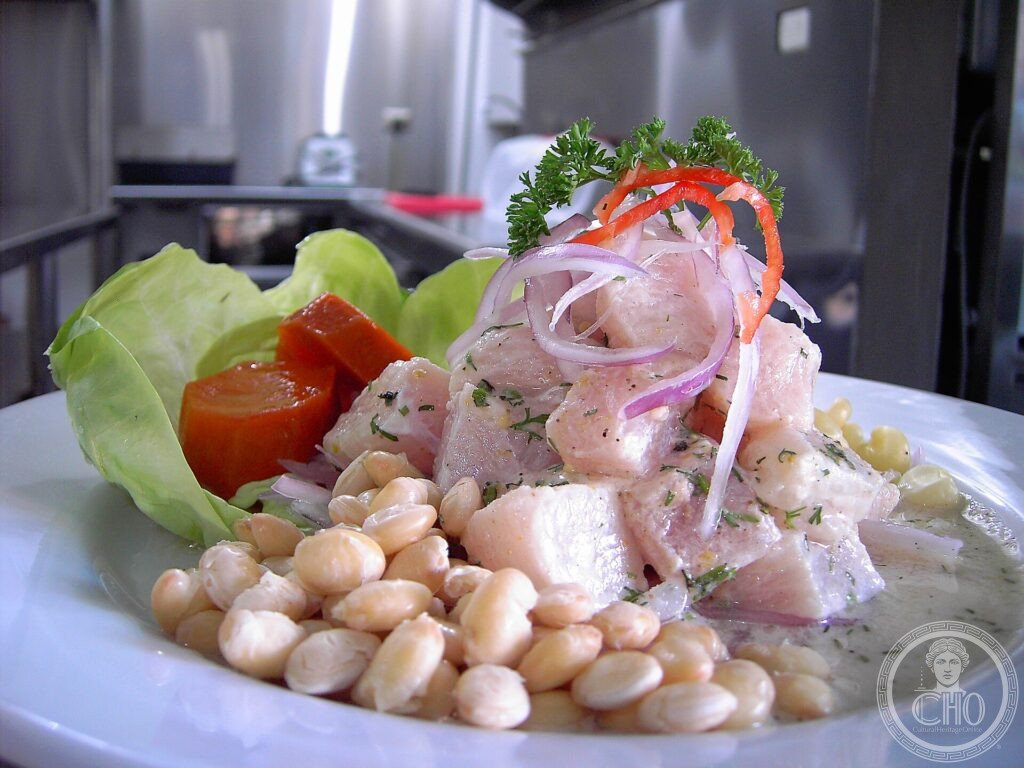
Peru’s national dish, ceviche is a cold preparation of raw fish or shellfish marinated in citrus juice and seasonings, where acid denatures the seafood rather than heat or preservation. The practice embodies centuries of Andean culinary knowledge and the ritual of shared coastal eating.
In UNESCO’s words
Ceviche is a traditional dish in Peru prepared with raw fish marinated in lemon, seasoned with chili pepper and salt and accompanied with locally grown produce. The dish is consumed both on a daily basis and during festivities. It is associated with moments of celebration and social gathering, as well as with ritual celebrations, particularly the festivity of Saint Peter, patron saint of artisanal fishers. Ceviche can be made at home or sold in traditional spaces such as cevicherías, where the work of traditional female cooks stands out. Its preparation and consumption entail specific practices, knowledge and meanings at each stage, from fishing to cultivating the ingredients and preparing the dish. As recipes vary from one region to the next, the dish also strengthens regional cultural identity. The knowledge and techniques are generally transmitted within families. This can be complemented by training programmes, for instance to contribute to the proper management of natural resources. Bearers see a direct correlation between the quality and flavour of the dish and local and sustainable produce. As a result, they have developed community measures for the protection and recovery of traditional ingredients, such as various species of fish.
Official description, UNESCO Intangible Cultural Heritage List — Practices and meanings associated with the preparation and consumption of ceviche, an expression of Peruvian traditional cuisine
At a glance
Ceviche is a traditional Peruvian dish of raw fish marinated in lemon juice, seasoned with chili pepper and salt, and served with locally grown produce. It is eaten daily and during celebrations, appearing at festive gatherings and ritual occasions, particularly the Saint Peter festival honoured by artisanal fishers. The dish is prepared at home or sold in cevicherías, traditional spaces where female cooks play a central role in its making and serving.
Origins & history
Ceviche knowledge and techniques pass through families across generations, with recipes varying by region. Training programmes now complement family transmission, including education on sustainable resource management. The connection between the dish's quality and local, sustainable produce has led communities to develop measures protecting and recovering traditional ingredients, especially fish species.
The practice
Preparation involves specific practices at each stage, from fishing through ingredient cultivation to final assembly. Raw fish is marinated in lemon juice with chili pepper and salt, then accompanied by locally grown produce. The work of traditional female cooks—whether in home kitchens or cevicherías—demonstrates particular knowledge and skill. Regional variations in recipes reflect local ingredients and strengthen distinct cultural identities within Peru.
Cultural significance
Ceviche carries deep meaning for Peruvian communities as an expression of their connection to Pacific heritage and tradition. The dish represents accumulated knowledge about transforming raw ingredients into nourishment. It serves as a marker of celebration and social gathering, and its practice embodies ritual significance tied to community identity. Bearers recognise that maintaining quality depends on protecting local and sustainable produce sources.
Key facts
- Country: Peru
- Inscribed: 2023
- UNESCO list: Representative List of the Intangible Cultural Heritage of Humanity
- UNESCO reference: 01952
- UNESCO vocabulary: Food customs
- Map: not shown — UNESCO’s official description of this element names no locality, and a living tradition is practised across a community, not at one address.
- Related World Heritage site: City of Cuzco, Historic Centre of Lima, Historical Centre of the City of Arequipa, Manú National Park (a different UNESCO designation, not the place of the tradition)
Where to experience it
Ceviche lives in the communities of Peru where it is prepared and shared, from family kitchens to traditional cevicherías run by skilled female cooks. Visitors can taste the dish in these establishments and witness how regional recipes reflect local identity and sustainable fishing practices. The tradition remains strongest in coastal areas, where the festivity of Saint Peter celebrates the artisanal fishers whose catch forms the heart of this beloved preparation. Each region's version carries distinct knowledge passed down through families, connecting the dish to local ingredients and time-honoured techniques.
Sources & resources
- UNESCO — official element page: Practices and meanings associated with the preparation and consumption of ceviche, an expression of Peruvian traditional cuisine
- UNESCO — open data record: Intangible Heritage List, reference 01952
- UNESCO — official photograph: Ceviche is a traditional culinary dish prepared with raw fish marinated in lemon, seasoned with chili pepper and salt and accompanied with local grown produce, which makes possible the existence of a quite large number of ceviche varieties — Antonio Rodríguez Romaní — Ministry of Culture of Peru, 2022
- Reference — Wikipedia (secondary): Ceviche — consulted as a secondary reference, not as confirmation
- Cultural Heritage Online: Our archive and city guides
