
Jockeys compete on camels around circular tracks in a competitive sport that combines traditional horsemanship with modern regulation and technology.
In UNESCO’s words
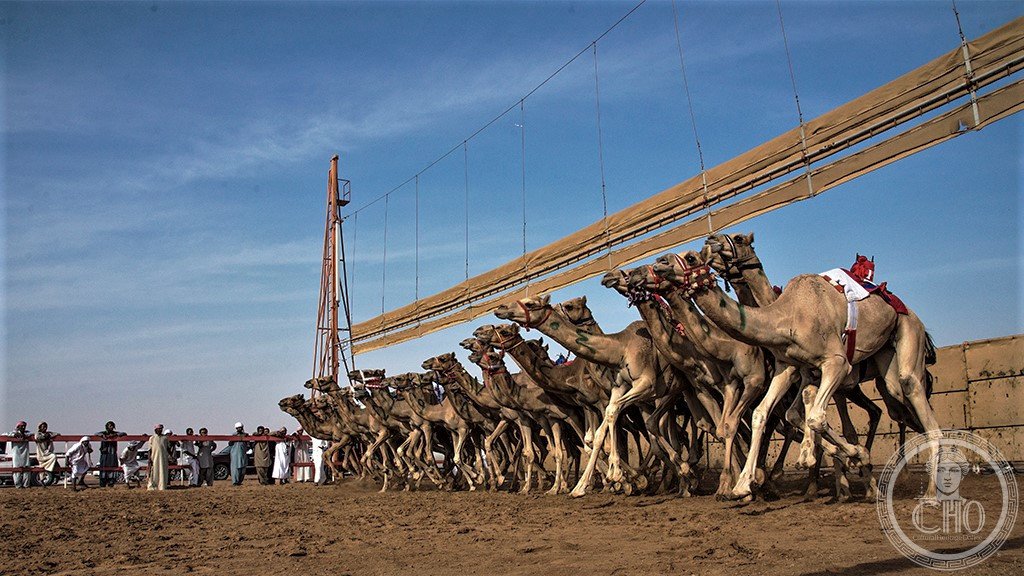
Camel racing, a social practice and festive heritage associated with camels, is a popular social practice in the communities concerned. Preparing the racing camels involves several stages. Camels are selected based on type, origin and age and are given a special diet. They practise on the racetrack in groups and are trained to take part in the races. Camel racing is conducted on specially designed fields under the supervision of specialised community committees. Usually, there are between fifteen and twenty racing camels in each round, and the racing distance is determined based on the camel’s age. There are recognized community traditions, customs and principles governing the races and community practices and a preparation committee verifies the camel’s origin. The related knowledge and skills are transmitted thanks to the combined efforts of community representatives, government institutions, specialized centres and the federation of racing and clubs. Children and young people gradually acquire knowledge and skills related to the practice through observation, simulation and oral expressions. Camel racing is a fundamental part of their nomadic lifestyle and a source of inspiration in poetry and singing. Its importance and continuity in Bedouin society is connected to the prominent role camels play in the desert environment.
Official description, UNESCO Intangible Cultural Heritage List — Camel racing, a social practice and a festive heritage associated with camels
At a glance
Camel racing is a social practice and festive heritage centred on racing camels. It is a popular social activity in the communities that practise it, involving the preparation, training and racing of camels on specially designed fields.
Origins & history
Camel racing emerges from centuries of camel herding and trade across desert regions. The sport formalized as a competitive, spectacle-driven practice in the Gulf states, where it became central to regional festive culture and social gatherings.
The practice
Racing events feature between fifteen and twenty camels per round on specially designed fields. Camels are selected by type, origin and age, given a special diet, and trained in groups on the racetrack. Racing distance varies according to the camel's age. Specialised community committees supervise the races, and a preparation committee verifies each camel's origin. Recognised community traditions and principles govern the practices. Knowledge and skills are transmitted through community representatives, government institutions, specialised centres and racing federations, with children and young people learning through observation, simulation and oral instruction.
Cultural significance
Camel racing is fundamental to the nomadic lifestyle of Bedouin society and serves as a source of inspiration for poetry and singing. Its importance and continuation are connected to the prominent role camels play in the desert environment. Community traditions and customs that govern the practice help sustain this cultural heritage.
Key facts
- Country: United Arab Emirates, Oman
- Inscribed: 2020
- UNESCO list: Representative List of the Intangible Cultural Heritage of Humanity
- UNESCO reference: 01576
- UNESCO vocabulary: Sports competitions
- Map: not shown — UNESCO’s official description of this element names no locality, and a living tradition is practised across a community, not at one address.
- Related World Heritage site: Cultural Sites of Al Ain (Hafit, Hili, Bidaa Bint Saud and Oases Areas) (a different UNESCO designation, not the place of the tradition)
Where to experience it
Camel racing takes place within the communities that practise this heritage across desert regions where nomadic lifestyles remain central. Visitors can witness racing events held on specially designed fields, where between fifteen and twenty camels compete in each round. These races are governed by recognized community traditions and supervised by specialized committees. The preparation of racing camels—their selection, training, and conditioning—unfolds throughout the year, and interested observers may encounter these activities at racing clubs and specialized centres where knowledge and skills are transmitted across generations.
Sources & resources
- UNESCO — official element page: Camel racing, a social practice and a festive heritage associated with camels
- UNESCO — open data record: Intangible Heritage List, reference 01576
- UNESCO — official video: UNESCO film on this element — embedded on this page
- UNESCO — official photograph: Support camel racing practitioners by allocating the necessary space for camel breeding — Mohamed Ahmad El Omda — Ministry of Heritage and Culture, Sultanate of Oman, 2019
- Reference — Wikipedia (secondary): Camel racing — consulted as a secondary reference, not as confirmation
- Cultural Heritage Online: Our archive and city guides

Sources
- S1 — Khalaf, Sulayman. Poetics and Politics of Newly Invented Traditions in the Gulf: Camel Racing in the UAE. Human Organization, 2000. / Heard-Bey, Frauke. From Trucial States to United Arab Emirates. Longman, 1982. ISBN 978-0-582-78032-3.
- S2 — Al-Fahim, Mohammed. From Rags to Riches: A Story of Abu Dhabi. London Centre for Arab Studies, 1995. ISBN 978-1-900404-00-6.
Spotted an error? Write to editorial@culturalheritageonline.com and we correct it the same day.