
For millennia, artisans have shaped molten glass into luminous beads—objects of trade, adornment, and cultural exchange. This ancient craft persists as a living art form, passed through generations of makers across Europe.
In UNESCO’s words
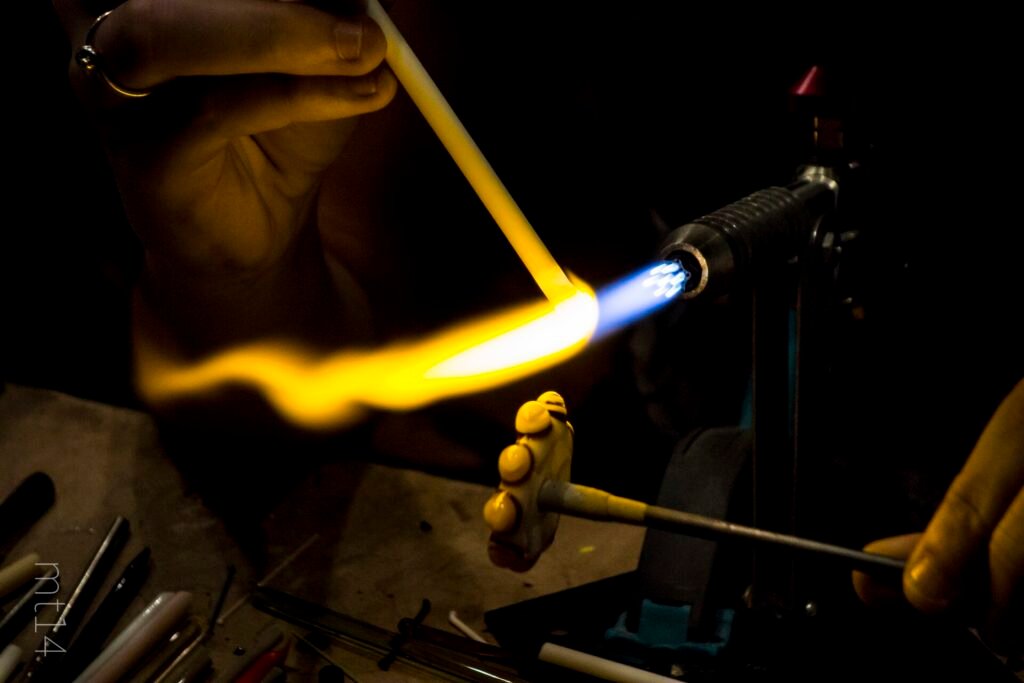
The art of glass beads is closely linked to the wealth of knowledge and mastery of a material (glass) and element (fire). The art covers specific knowledge and shared skills, reflects the use of specific traditional tools and processes, and includes various stages. In Italy, technical knowledge related to the production takes two forms: 1) a lume beads (with a blowtorch) and 2) da canna beads, made by sectioning, softening and polishing a hollow cane. In France, solid beads are made with a torch and the hot glass is rounded through rotation and gravity, or hollow beads are made either on a mandrel or by blowing into a hollow cane. The more complex production of murrines, common in both States, consists of assembling multicoloured glass canes around a core. The beads are then decorated and used in a wide variety of ways. In both States Parties, the practice is mainly transmitted informally in workshops, where apprentices acquire knowledge through observation, experimentation and practice under the supervision of expert craftspeople. Transmission can also occur through formal education in technical establishments. Gifts made with glass beads are used to mark certain events and social occasions, and the practice promotes social cohesion and dexterity in manual and craft work. Bearers and practitioners recognize themselves in a collective identity made up of shared memories and spaces.
Official description, UNESCO Intangible Cultural Heritage List — The art of glass beads
At a glance
Glass bead making is a craft rooted in knowledge of glass and fire. Practitioners in Italy and France use specific traditional tools and processes to create beads through various stages. Italian methods include lume beads made with a blowtorch and da canna beads formed by sectioning and polishing hollow cane. French techniques involve solid beads shaped by torch, heat, rotation and gravity, or hollow beads made on a mandrel or by blowing into cane. Both countries produce murrines—complex beads assembled from multicoloured glass canes around a core. The finished beads are decorated and used in many ways.
Origins & history
The oldest known glass beads date back more than 3,000 years. Egyptian faience beads—clay with a self-forming vitreous coating—represent perhaps the earliest glass-like beads. Around 1,500 BC, in Egypt and Mesopotamia, glass beads became prized decorative items, symbolizing wealth, artistry, and the expanding trade networks of ancient civilizations.
People have been making beads from glass since at least Ancient Roman times. The presence of glass beads in archaeological contexts often signals trade routes and the spread of bead-making technology across distant regions, making them valuable markers of cultural contact and exchange.
The practice
In workshops in Italy and France, apprentices learn through observation, experimentation and practice under expert craftspeople. Knowledge can also be transmitted through formal education in technical establishments. The work involves heating glass with specific tools, shaping it through rotation and gravity, and decorating the beads. After creation, beads are finished through various decorative processes before use.
Cultural significance
Glass bead gifts mark certain events and social occasions, promoting social cohesion within communities. The practice develops manual and craft dexterity among practitioners. Bearers and practitioners share a collective identity formed through shared memories and shared workshop spaces. The tradition connects people across generations through this common heritage.
Key facts
- Country: Italy, France
- Inscribed: 2020
- UNESCO list: Representative List of the Intangible Cultural Heritage of Humanity
- UNESCO reference: 01591
- UNESCO vocabulary: Art glass; Craft workers
- Map: not shown — UNESCO’s official description of this element names no locality, and a living tradition is practised across a community, not at one address.
- Related World Heritage site: Venice and its Lagoon, Paris, Banks of the Seine, Chaîne des Puys – Limagne fault tectonic arena (a different UNESCO designation, not the place of the tradition)
Where to experience it
Glass bead artistry thrives in both Italy and France, where practitioners work in small workshops and studios. In these spaces, visitors can observe craftspeople at work using traditional techniques with torches and mandrels, and some artisans offer demonstrations or workshops for those interested in learning. The practice is transmitted informally through apprenticeship, where knowledge passes from experienced makers to newcomers through observation and hands-on experience. Local craft fairs and heritage centres occasionally showcase this living tradition, connecting visitors with active practitioners and the shared identity that binds the glass bead-making community together.
Sources & resources
- UNESCO — official element page: The art of glass beads
- UNESCO — open data record: Intangible Heritage List, reference 01591
- UNESCO — official video: UNESCO film on this element — embedded on this page
- UNESCO — official photograph: Photograph of this element — Claudia Cottica/CPVV, 2018
- Reference — Wikipedia (secondary): Glass bead making — consulted as a secondary reference, not as confirmation
- Cultural Heritage Online: Our archive and city guides

Sources
- S1 — Sarpellon, Giovanni. Miniature di vetro: Murrine 1838-1924. Arsenale Editrice, 1990. ISBN 978-88-7743-081-6.
- S2 — Howard, Deborah. The Architectural History of Venice. Yale University Press, 2002. ISBN 978-0-300-09029-1.
Spotted an error? Write to editorial@culturalheritageonline.com and we correct it the same day.