
A Sundanese bamboo instrument played in ensembles where each performer sounds a single pitch to create melody through collective timing and coordination.
In UNESCO’s words
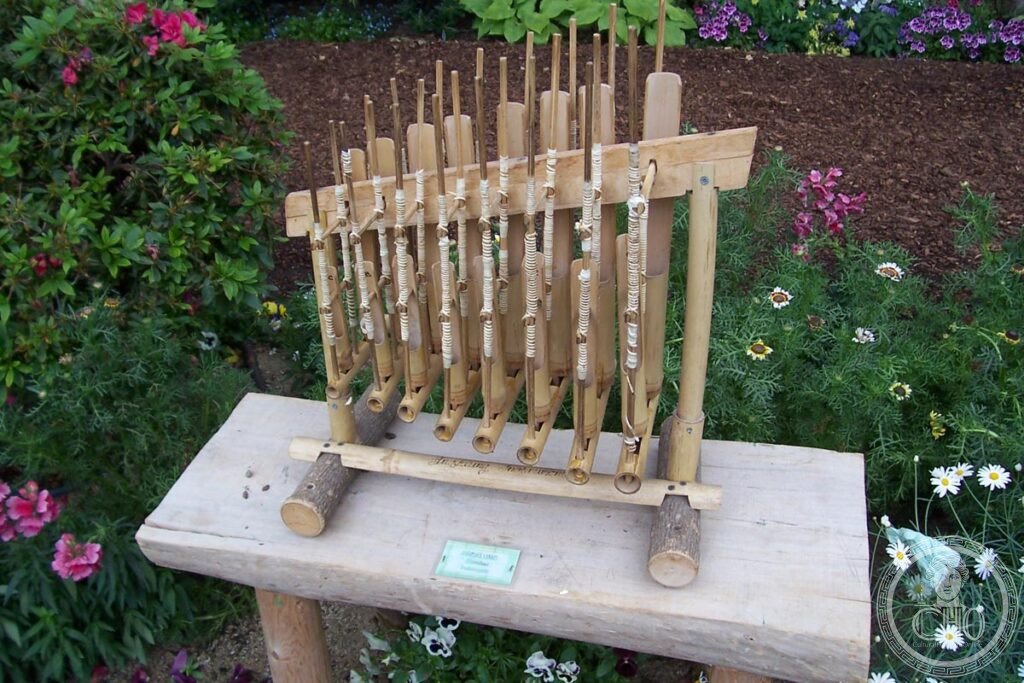
Angklung is an Indonesian musical instrument consisting of two to four bamboo tubes suspended in a bamboo frame, bound with rattan cords. The tubes are carefully whittled and cut by a master craftsperson to produce certain notes when the bamboo frame is shaken or tapped. Each Angklung produces a single note or chord, so several players must collaborate in order to play melodies. Traditional Angklungs use the pentatonic scale, but in 1938 musician Daeng Soetigna introduced Angklungs using the diatonic scale; these are known as ''angklung padaeng.'' The Angklung is closely related to traditional customs, arts and cultural identity in Indonesia, played during ceremonies such as rice planting, harvest and circumcision. The special black bamboo for the Angklung is harvested during the two weeks a year when the cicadas sing, and is cut at least three segments above the ground, to ensure the root continues to propagate. Angklung education is transmitted orally from generation to generation, and increasingly in educational institutions. Because of the collaborative nature of Angklung music, playing promotes cooperation and mutual respect among the players, along with discipline, responsibility, concentration, development of imagination and memory, as well as artistic and musical feelings.
Official description, UNESCO Intangible Cultural Heritage List — Indonesian Angklung
At a glance
Angklung is an Indonesian percussion instrument made from bamboo tubes suspended in a bamboo frame and bound with rattan cords. A master craftsperson carefully whittles and cuts the tubes to produce specific notes when the frame is shaken or tapped. Since each angklung produces only a single note or chord, multiple players must work together to perform melodies. Traditional angklungs use the pentatonic scale, while a modern variation introduced in 1938 uses the diatonic scale.
Origins & history
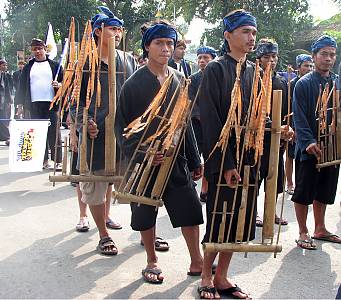
Angklung is deeply woven into Indonesian traditional customs and cultural identity, played during ceremonies marking rice planting, harvest, and circumcision. Knowledge of the instrument has been passed orally from generation to generation, and is now also taught in educational institutions. In 1938, musician Daeng Soetigna created a new form called angklung padaeng, which uses the diatonic scale rather than the traditional pentatonic tuning.
The practice
The black bamboo used for angklung is harvested during the two weeks each year when cicadas sing, then cut at least three segments above the ground to allow the roots to continue growing. A master craftsperson whittles and cuts the tubes to precise dimensions. In performance, players hold the bamboo frame and shake or tap it to produce their assigned note or chord, coordinating their strikes with other performers to create complete melodies.
Cultural significance
Playing angklung promotes cooperation, mutual respect, discipline, responsibility, concentration, imagination, memory, and artistic and musical feeling among performers. The collaborative nature of the music—where each player contributes a single note to a shared melody—embodies the community's values and strengthens social bonds. The tradition's survival depends on continued transmission through oral teaching and educational programs.
Key facts
- Country: Indonesia
- Inscribed: 2010
- UNESCO list: Representative List of the Intangible Cultural Heritage of Humanity
- UNESCO reference: 00393
- UNESCO vocabulary: Idiophones; Instrumental music
- Map: not shown — UNESCO’s official description of this element names no locality, and a living tradition is practised across a community, not at one address.
Where to experience it
Angklung remains a living tradition within Indonesian communities, particularly among the Sundanese people. The instrument is played during ceremonies such as rice planting, harvest, and circumcision celebrations, where its collaborative nature brings people together. Visitors can encounter angklung performances at cultural festivals and educational institutions throughout Indonesia, where the tradition continues to be transmitted orally from generation to generation. Local cultural organizations and community centers often host demonstrations where craftspeople showcase the careful art of creating these bamboo instruments and musicians perform traditional and modern compositions together.
Sources & resources
- UNESCO — official element page: Indonesian Angklung
- UNESCO — open data record: Intangible Heritage List, reference 00393
- UNESCO — official photograph: Photograph of this element — Gaura Mancacaritadipura — 2009 by Centre for Research and Development of Culture, Indonesia
- Reference — Wikipedia (secondary): Angklung — consulted as a secondary reference, not as confirmation
- Cultural Heritage Online: Our archive and city guides
Sources
- S1 — Kunst, Jaap. Music in Java: Its History, Its Theory and Its Technique. Martinus Nijhoff, 1973. ISBN 978-94-011-9285-9.
- S2 — Kartomi, Margaret J. On Concepts and Classifications of Musical Instruments. University of Chicago Press, 1990. ISBN 978-0-226-42571-9.
Spotted an error? Write to editorial@culturalheritageonline.com and we correct it the same day.