
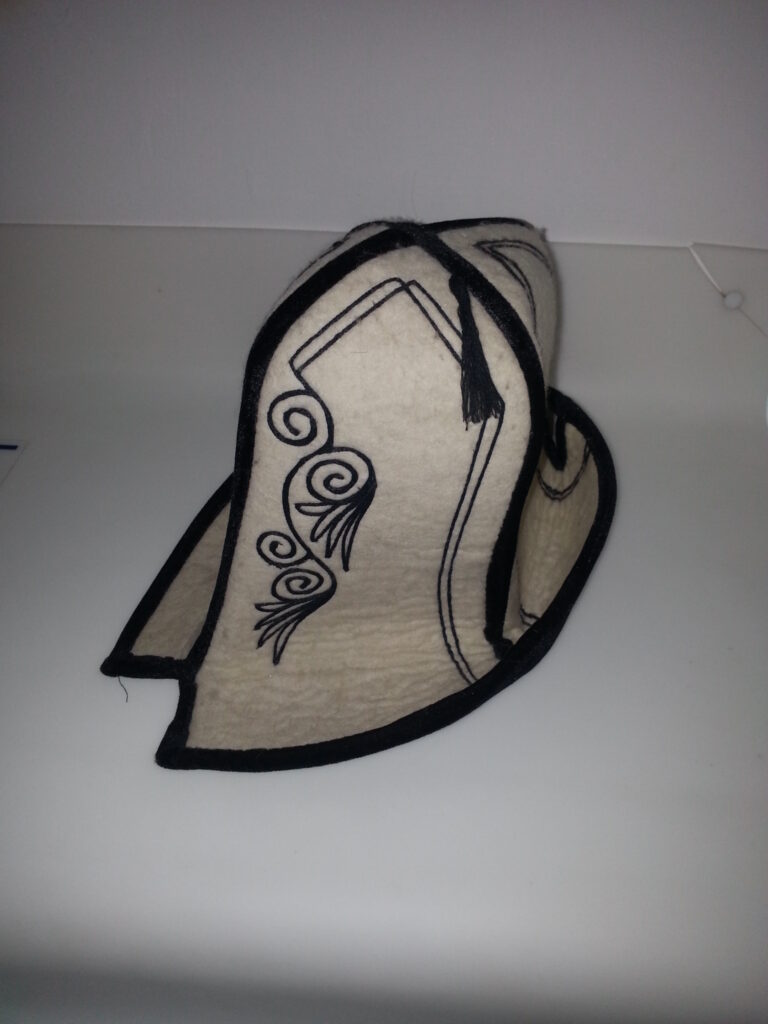
The ak-kalpak is a high-crowned felt or sheepskin cap worn by men throughout Kyrgyzstan and Central Asia, made and adapted by hand for protection against extremes of climate.
In UNESCO’s words
Ak-kalpak craftsmanship is a traditional Kyrgyz handicraft. The Ak-kalpak is a traditional male hat made with white felt, which bears deep sacral meanings. Ak-kalpak craftsmanship is a cumulative, ever-evolving body of knowledge and skills passed down by craftswomen in the communities concerned comprising felting, cutting and sewing and pattern embroidery. Related knowledge and skills are transmitted via oral coaching, hands-on training and joint making in workshops. More than eighty kinds of Ak-kalpak can be distinguished, decorated with various patterns bearing a sacred meaning and history. Environmentally friendly and comfortable, the Ak-kalpak resembles a snow peak, with four sides representing the four elements: air, water, fire and earth. The four edging lines symbolize life, with the tassels on the top symbolizing ancestors’ posterity and memory, and the pattern symbolizing the family tree. Ak-kalpak unites different Kyrgyz tribes and communities and makes Kyrgyz people recognizable to other ethnic groups. It also fosters inclusivity when representatives of other ethnic groups wear it on holidays or days of mourning to express unity and sympathy. There are workshops all over the country where related knowledge and skills are passed down, and in 2013 a project entitled ‘From generation to generation’ was conducted on traditional Ak-kalpak-making techniques nationwide, resulting in an exhibition and published book.
Official description, UNESCO Intangible Cultural Heritage List — Ak-kalpak craftsmanship, traditional knowledge and skills in making and wearing Kyrgyz men’s headwear
At a glance
The ak-kalpak is a traditional Kyrgyz male hat made from white felt that holds deep sacred meanings. Its shape resembles a snow peak with four sides representing the four elements: air, water, fire and earth. The four edging lines symbolize life, while tassels on top represent ancestors' posterity and memory. Various patterns on the hat carry sacred meaning and tell family history. More than eighty kinds of ak-kalpak can be distinguished, each with different decorative patterns.
Origins & history
The kalpak is a Turkic form of headwear long established across Central Asia and the Caucasus. Its design reflects the needs of pastoral and mountain communities where temperature swings are sharp and protection from both cold and intense sun is essential to daily survival.
The practice
Craftswomen create the ak-kalpak through felting, cutting, sewing and pattern embroidery. Knowledge and skills are transmitted via oral coaching, hands-on training and joint making sessions in workshops located throughout the country. The craft represents a cumulative, ever-evolving body of knowledge that combines technical skill with understanding of the hat's symbolic elements and their meanings.
Cultural significance
The ak-kalpak unites different Kyrgyz tribes and communities, making Kyrgyz people recognizable to other ethnic groups. It fosters inclusivity when representatives of other ethnic groups wear it on holidays or days of mourning to express unity and sympathy. The hat embodies family identity and connection to ancestral memory, serving as a symbol of belonging and cultural continuity within Kyrgyz society.
Key facts
- Country: Kyrgyzstan
- Inscribed: 2019
- UNESCO list: Representative List of the Intangible Cultural Heritage of Humanity
- UNESCO reference: 01496
- UNESCO vocabulary: Handicrafts; Hats
- Map: not shown — UNESCO’s official description of this element names no locality, and a living tradition is practised across a community, not at one address.
Where to experience it
Ak-kalpak craftsmanship thrives in Kyrgyz communities across the country, where workshops dedicated to the craft continue to transmit traditional knowledge and skills from generation to generation. Visitors can observe the felting, cutting, sewing and embroidery techniques that create these iconic white felt hats, each bearing sacred patterns unique to different Kyrgyz tribes. The 2013 nationwide project 'From generation to generation' resulted in an exhibition and published book documenting traditional Ak-kalpak-making techniques, offering further insight into this living heritage that unites Kyrgyz people and remains central to their cultural identity.
Sources & resources
- UNESCO — official element page: Ak-kalpak craftsmanship, traditional knowledge and skills in making and wearing Kyrgyz men’s headwear
- UNESCO — open data record: Intangible Heritage List, reference 01496
- UNESCO — official video: UNESCO film on this element — embedded on this page
- UNESCO — official photograph: Old men in Kyrgyz traditional headwear Ak-kalpak giving a bless at the holiday; Ak-kalpak symbolizes patriotic unity, especially in days of celebrations and ritual events — Public Foundation 'Min Kiyal', Kyrgyzstan, 2018
- Reference — Wikipedia (secondary): Kalpak — consulted as a secondary reference, not as confirmation
- Cultural Heritage Online: Our archive and city guides
