

Curated Itinerary
Milan Liberty: A Walking Tour from Porta Venezia
Six Liberty buildings between Corso Venezia, Via Senato and Via Malpighi, from Sommaruga’s Palazzo Castiglioni to the polychrome façades of Casa Galimberti and Casa Guazzoni.
Take this route into Google Maps
From Palazzo Castiglioni to Casa Guazzoni, in the order we curated them.
➤ Turn on the navigator in Google MapsIt opens in the Google Maps app with every stop already loaded, in the order we put them in. From there the route is yours: pick how you travel — on foot, by bike, by public transport or by car — change where you start and where you end, drag the stops into a different order, and add places of your own along the way.
Milan’s Liberty is not monumental. It appears on the fronts of apartment buildings, in the ironwork of a doorway, in the ceramic tiles that cover a whole façade. The six buildings of this walk stand within a kilometre and a half of each other, in the streets between Corso Venezia and Porta Venezia.
What you see
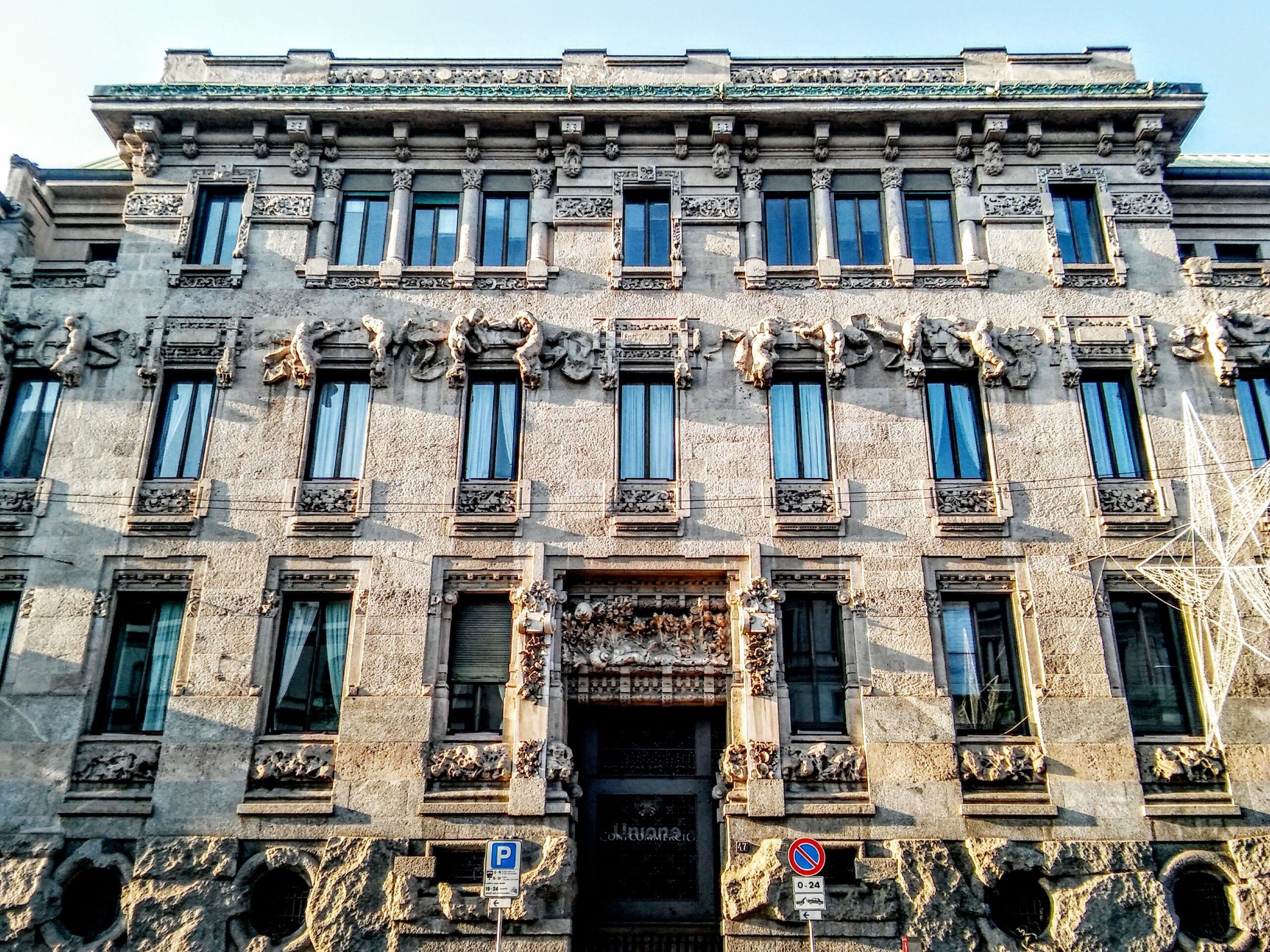
The walk opens with Palazzo Castiglioni (Giuseppe Sommaruga, 1901–1903) on Corso Venezia, where the new style first took a whole building and argued with the academy. Casa Tosi, also called Palazzo Baratti (Alfredo Campanini, 1909), stands in Via Senato with its neo-Rococo borrowings; in Via Mozart the first Casa Berri-Meregalli (Giulio Ulisse Arata, from 1911) mixes Liberty, eclecticism and early Deco in rough stone and brick.
The last two make the pair on Via Malpighi: Casa Galimberti (1903–1905), by Giovanni Battista Bossi, with a façade sheathed entirely in painted ceramic tiles, and Casa Guazzoni (1903–1906), the corner palazzina where Bossi added Alessandro Mazzucotelli’s wrought-iron balconies and Paolo Sala’s frescoes.
How to do it
On foot, six stops, 3.4 kilometres measured on the streets, about three hours including the time to look. The route is flat and stays inside the block between Corso Venezia, Via Senato and Via Malpighi. Under the map you find the track and the points to download for a phone navigator.
When to go
Weekday mornings, when the pavements are quiet. The façades face the street, so the light matters less than the crowds.
Read the article
The magazine has a longer piece on this walk, with a photograph of each building and the history behind it: Milan’s Liberty, six buildings on foot.
Step by step

Palazzo Castiglioni
Giuseppe Sommaruga’s Palazzo Castiglioni on Corso Venezia is the moment Milan’s Liberty grammar found its public face — sculptural mass, polychrome surfaces…

Casa Tosi (Palazzo Baratti), Milan
Casa Tosi, also known as Palazzo Baratti (Alfredo Campanini, 1909), in Via Senato is a Liberty palace shot through with neo-Rococo borrowed from the Milanese Baroque.

Casa Berri-Meregalli (Via Mozart), Milan
The first Casa Berri-Meregalli in Via Mozart (Giulio Ulisse Arata, from 1911) mixes Liberty, eclecticism and early Deco in rough stone, brick and fresco.

Casa Campanini
The building Alfredo Campanini designed for himself stands on Via Vincenzo Bellini 11 as one of the most assured statements of Milanese Liberty, completed…

Casa Galimberti
A residential building on Via Malpighi whose entire facade is sheathed in painted ceramic tiles, Casa Galimberti remains one of the most vivid expressions of…

Casa Guazzoni
Giovanni Battista Bossi’s corner palazzina on Via Malpighi is one of Milan’s most complete Liberty statements, where Alessandro Mazzucotelli’s wrought iron…
Download for tour navigation
PDF is the stop list with GPS, to print or keep on the phone. GPX for Garmin / Komoot / OsmAnd. KML for Google Earth and Maps.
Walk it with the navigator on
It opens in the Google Maps app with every stop already loaded, in the order we put them in. From there the route is yours: pick how you travel — on foot, by bike, by public transport or by car — change where you start and where you end, drag the stops into a different order, and add places of your own along the way.
To keep the route in the app instead of opening it once, download the KML above and import it into Google My Maps — Create a new map, then Import: the route then sits among your own maps in Google Maps, with the stops and our notes attached to each one.