
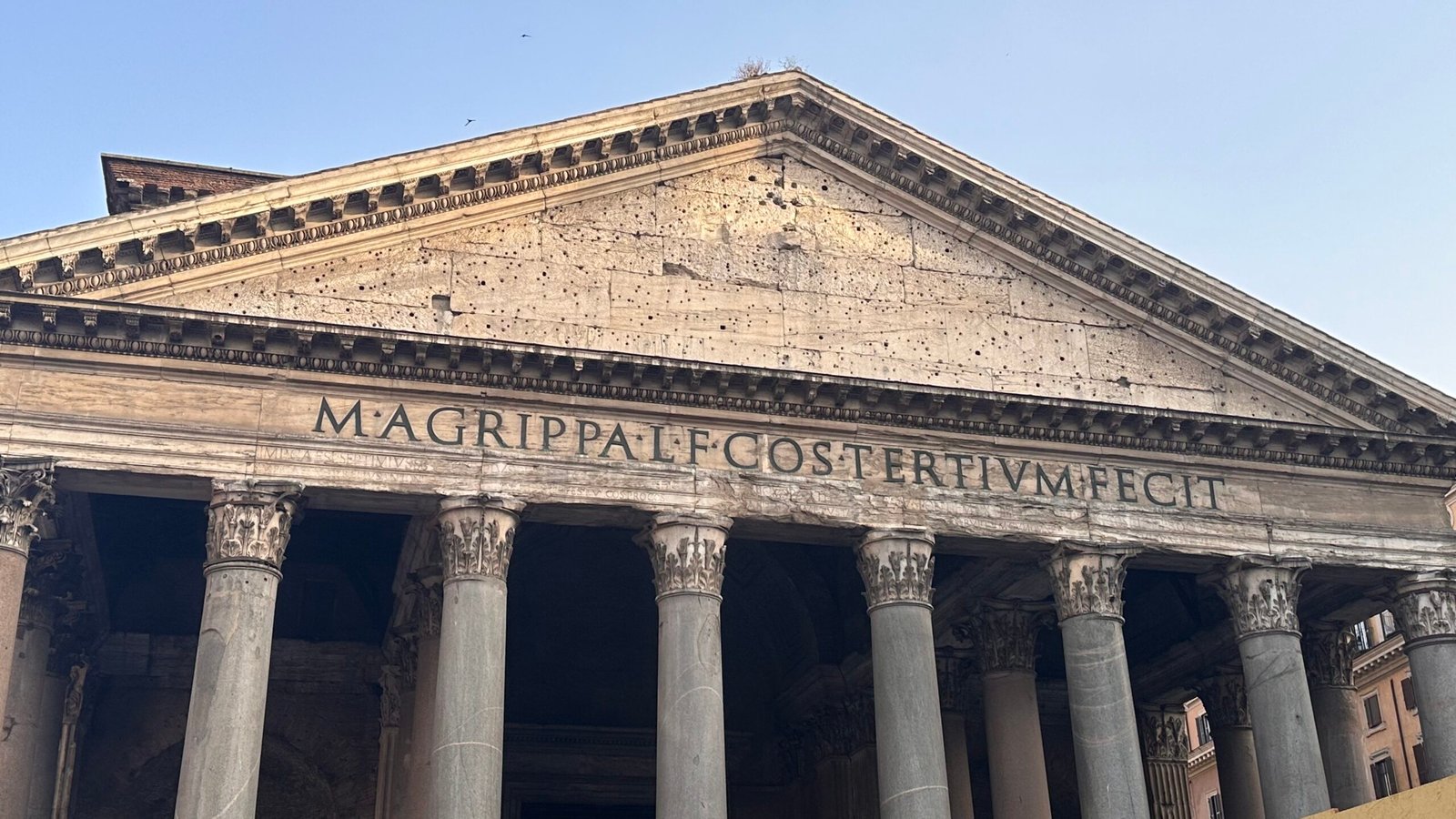
For nineteen centuries the Pantheon has held the widest unreinforced concrete dome ever built, lit by a single round opening onto the sky.
At a glance
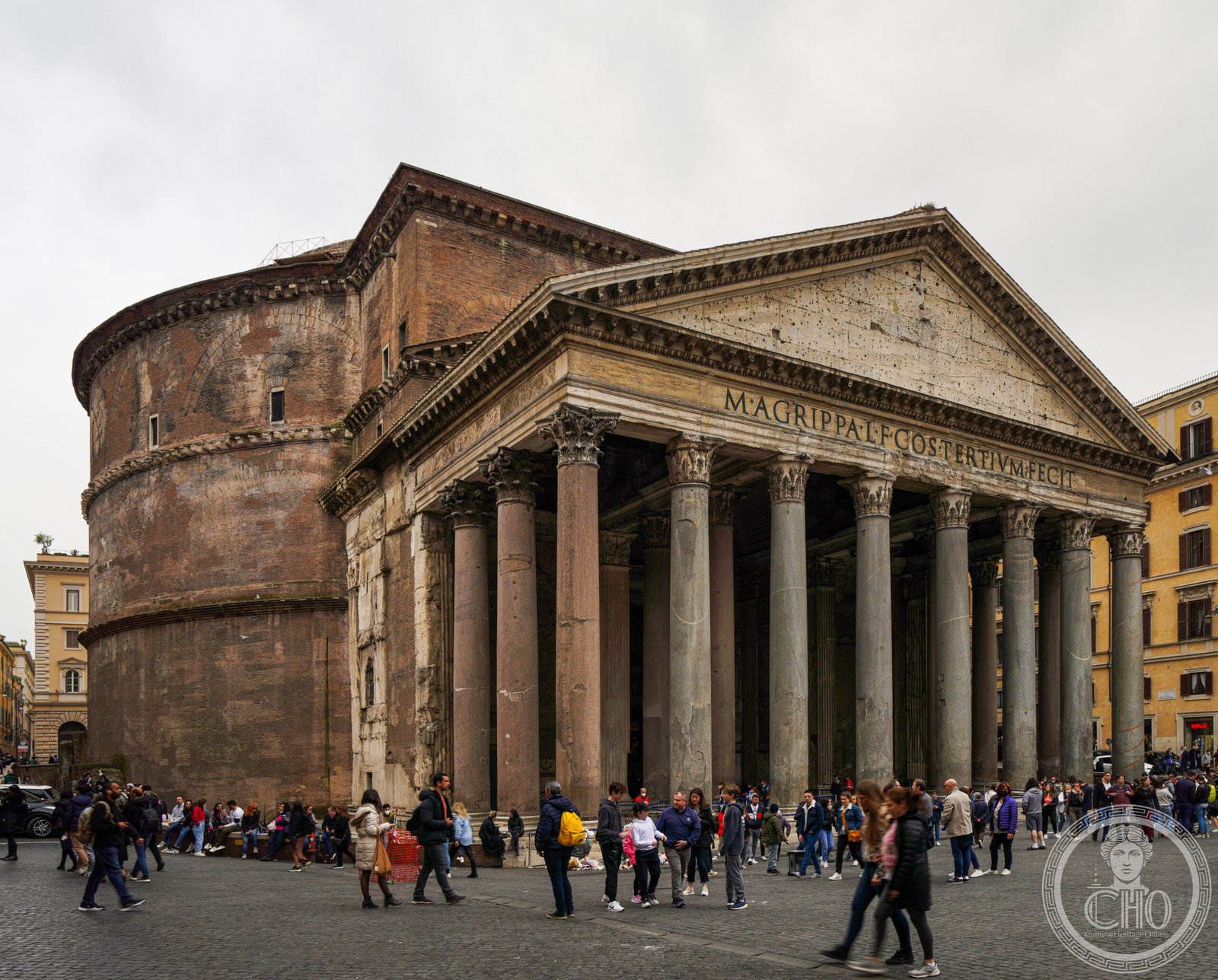
The Pantheon stands on Piazza della Rotonda in the heart of Rome, a temple to all the gods turned Christian church. The portico carries the name of Marcus Agrippa; the domed rotunda behind it is the work of the emperor Hadrian. Few ancient buildings have survived so complete, and none has been copied so often.
History
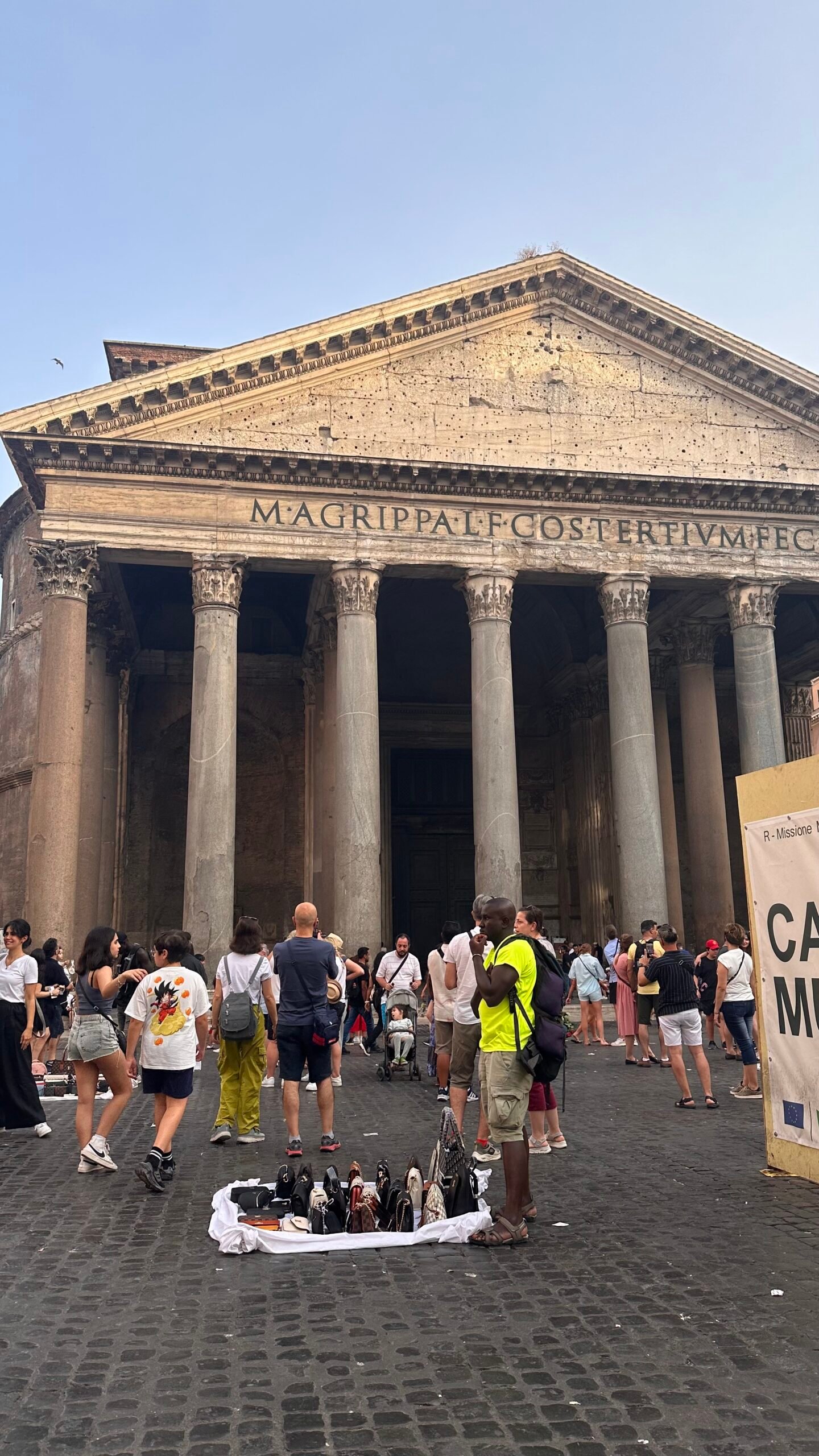
Marcus Agrippa, son-in-law of Augustus, built the first Pantheon around 27–25 BC. Fire destroyed it, and the emperor Hadrian rebuilt it between about 118 and 125 AD. Hadrian kept Agrippa’s name on the frieze — M·AGRIPPA·L·F·COS·TERTIVM·FECIT, “Marcus Agrippa, son of Lucius, consul for the third time, built this” — which for centuries hid the true builder.
In 609 AD Pope Boniface IV consecrated the temple as the church of Santa Maria ad Martyres. That act saved it: while other pagan monuments were quarried for stone, the Pantheon stayed in continuous use. It later became a burial place for the painter Raphael, who died in 1520, and for the first two kings of a united Italy, Vittorio Emanuele II and Umberto I.
What you see
The portico rests on sixteen Corinthian columns of Egyptian granite, each a single shaft. Step through the bronze doors and the building changes character entirely. The rotunda is a perfect geometric idea made solid: the internal diameter, 43.3 metres, exactly equals the height to the top of the dome, so a sphere would fit inside it.
The dome is coffered concrete, thinning and lightening toward the crown. At its centre the oculus, nearly nine metres across, stands open to the weather — rain falls straight to the floor, where drains carry it away, and a shaft of sun tracks the walls through the day. It is the only source of light, and it is enough.
Key facts
- Location: Piazza della Rotonda, Rome, Lazio, Italy
- Built: original by Agrippa c. 27–25 BC; rebuilt under Hadrian c. 118–125 AD
- Dome: unreinforced concrete, 43.3 m internal diameter (equal to its height); still the largest of its kind
- Oculus: circular opening about 9 m across, open to the sky
- Church since: 609 AD, as Santa Maria ad Martyres
- Tombs: Raphael; kings Vittorio Emanuele II and Umberto I
Practical information
- An entry ticket is required (introduced in 2023); reduced or free access on some days
- Allow 30–45 minutes
- Modest dress is expected, as it is an active church
- Early morning is the quietest time
Getting there
The Pantheon sits in the historic centre, a short walk from Piazza Navona and Largo di Torre Argentina. The nearest Metro stops are Barberini and Spagna (Line A), each about a 15-minute walk; many bus routes stop at Largo Argentina. The centre is best explored on foot.
Gallery
The Pantheon, photographed by Luigi De Marchi.
See the place
Sources
- Turismo Roma — official tourism of Roma Capitale (turismoroma.it)
- UNESCO World Heritage: Historic Centre of Rome (whc.unesco.org/en/list/91)
Gallery
Find it on the map
See this place and what’s around it →Historical events at this place (1)
📷 Become a Cultural Heritage Online photographer
Share your photos of places: they stay published under your name as the author. The more they're seen, the more you get noticed — and soon a contest will reward the most appreciated photos.
Log in or sign up free to add a photoIs this page about you?
This page is read by travellers and heritage enthusiasts who find it on Google. Tell us how you are connected to this place and we will take it from there.