

The Tokyo National Research Institute for Cultural Properties studies how cultural property is made, how it decays and how it is repaired, from pigments and lacquer to buildings, performing arts and intangible heritage.
At a glance
The institute, known as TOBUNKEN, occupies a quiet corner of Ueno Park in Taitō ward, among the museums at the park's northern end. It belongs to the National Institutes for Cultural Heritage and works on conservation science and restoration techniques. Its office building is recent, completed in 2000; the institute itself goes back to 1930, when it was set up with money left by the painter Kuroda Seiki. It also looks after the Kuroda Memorial Hall, the 1928 gallery in the same park that holds his paintings.
Key facts
- Address: 13-43 Ueno Park, Taitō-ku, Tokyo 110-8713
- Founded in 1930 as the Institute of Art Research, with Kuroda Seiki's bequest
- Office building completed in 2000, opened with a ceremony on 11 May
- One of the research institutes of the National Institutes for Cultural Heritage
- Runs the Kuroda Memorial Hall of 1928, free to enter, in the same park
- Seven minutes on foot from the south exit of JR Uguisudani
History
The institute began in 1930 as the Institute of Art Research, attached to the Imperial Academy of Fine Arts and paid for out of the bequest of the painter Kuroda Seiki. It passed to the National Museum in 1947 and to the Cultural Properties Protection Committee in 1950. In 1952 it was reorganised as the Tokyo National Research Institute of Cultural Properties, with departments of fine arts, performing arts and conservation science.
A department of restoration techniques followed in 1973 and one of archives in 1974. From 2001 the institute worked as a branch of an independent administrative institution, and in April 2007 it became part of the National Institutes for Cultural Heritage. Its departments were reordered in 2006, 2011 and 2016, when the centre for conservation science took its present name.
The present office building was finished on 4 February 2000 in the twelfth year of Heisei. The opening ceremony on 11 May 2000 fixed the institute's anniversary. The building holds laboratories, including a vacuum freeze dryer for waterlogged and fire-damaged material, and works with the Cultural Heritage Disaster Risk Management Center as its core for eastern Japan. After the Noto Peninsula earthquake of 1 January 2024 the staff there treated objects recovered from the damage.
The Kuroda Memorial Hall, finished in 1928, is the institute's other address in the park. Kuroda Seiki, often called the father of modern Western-style painting in Japan, left part of his estate for the encouragement of art when he died in 1924. The hall was built with that money and holds his work.
What you see
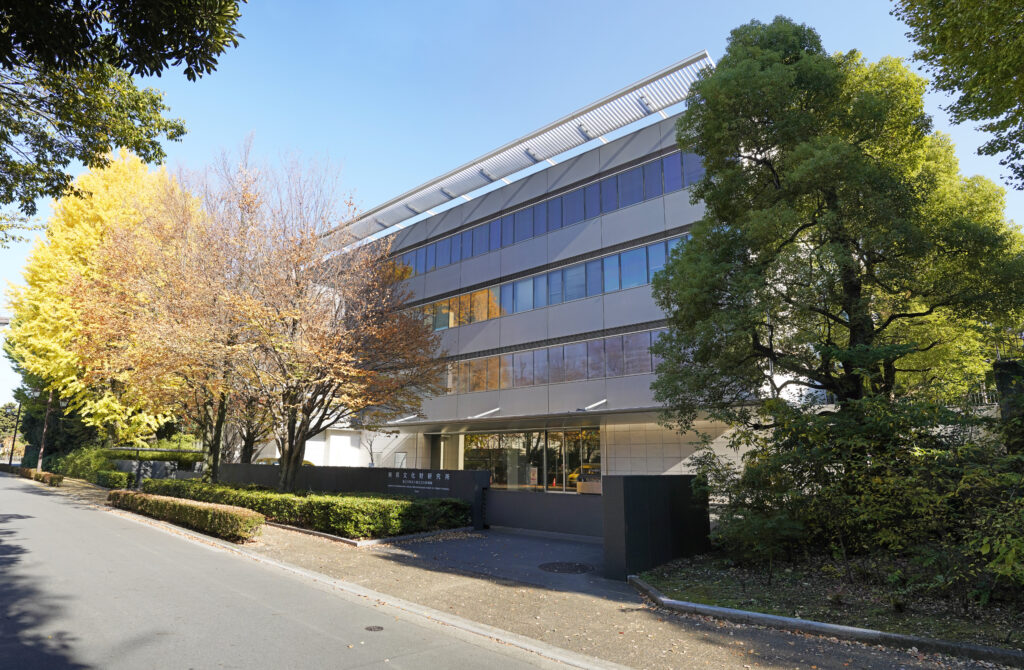
From the park road the institute looks like a sober office block of glass and pale stone, set back behind trees, with its name on a dark panel beside the entrance. There is nothing of the museum about the outside. Inside, the entrance lobby carries panel exhibitions that change through the year and set out what the institute's researchers have found.
The working floors hold laboratories, studios for restoration and a library reading room, open to people who need the collections for research or teaching. Facilities can be visited by application, and the institute publishes its research in reports and databases. The paintings are at the Kuroda Memorial Hall, a short walk away, where the highlights gallery shows Lakeside, Maiko, Reading and Wisdom, Feeling, and Emotions for two weeks at a time, three times a year.
Practical information
- Address: 13-43 Ueno Park, Taitō-ku, Tokyo 110-8713; telephone 03-3823-2241
- Seven minutes on foot from the south exit of JR Uguisudani, thirteen from the Park exit of JR Ueno
- Entrance lobby panel exhibitions; library reading room and facility tours by application
- Kuroda Memorial Hall, 13-9 Ueno Park: free, 9:30-17:00, closed on Mondays and at the year end
- A research institute rather than a museum: there are no permanent displays to walk through
Getting there
From the south exit of JR Uguisudani the walk takes seven minutes along the park edge; from the Park exit of JR Ueno it takes thirteen.
Nearby
- Tokyo National Museum
- National Museum of Nature and Science
- Ueno Zoo
- Shinobazu Pond
Sources
Find it on the map
See this place and what’s around it →📷 Become a Cultural Heritage Online photographer
Share your photos of places: they stay published under your name as the author. The more they're seen, the more you get noticed — and soon a contest will reward the most appreciated photos.
Log in or sign up free to add a photoIs this page about you?
This page is read by travellers and heritage enthusiasts who find it on Google. Tell us how you are connected to this place and we will take it from there.
This entry stays online and free either way — and a free account lets you add to it yourself.