

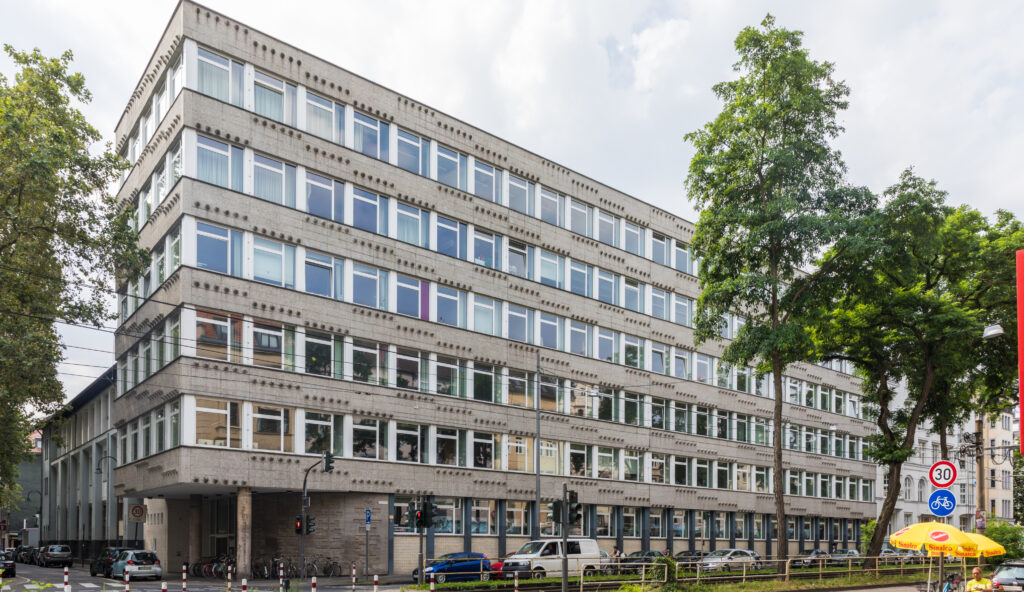
The Cologne Institute for Conservation Sciences teaches the repair of paintings, paper, textiles, wood, stone and glass inside the former Kölner Werkschulen, a school of applied arts of 1922-24 by Martin Elsässer.
At a glance
The institute belongs to the Faculty of Cultural Studies of TH Köln and occupies part of a school complex laid out along the Ubierring, the Mainzer Straße and the Maternusstraße. The east, south and west wings are largely of 1922-24 and follow a design by Martin Elsässer. A six-storey postwar block by Stefan Leuer, with a facade shaped by Ludwig Gies, closed the corner towards the Mainzer Straße between 1960 and 1967. Five study directions carry on the teaching, from paintings and sculpture to stained glass.
Key facts
- Address: Ubierring 40, 50678 Köln
- Built 1922-24 as the Kölner Werkschulen, architect Martin Elsässer
- Red brick gave the school its nickname, the Rotes Haus
- Postwar block of 1960-67 by Stefan Leuer, facade by Ludwig Gies
- Five study directions, from paintings to stained glass and stone
- Bachelor and master in the conservation of art and cultural property
- Tram lines 15 and 16 stop at Ubierring
History
The Kölner Werkschulen came out of the department of applied arts of Cologne's municipal trade schools, founded in 1879. Four decades of growth left it short of rooms and workshops, and in 1920 the city appointed Martin Elsässer, until then an architect in Stuttgart, as director. He accepted on condition that the school got a new building. It went up in only four years, beside workshops of the Gewerbeförderungsanstalt that the school also used, and the east wing along the Mainzer Straße, the south wing along the Maternusstraße and the west wing still date from 1922-24.
Red brick, Elsässer's preferred material in his late Cologne years, gave the complex its nickname, the Rotes Haus. Elsässer left Cologne in 1925, and a postwar teaching block followed at the corner with the Mainzer Straße between 1960 and 1967. Stefan Leuer designed it, with a facade by Ludwig Gies. Its six storeys make it visibly taller than the 1920s wing beside it.
In 1971 the school was taken out of the hands of the city and folded into the Fachhochschule Köln, founded that year. The architecture department moved to Deutz in 1973 and the former Werkschulen building passed to the design and conservation institutes. Since 2015 the institution has been the Technische Hochschule Köln. The Cologne Institute for Conservation Sciences has existed for 35 years and now holds part of the building, with the two degrees that train conservators for museums, monuments and private studios.
Richard Seewald left sgraffiti on the wing along the Mainzer Straße around 1929: scratch-work plaster pictures between the windows of the ground and first floors. They survive, in part damaged.
What you see
The complex forms an irregular quadrangle along the Ubierring, the Mainzer Straße and the Maternusstraße, with a courtyard closed off by the west wing. The 1920s facades mix red brick with red render and carry tall windows set in bands; the postwar block answers them with a concrete grid and a patterned relief across the whole front.
The building is a working institute rather than a museum. Studios and workshops for the five study directions occupy the former classrooms, and the results come out in the master days, when graduates present their final projects, and in the annual reviews the institute publishes. Access to the studios is arranged with the secretariat; the building itself is reached from the street through the central entrance on the Ubierring.
Practical information
- Address: Ubierring 40, 50678 Köln; institute secretariat +49 221-8275-3454
- Campus open Monday to Friday 6.30-22.00 and Saturday 7.00-19.00; after 19.00 and at weekends entry only through the main gates
- Tram lines 15 and 16, stop Ubierring
- A teaching institute, not a museum: studio visits by arrangement with the secretariat
- Chlodwigplatz, with buses and the Severin quarter, is a few minutes north
Getting there
Tram lines 15 and 16 stop at Ubierring, a short walk from the central entrance. The building stands on the left bank of the Rhine, at the southern end of Cologne's inner ring.
Nearby
- Chlodwigplatz and the Severin quarter
- Severinstorburg
- Volksgarten park
- Rheinauhafen harbour
Sources
- https://www.th-koeln.de/mam/downloads/deutsch/hochschule/aktuell/nachrichten/2021/kolner_beitrage_zur_baugeschichte_und_denkmalpflege_band_3_kunst_an_gebauden_der_technischen_hochschule_koln.pdf
- https://www.th-koeln.de/kulturwissenschaften/institut-fuer-restaurierungs–und-konservierungswissenschaft_10217.php
- https://www.th-koeln.de/kulturwissenschaften/das-institut_10350.php
- https://www.th-koeln.de/kulturwissenschaften/studium_10292.php
- https://www.th-koeln.de/hochschule/campus-suedstadt_76504.php
- https://www.th-koeln.de/kulturwissenschaften/geschichte_10531.php
Find it on the map
See this place and what’s around it →📷 Become a Cultural Heritage Online photographer
Share your photos of places: they stay published under your name as the author. The more they're seen, the more you get noticed — and soon a contest will reward the most appreciated photos.
Log in or sign up free to add a photoIs this page about you?
This page is read by travellers and heritage enthusiasts who find it on Google. Tell us how you are connected to this place and we will take it from there.
This entry stays online and free either way — and a free account lets you add to it yourself.