

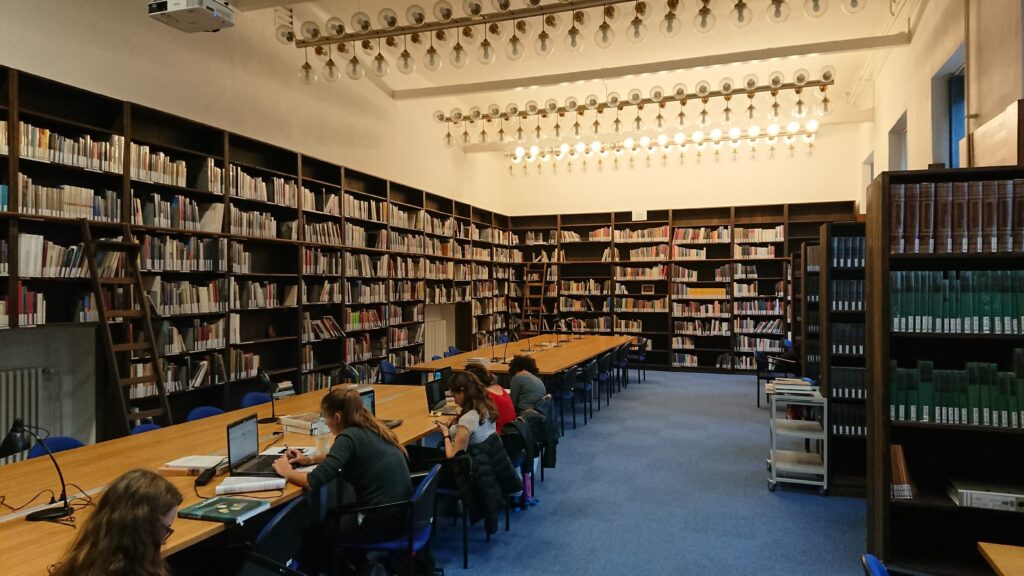
Masaryk University's art history seminar has taught since 1927, from the Faculty of Arts in Brno and from two libraries of its own.
At a glance
The Seminář dějin umění is the art history department of Masaryk University. It is one of the oldest art-historical institutions in the Czech Republic. It belongs to the Faculty of Arts, seated on the Arna Nováka campus. The department's rooms, and both its libraries, are in Building K at Veveří 28. It teaches from bachelor to doctoral level. It researches art, architecture and visual culture, from antiquity to the present.
Key facts
- Seminar founded in 1927, the second art-historical institution in Czechoslovakia
- Building A of the faculty was the city orphanage, built 1871–1872
- Architect Josef Arnold designed the orphanage with Moritz Kellner
- Library of about 35,000 monographs and 250 journal series
- Two reading rooms: the Getty Library and the Hans Belting Library
- Bachelor, master and doctoral programmes, plus a university of the third age
History
The seminar was founded in 1927. It was the second art-historical institution in Czechoslovakia. Its first head was Eugen Dostál, a specialist in medieval art trained in Vienna under Max Dvořák. Departmental status came in 1952.
German troops closed the university in November 1939. Staff and students lost their posts or were sent to industry. Many were deported to camps. Teaching resumed in 1945 under Albert Kutal, one of the seminar's first students. The communist decades brought repeated reorganisations. The department was folded into larger units with aesthetics, archaeology, musicology and ethnography. Before 1989 it carried the name of a department of Marxist-Leninist aesthetics.
In 1990 it was restored as an independent seminar. Zdeněk Kudělka led it, then Jiří Kroupa, Lubomír Slavíček and Ondřej Jakubec. Continuity survived the reorganisations. Dostál's interest in architecture passed to later generations.
Building A of the Arna Nováka campus began as the city orphanage. Two brick manufacturers paid for it. Josef Arnold designed it with Moritz Kellner von Brünnheim in 1871–1872, in a strict classical manner modelled on Alberti. The city owned the building, so the new Faculty of Arts moved in soon after the university was founded. A corner extension followed in 1905, the present Building B1.
What you see
Building A keeps the orphanage's classical facade, with a courtyard reached from Arna Nováka. The faculty has hung its corridors with casts, paintings and sculpture. Plaster copies of antique statues came after the war from Professor Josef Della's collection, among them the Medici Venus and the Borghese Warrior. A bronze by Michal Gabriel stands in the courtyard. A fresco of the Armenian genocide fills a first-floor hall in Building D.
The department's rooms are across the city centre, in Building K at Veveří 28. Its library is one of the largest art-historical libraries in the country. Two reading rooms hold some 35,000 monographs and 250 journal series. The Getty Library covers the early modern period onwards. The Hans Belting Library, opened in 2016, holds antiquity and the Middle Ages. The old-print collection came from the Matice Moravská, with treatises by Vignola, Palladio and Pozzo and the collected Winckelmann. Both rooms are open to outside researchers.
Practical information
- Address: Seminář dějin umění, Veveří 470/28, 602 00 Brno (correspondence: Arna Nováka 1, 602 00 Brno).
- Getty Library: Monday to Thursday, 9:00–18:00.
- Hans Belting Library: Monday to Thursday 10:00–19:00, Friday 10:00–18:00.
- Loans are for consultation on site; the catalogue is online, older journals on cards.
- Status: a working university department, open to researchers who ask in advance.
Getting there
Arna Nováka and Veveří are both in central Brno. Trams stop at Grohova and Česká. The main railway station is twenty minutes away on foot.
Nearby
- Špilberk Castle
- Cathedral of St Peter and Paul on Petrov
- Moravian Gallery in Brno
- Villa Tugendhat
Sources
Find it on the map
See this place and what’s around it →📷 Become a Cultural Heritage Online photographer
Share your photos of places: they stay published under your name as the author. The more they're seen, the more you get noticed — and soon a contest will reward the most appreciated photos.
Log in or sign up free to add a photoIs this page about you?
This page is read by travellers and heritage enthusiasts who find it on Google. Tell us how you are connected to this place and we will take it from there.
This entry stays online and free either way — and a free account lets you add to it yourself.