

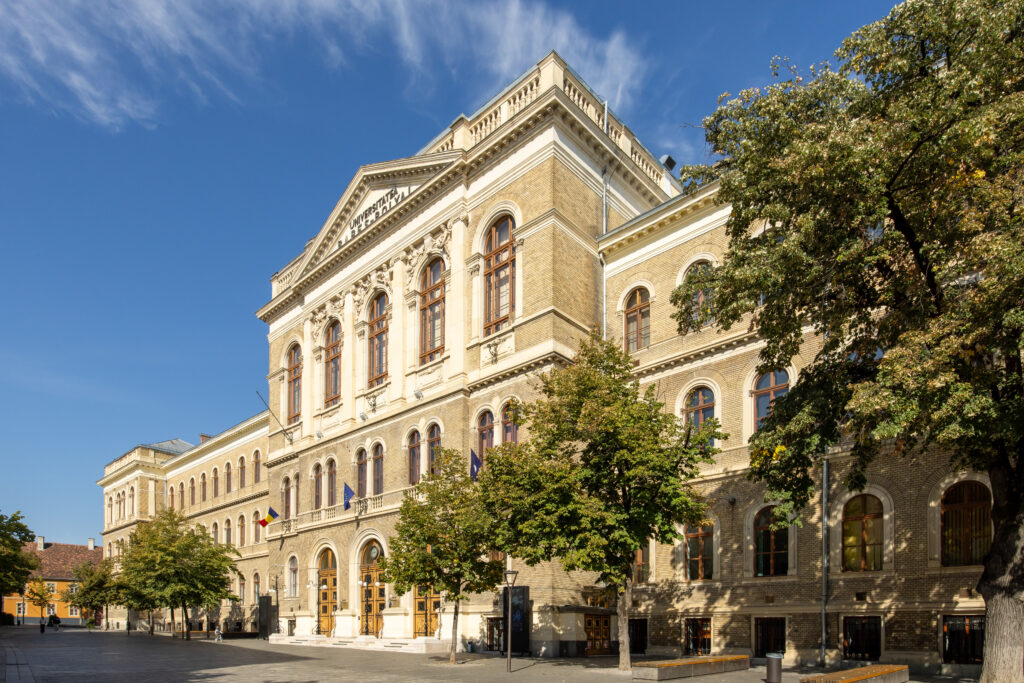
The neo-Renaissance central building of Babeș-Bolyai University stands at the Kogălniceanu street entrance to the old town, and holds the Aula Magna used for the university's ceremonies.
At a glance
The central building of Babeș-Bolyai University stands at Str. Mihail Kogălniceanu 1 in Cluj-Napoca. It was raised in three stages between 1893 and 1902 for the Hungarian university founded in 1872. It contains teaching rooms and ceremonial halls, including the Aula Magna, and covers 4,226 square metres.
Key facts
- Built in three stages between 1893 and 1902
- Neo-Renaissance architecture, 4,226 square metres
- Houses the Aula Magna and teaching rooms
- University founded in 1872 with forty chairs
- University library built 1906–1909 after the model of Basel
- Women admitted from 1895
- Babeș-Bolyai name in use since 1959
History
Academic teaching in Cluj goes back to 1581, when Stephen Báthory signed the founding diploma of the Jesuit college there. He signed it at Vilnius, where he was then ruling. The college taught grammar, humanities, rhetoric, philosophy and theology, and its first rector was Jakub Wujek.
The modern university opened in 1872 with forty chairs and forty teachers. Building followed at speed. By 1918 the city held 63 university buildings. The central building was put up in three stages between 1893 and 1902, with a neo-Renaissance front and 4,226 square metres of floor.
The university library came between 1906 and 1909, modelled on the library of the University of Basel, and the clinics complex was completed in 1903. Chairs rose from forty to sixty-one by 1919, served by 150 teachers. Women were admitted from 1895. More than 40,000 students passed through between 1872 and 1918.
The institution was reorganised under Romanian administration after 1919 and took the name of King Ferdinand I in 1927. A Hungarian-language university was created in 1945 and named after the Bolyai mathematicians; the two were merged in 1959 into a single state university, which took the name Babeș-Bolyai and began teaching in September 1959. The central building has stayed in use throughout, and still carries both teaching rooms and the ceremonial halls.
What you see
The building is a long, regular block in neo-Renaissance dress, with a rusticated base, arched windows and a heavy cornice; it reads as an institution rather than a palace. It covers 4,226 square metres and holds teaching rooms alongside the ceremonial spaces.
The Aula Magna is the room the university uses for ceremonies. It stands among ordinary seminar rooms. The central building is one of 63 academic buildings put up in Cluj before 1918, alongside the university library and the clinics complex, and the group still defines the streets around Kogălniceanu.
Practical information
- Address: Str. Mihail Kogălniceanu 1, 400084 Cluj-Napoca
- Telephone +40 264 405 300
- Ceremonial halls include the Aula Magna
- University library about 550 m away, built 1906–1909
- A working university building; the Aula Magna serves ceremonial functions
Getting there
The building stands at the Kogălniceanu entrance to the historic centre, about 280 m from Piața Unirii and 550 m from the central university library.
Nearby
- Piața Unirii
- St Michael's Church
- Central University Library
- Piața Avram Iancu
Sources
Find it on the map
See this place and what’s around it →📷 Become a Cultural Heritage Online photographer
Share your photos of places: they stay published under your name as the author. The more they're seen, the more you get noticed — and soon a contest will reward the most appreciated photos.
Log in or sign up free to add a photoIs this page about you?
This page is read by travellers and heritage enthusiasts who find it on Google. Tell us how you are connected to this place and we will take it from there.
This entry stays online and free either way — and a free account lets you add to it yourself.