


A fifteenth-century palace on Piazza Venezia in Rome, built for the Venetian cardinal Pietro Barbo and now housing the Museo Nazionale di Palazzo Venezia.
At a glance
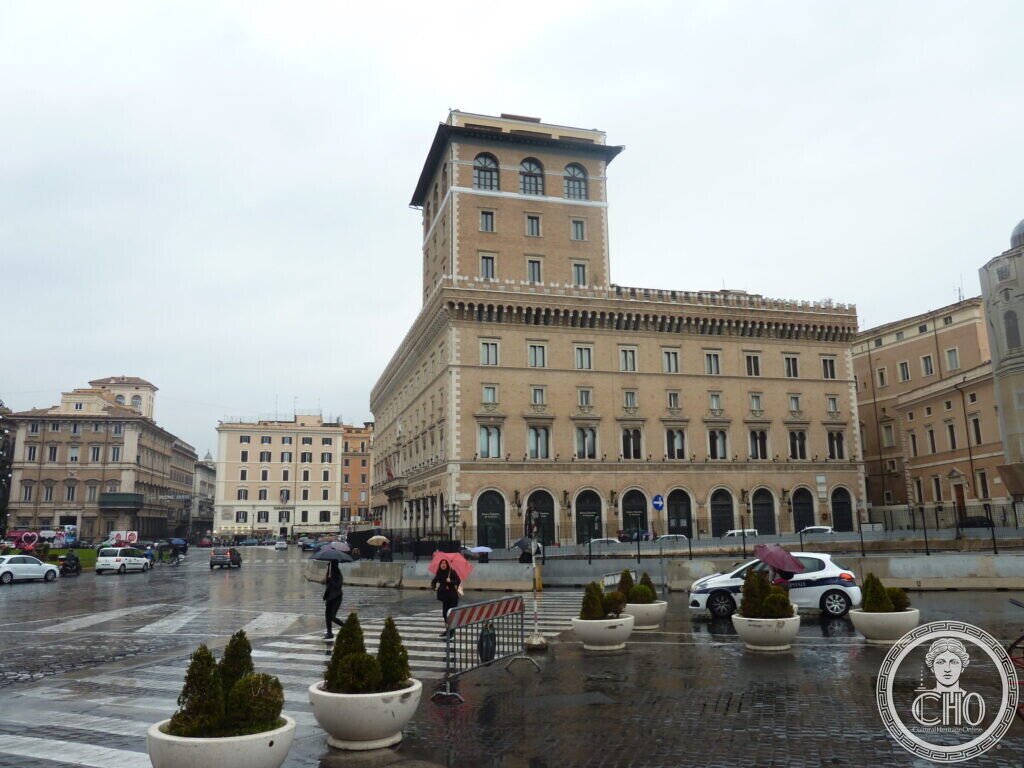
The palace faces Piazza Venezia in central Rome, with a long sober Renaissance front, a tall brick tower at one end and three rows of windows below a battlemented cornice. The Rome Museum website calls it the largest Roman civil work of the fifteenth century. Today the building houses the National Museum of Palazzo Venezia and the Institute for Archaeology and Art History.
Key facts
- Where: Piazza Venezia, 3 / Via del Plebiscito, 118, Roma
- What: Palace
- When: 1455–1467, according to the Rome Museum website
- GPS: 41.8964, 12.4814 · Open in Google Maps
History
Palazzo Barbo, as it was originally called, was constructed between 1455 and 1467 at the wish of the Venetian cardinal Pietro Barbo, who later became Pope Paul II. According to the Rome Museum website, the builders reused travertine taken from the Colosseum and the Theatre of Marcellus. In 1564, Pope Pius IV Medici handed part of the building to the Republic of Venice; the Venetian embassy stayed there until 1797, and it is this link that gave the palace its present name. After the Napoleonic period the building became the seat of the Austro-Hungarian diplomatic representation. The museum inside was founded in 1921 and gradually built up a collection of applied arts. Between 1929 and 1943, the palace served as Mussolini’s residence as Head of Government and as the meeting place of the Grand Council of Fascism, and from its balcony he addressed the crowds.
What you see
The photographs show the palace from Piazza Venezia on a rainy day, according to Stefano Vigolo’s notes. The soaked cobbled square reflects the long flat front, and a decorated Christmas tree stands at the left. The tall brick tower rises above the roofline. On the lower part of the building the words «BIBLIOTECA NAZIONALE» are visible. The sources do not say whether this lettering belongs to the palace or to an adjoining entrance. The building is described as deliberately severe in appearance, with three rows of windows and battlements along the cornice.
Do you know more about this place?
If you know a date, a name, a document, a plaque or a photograph that tells its story, write to Sofia through the contact page. What arrives with a source goes into this page, with your name as the contributor.
Nearby
- Parish Basilica of San Marco Evangelista al Campidoglio — church beside the palace, 64 m off
- Grazioli Palace — palatial neighbour, 81 m off
- PAN, Polish Academy of Sciences — nearby institution, 57 m off
Gallery
Sources
- Turismo Roma, Museo Nazionale di Palazzo Venezia: foundation date, addresses, collection origins and Mussolini period
- Rome-Museum, Palazzo Venezia – Useful Information: construction dates, embassy history, building description and balcony use
- OpenStreetMap, Palazzo Venezia: address and coordinates
- Stefano Vigolo, photographs and notes to the editorial staff (2026): identification of the subject and the year of the photographs. Not a published source
Find it on the map
See this place and what’s around it →
Advertisement. Pictured, from the Cleveland Museum of Art (CC0) and not for sale: Latz commode, Meissen group, Paul Storr tureen. How we handle this
📷 Become a Cultural Heritage Online photographer
Share your photos of places: they stay published under your name as the author. The more they're seen, the more you get noticed — and soon a contest will reward the most appreciated photos.
Log in or sign up free to add a photoIs this page about you?
This page is read by travellers and heritage enthusiasts who find it on Google. Tell us how you are connected to this place and we will take it from there.
This entry stays online and free either way — and a free account lets you add to it yourself.