

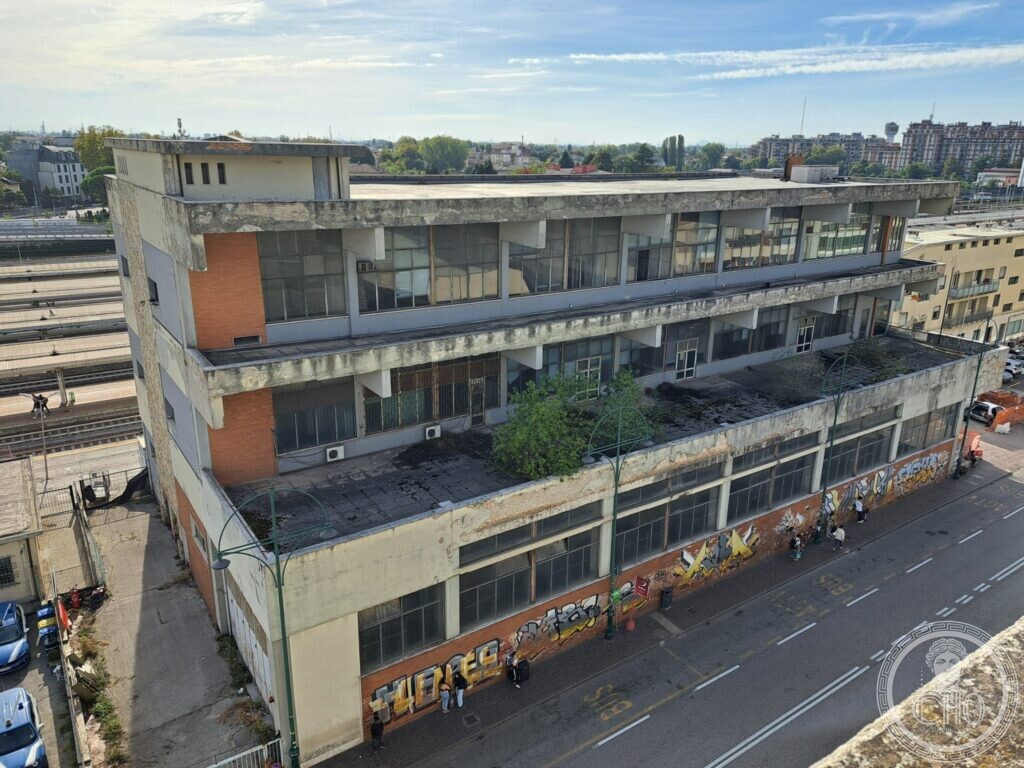
A brutalist postal processing building in Mestre, next to the railway station, now empty and part of a long-debated redevelopment plan.
At a glance
The building stands on Piazzale Favretti, immediately beside Mestre railway station. It was opened as a main post office handling arrivals and departures, and later became known as a centre for processing mail. Since the postal service abandoned rail transport, the structure has been left empty and is now described in local reporting as an example of brutalist architecture awaiting transformation.
Key facts
- Where: Piazzale Favretti, Mestre, Venezia
- What: Building
- When: Opened as Mestre Arrivi e partenze with effect from 10 August 1965
- GPS: 45.4821, 12.2335 · Open in Google Maps
History
According to the philatelic expert Mario Pozzati, a ministerial decree of 1 August 1964 provided for the opening of the building as a main office with the name Mestre Arrivi e partenze, effective from 10 August 1965, with the postal code 67/126. A further decree of 9 April 1969, operational from 1 May of that year, activated the telegraph service and the accounting section, simplifying the name to Mestre. The building’s position next to the railway station was deliberate: it was used for sending registered mail and telegrams by train. When Poste italiane moved away from rail transport in favour of road haulage, the building fell into disuse. In 2019, La Nuova Venezia reported that the German entrepreneur Michael Kluge was ready to sell the former post office building, which he had bought for about 6 million euros, for a sum between 12 and 14 million euros, with the plan to turn it into a hostel or hotel with around 600 beds. The architectural studio of Sandro Bisà had been working on the project. An earlier owner, Immobiliare Favretti, had also planned to convert the building into a hotel, but the project stalled. Il Gazzettino reported that the Comune and the Regione had agreed to remove the architectural protection order from the building, which had been considered a rare remaining example of the brutalist movement born in the 1950s. Removing the order would allow renovation or even demolition. Previously, in 2019, Michael Kluge had announced he would abandon an 80-million-euro project to build two towers for offices and hotels joined by a commercial platform.
What you see
The photographs show a long three-storey concrete building with a flat roof and a ground floor covered in graffiti. The reinforced concrete structure is visible on the façade. Along one side run railway tracks. At street level there are areas where cars park and pass, and groups of people gather or wait along the pavement. The building’s large volume and bare concrete surfaces match the descriptions of it in local reporting as an example of brutalist architecture.
In the aerial photographs, the building’s low, sprawling mass is more legible than at street level: its flat roof appears partly overgrown, and the parcel sits directly against a dense network of railway sidings, reinforcing the functional link with rail handling. The lower section is shown as brick rather than bare concrete, with large graffiti panels running along the base. In 2020, the UNESCO mission report on Venice and its lagoon specifically drew attention to the project for the towers at the former post office in Mestre, recommending a stop to buildings exceeding eight storeys in the city, a point that bears directly on the later proposal to demolish the structure for two modern towers.
In the additional views supplied by Stefano Vigolo, the lower band of graffiti is legible enough to include the lettering “Hienco” along the platform side, while the aerial shots make the contrast between the weathered reinforced-concrete upper floors and the brick-textured ground level more explicit than in the existing description. The setting is less static than the earlier photographs suggested: the new street-level images show a white truck parked close to the graffitied base and several people standing or sitting along the pavement, reinforcing the building’s current role as a waiting and gathering point beside the station. The view along the railway platforms also recalls the functional origin recorded in Vaccari news, which notes that the structure was deliberately placed beside the tracks because it handled registered mail and telegrams sent by train.
The new photographs make the materials and frontage of the former post office clearer than earlier images did. The lower band is not bare concrete but brick, and the long elevation facing the street is covered with large, colourful graffiti panels, including the inscription “Hienco” along the platform side. The aerial views show the rooftop partly overgrown with vegetation, while the street-level scenes place the building in current use as a waiting and gathering point: a white truck is parked close to the graffitied base, and people stand or sit on the pavement near the kerb. The photographs also reflect recent changes to the immediate setting, where new parking spaces have replaced the Flixbus stop in front of the building.
Do you know more about this place?
If you know a date, a name, a document, a plaque or a photograph that tells its story, write to Sofia through the contact page. What arrives with a source goes into this page, with your name as the contributor.
Nearby
- The Former Post Office Building of Mestre Station — a Brutalist Block Waiting fo — the same building, listed under a longer name
Gallery


Sources
- Vaccari news, Mestre/1 Dove si spedivano raccomandate e telegrammi: opening dates, postal functions and the building’s abandonment
- La Nuova Venezia, Mestre, l’ex palazzo delle Poste torna in vendita. Kluge è pronto a cedere il progetto: sale negotiations, purchase price and proposed conversion to a hostel or hotel
- Il Gazzettino, Mestre. L’edificio ex Poste potrà essere demolito: il progetto da 80milioni di euro per due torri con uffici e alberghi: removal of the architectural protection order, the brutalist classification and the 80-million-euro tower project
- Stefano Vigolo, photographs and notes to the editorial staff (2026): identification of the subject and current appearance. Not a published source
Find it on the map
See this place and what’s around it →📷 Become a Cultural Heritage Online photographer
Share your photos of places: they stay published under your name as the author. The more they're seen, the more you get noticed — and soon a contest will reward the most appreciated photos.
Log in or sign up free to add a photoIs this page about you?
This page is read by travellers and heritage enthusiasts who find it on Google. Tell us how you are connected to this place and we will take it from there.
This entry stays online and free either way — and a free account lets you add to it yourself.