

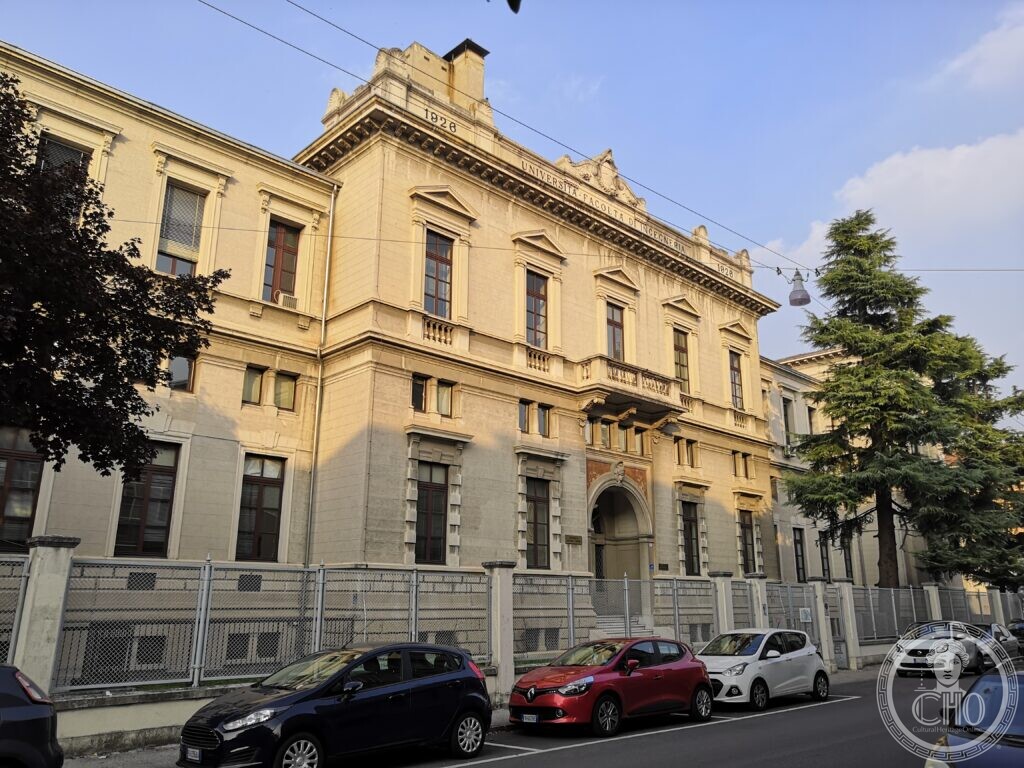
The Department of Civil, Environmental and Architectural Engineering of the University of Padua, housed in a pale stone building on Via Marzolo with an inscribed frieze.
At a glance
The building stands at Via Marzolo 9 in Padua, facing the street behind a metal fence with a forecourt. The department’s own site identifies it as part of the University of Padua and gives its address, while Apple Maps describes it as an engineering school at the same location. The frieze visible on the facade carries the words ‘UNIVERSITA” and ‘DI INGEGNERIA’, along with dates that are not explained in the published documents found.
Key facts
- Where: Via Marzolo, 9, 35131 Padua, Italy
- What: Building
- When: not documented in the sources found
- GPS: 45.4096, 11.8890 · Open in Google Maps
History
The department’s site and the university’s institutional pages state that the Dipartimento di Ingegneria Civile, Edile e Ambientale (ICEA) is part of the University of Padua, which traces its origins to 1222. The Science4All page notes that the department’s educational tradition for technicians in transport systems, hydraulics and civil architecture was established from the early nineteenth century and developed through the nineteenth and twentieth centuries. The frieze on the building carries inscriptions and dates that are visible in the contributor’s photographs but not explained in the published documents found.
What you see
The photograph shows a large pale stone building with a flat facade, a protruding cornice, and a long inscribed frieze running below the roofline. The frieze reads ‘UNIVERSITA’ FASCOLI DI INGEGNERIA’ followed by a date, although the contributor notes that the word ‘FASCOLI’ is partly hard to read and may be different. A metal fence runs along the street in front of the building, with a narrow forecourt between the fence and the entrance. Cars are parked along the kerb, and in the second photograph a tall evergreen tree partially obscures the right side of the facade.
Stefano Vigolo’s photographs add the central three-arched portico and the roofline detail of a heraldic shield flanked by two circular panels, details not visible in the earlier image on the page. The main facade inscription reads ‘UNIVERSITA – FACOLTA DI INGEGNERIA’. According to AERtetto, the engineering complex was built from a design developed in phases by Daniele Donghi starting in 1910; construction was interrupted during the First World War, with completed structures partly occupied by the military in 1917, and work resumed after 1919, continuing until about 1933. The same source notes that the complex is organised around two large internal courtyards.
Do you know more about this place?
If you know a date, a name, a document, a plaque or a photograph that tells its story, write to Sofia through the contact page. What arrives with a source goes into this page, with your name as the contributor.
Nearby
- Palazzo di Ingegneria — Daniele Donghi’s Engineering School in Padua, and the Wing Dated 1926 — the engineering school complex to which this building likely relates
- Faculty of Engineering, University of Padua — adjacent faculty site, 28 m away
- The Fisica Tecnica Building on Via Marzolo — a University Institute Dated 1936 — another university institute on the same street, 143 m away
Gallery


Sources
- Università di Padova, INGEGNERIA CIVILE EDILE E AMBIENTALE | Università di Padova: gives the department name, address Via Marzolo 9, and its place within the university
- Apple Maps, Università degli Studi di Padova – Dipartimento di Ingegneria Civile, Edile e Ambientale in Padua, Italy: confirms the address, phone, and describes the location as an engineering school
- CCD-STeDe, UNIVERSITY OF PADUA – CCD-STeDe: states the University of Padua traces its origins back to 1222
- Science4All, Dipartimento di Ingegneria civile edile e ambientale – ICEA: notes the educational tradition for technicians was established from the early 1800s and developed through the nineteenth and twentieth centuries
- Stefano Vigolo, photographs and notes to the editorial staff (2026): identification of the subject and the frieze inscriptions. Not a published source
Find it on the map
See this place and what’s around it →📷 Become a Cultural Heritage Online photographer
Share your photos of places: they stay published under your name as the author. The more they're seen, the more you get noticed — and soon a contest will reward the most appreciated photos.
Log in or sign up free to add a photoIs this page about you?
This page is read by travellers and heritage enthusiasts who find it on Google. Tell us how you are connected to this place and we will take it from there.
This entry stays online and free either way — and a free account lets you add to it yourself.