

A 6.2 km walk linking four landmarks of 1920s and 1930s Shanghai, from a luxury hotel on the Bund to a former record-breaking tower by People’s Park.
A walk through Shanghai’s Art Deco decade
Shanghai’s Art Deco architecture is unlike that of any other city in Asia. Between 1926 and 1934, a small group of foreign architects and Chinese clients produced a sequence of commercial towers along the Bund and Nanjing Road that fused American skyscraper massing with British colonial detailing and local ornament. The four buildings on this walk – the Fairmont Peace Hotel, the Shanghai Customs House, the Rockbund Art Museum, and the Former Park Hotel – were all completed within eight years of one another. Together they map the brief period when Shanghai became the most modern city east of Suez.
What distinguishes Shanghai Deco from its counterparts in New York or Paris is the speed of its adoption and the tightness of its geography. The entire walk covers only 6.2 kilometres and can be completed in under three hours, yet it passes through a density of 1930s architectural ambition that few cities can match. The buildings were designed by the same handful of firms, notably Palmer & Turner and László Hudec, and they share a visual language of vertical piers, stepped setbacks, and polished stone bases that reads clearly from the pavement.
Fairmont Peace Hotel, 20 Nanjing Road East
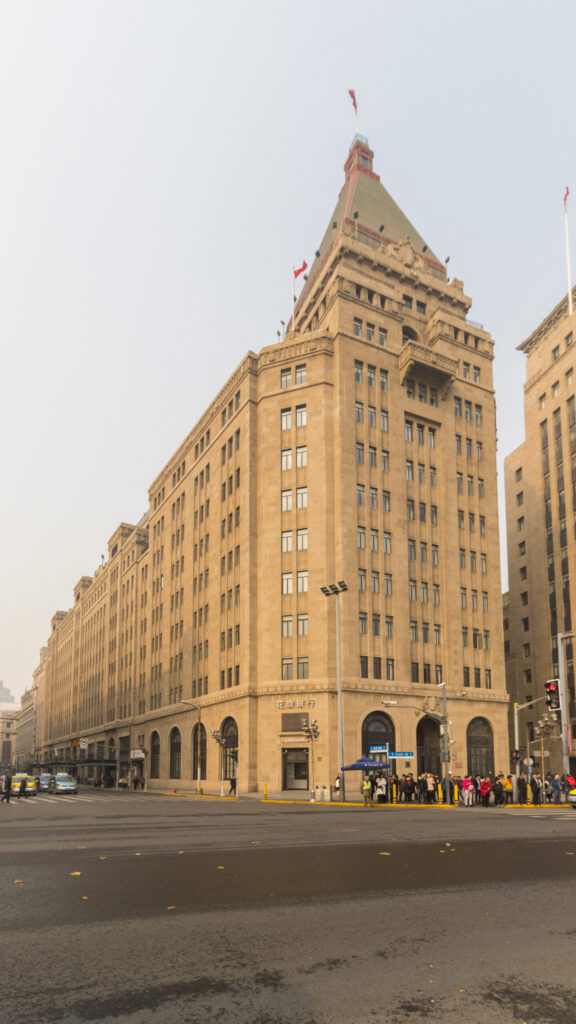
The Fairmont Peace Hotel stands at the northern end of the Bund, where Nanjing Road meets the Huangpu River. Built between 1926 and 1929 to designs by Palmer & Turner, it was originally called Sassoon House and housed the Cathay Hotel on its upper floors. The nine-storey tower rises over a four-storey podium and is crowned by a copper-clad pyramid, now verdigris green, which became a landmark visible from across the river. When it opened, the Cathay Hotel charged the highest room rates in Asia and its Jazz Bar was a social centre for Shanghai expatriate society throughout the 1930s.
The building was commissioned by Victor Sassoon, heir to the Sassoon trading dynasty, who had acquired the land in the early 1920s. Japanese forces occupied it in 1941 and used it as military quarters. After 1949 it was renamed the Peace Hotel and operated as a state guesthouse. The Fairmont group took over management in 2007 and restored the building completely, reopening it in 2010. The facade is articulated by vertical piers in pale granite that draw the eye upward to the green pyramid, while inside the nine themed suites preserve the cosmopolitan character of the original hotel.
Shanghai Customs House, 13 The Bund
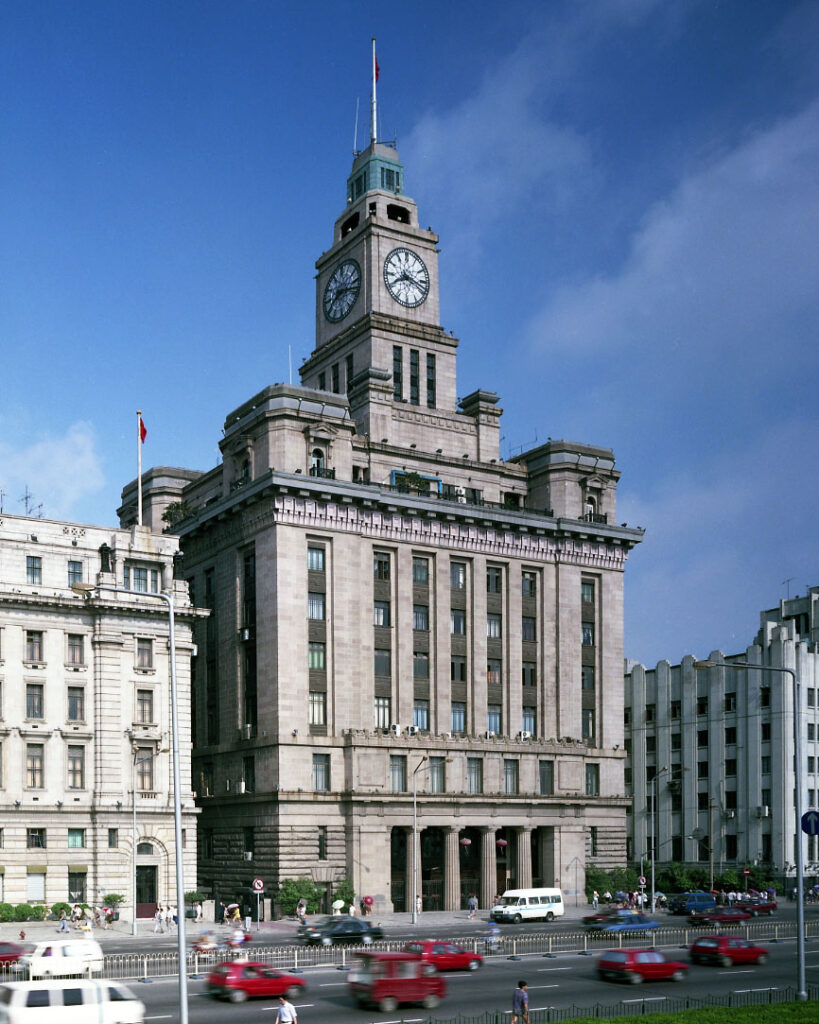
The Shanghai Customs House is the institutional anchor of the Bund. Completed in 1927, it was designed by Palmer & Turner under partner George Leopold Wilson. The building combines a Greek Revival colonnaded base with an Art Deco tower above, creating a silhouette that was intended to read clearly from ships approaching the port. Six giant Doric columns in granite frame the main entrance, while the tower houses a clock whose chimes have marked the waterfront for nearly a century. The building is a Shanghai Municipal Heritage Site and part of the Bund Historic Conservation Area.
The site has served Shanghai customs since the 1850s, but the earlier 1857 building was demolished when commercial growth demanded something grander. Construction of the current structure began in 1925. During the Japanese occupation from 1941, the clock mechanism bells were confiscated and melted for the war effort, silencing the tower. After 1949 the building passed to the People’s Republic of China; during the Cultural Revolution the clock played propaganda songs on the hour from amplifiers. The original chime mechanism was eventually restored, and the bell known as Big Ching rings again today.

Rockbund Art Museum, Huqiu Road
The Rockbund Art Museum occupies the former Royal Asiatic Society building, completed in 1933. It is located on Huqiu Road near the Bund and operates without a permanent collection, presenting rotating exhibitions of contemporary art. The building itself reflects 1930s architectural conventions, with proportions and materials typical of interwar Shanghai commercial construction. Its conversion from a learned society headquarters to an art venue is part of the wider transformation of the Bund district from colonial trading port to cultural hub.
The museum has become a platform for contemporary Chinese art on the international stage. Artists including Cai Guo-Qiang and Zeng Fanzhi have presented major works here. Its location connects historic preservation with current practice, placing new work inside a structure from the same decade as the other stops on this walk. Opening hours and admission details are available through the museum’s official channels.
Former Park Hotel, 170 Nanjing Road West
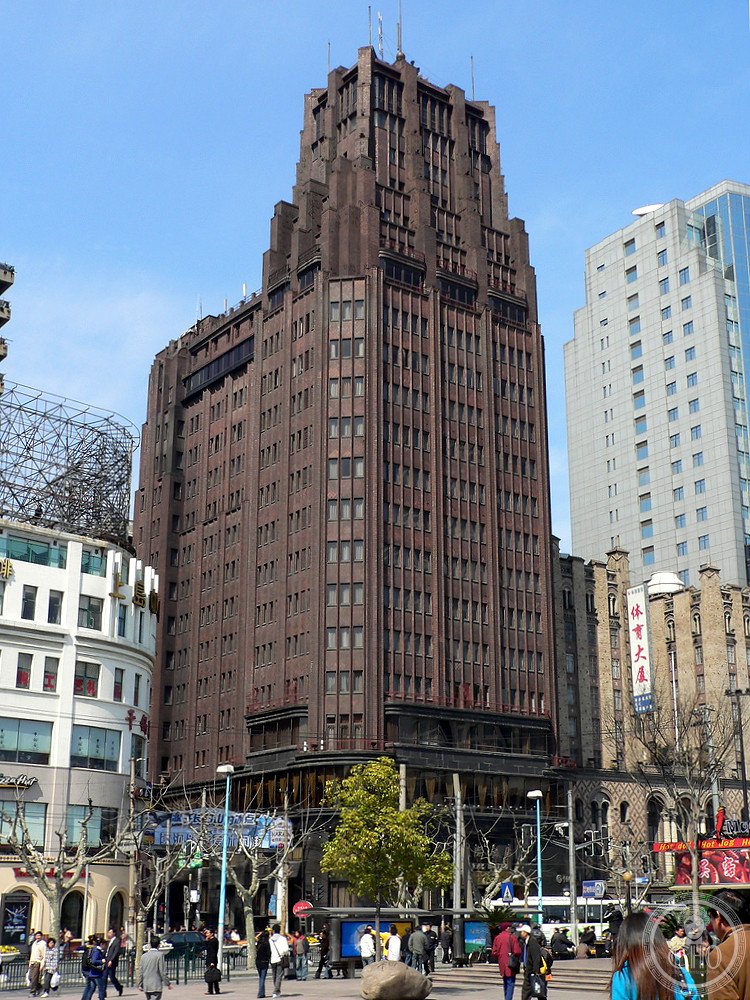
The Former Park Hotel anchors the western end of Nanjing Road, overlooking People’s Park. Designed by László Hudec and built between 1931 and 1934, it rises 22 floors above ground with two below. The lower storeys housed the Joint Savings Society Bank, while the upper floors were given over to hotel accommodation. At its opening on 1 December 1934, its height of 83.8 metres made it the tallest structure in Asia, a record it held until 1963. It remained the tallest building in China until 1966 and in Shanghai until 1983.
Hudec modelled the tower on the stepped-back American skyscraper type, achieving a vertical silhouette through successive setbacks. The base is sheathed in polished black granite from Shandong Province, contrasting with the dark-brown brick and ceramic tile cladding of the upper floors. Major renovation campaigns in the 1950s, 1980s, 1997, and 2001 restored the Art Deco interiors and updated the building services. Today managed by Shanghai Jinjiang International Hotels, it offers approximately 200 guest rooms.
Planning the walk
The full distance from the Fairmont Peace Hotel to the Former Park Hotel is 6.2 kilometres, and the walk takes approximately 175 minutes without extended stops. The sequence runs from east to west: Fairmont Peace Hotel at 20 Nanjing Road East, Shanghai Customs House at 13 The Bund, Rockbund Art Museum on Huqiu Road, and finally the Former Park Hotel at 170 Nanjing Road West. All four buildings are within central Shanghai and connected by the pedestrian spine of Nanjing Road and the Bund promenade.
The walk can be done in either direction, but starting at the Bund gives the clearest narrative of the city’s westward expansion. The buildings are open to the public in different ways: the hotel and customs house are working institutions, while the museum has rotating exhibitions. Early morning offers the quietest experience of the Bund, and late afternoon light is useful for viewing the stone facades. The route is flat and fully urban, suitable in any season.
The full route, with the order of the stops and the distances, is on the Shanghai Art Deco: a walk from the Bund to People's Square page.
Sources
- Fairmont Peace Hotel · https://culturalheritageonline.com/places/fairmont-peace-hotel/
- Shanghai Customs House · https://culturalheritageonline.com/places/shanghai-customs-house/
- Rockbund Art Museum · https://culturalheritageonline.com/places/rockbund-art-museum/
- Former Park Hotel Shanghai · https://culturalheritageonline.com/places/former-park-hotel-shanghai/
- Shanghai Art Deco: a walk from the Bund to People's Square · https://culturalheritageonline.com/itineraries/shanghai-art-deco-walk/
Spotted an error? Write to [email protected] and we correct it the same day.


