

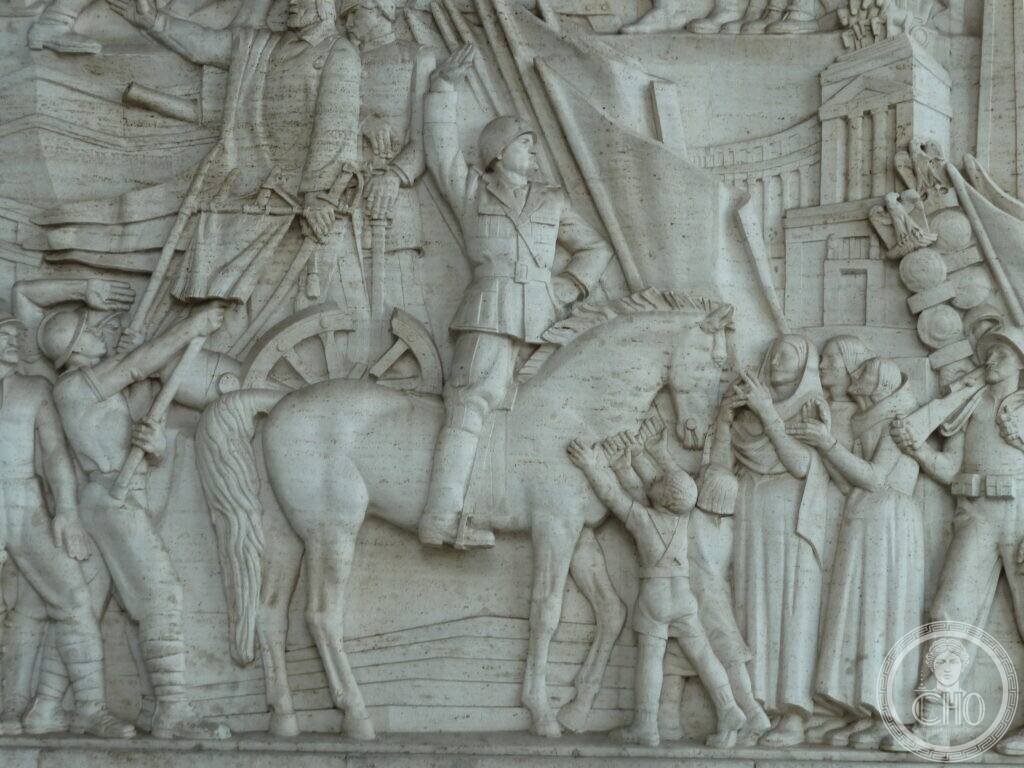
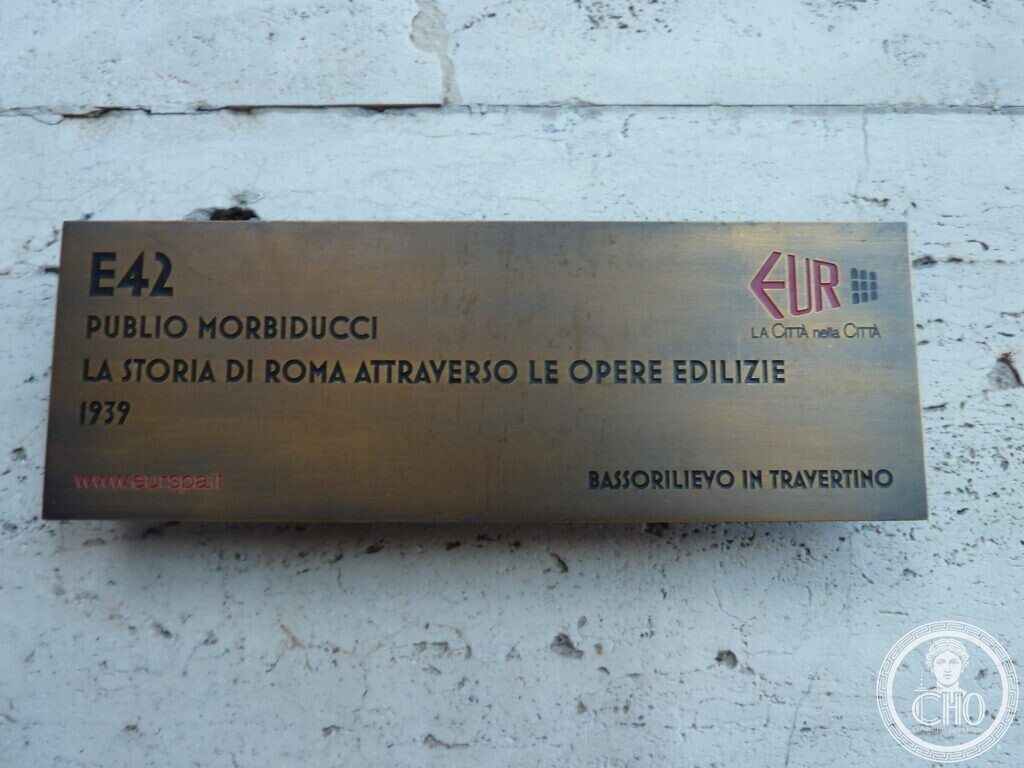
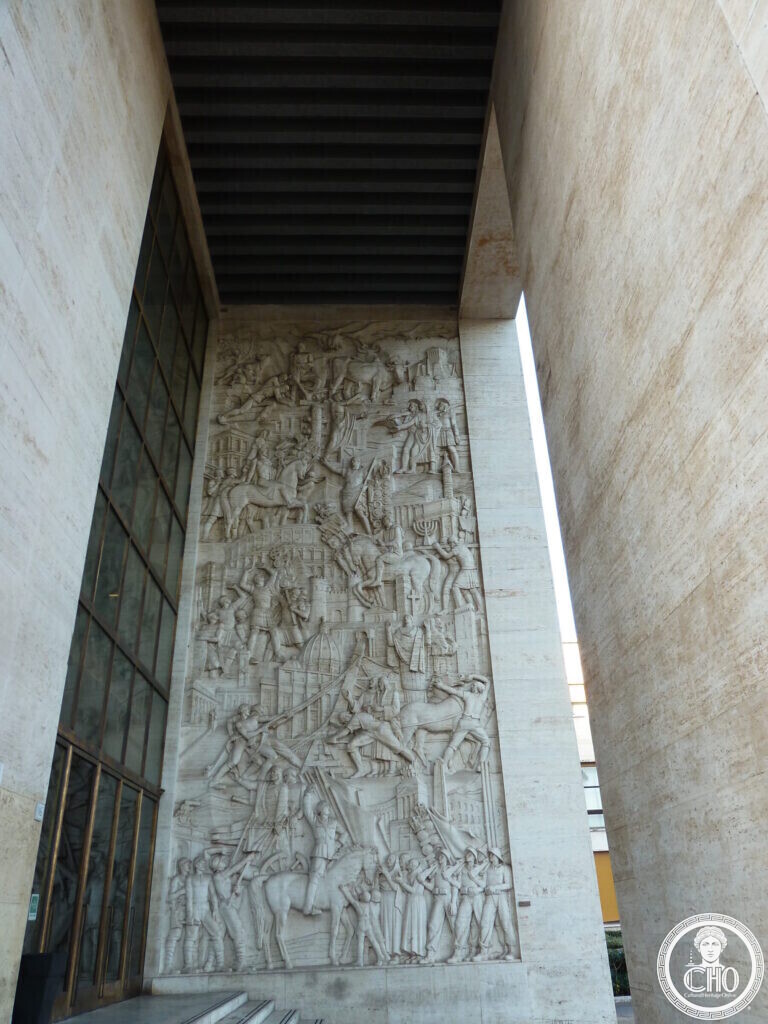
A monumental travertine relief by Publio Morbiducci at the main entrance of the Palazzo degli Uffici in the EUR district, narrating the construction history of Rome from its mythical origins to the Fascist era.
At a glance
The relief decorates the main entrance of the Palazzo degli Uffici, the first building completed for the 1942 Esposizione Universale di Roma. It presents the history of Rome through a dense sequence of its most representative buildings and construction episodes, arranged in a narrative read like a written page.
Key facts
- Where: Main entrance of the Palazzo degli Uffici, Via Ciro il Grande, EUR, Rome
- What: Monumental travertine bas-relief
- When: 1939
- GPS: 41.8367, 12.4690 · Open in Google Maps
History
The Palazzo degli Uffici was designed by Gaetano Minnucci in 1937 and completed in 1939, making it the only building planned for the 1942 Esposizione Universale di Roma to be finished before the Second World War. The relief by Publio Morbiducci forms part of its decorative programme, presenting the story of Rome through its architecture and public works. EUR S.p.A. notes that the subject matter is explicitly propagandistic, presenting the achievements of the Fascist regime as the culmination to which the whole history of Rome is prophetically directed. In the summer of 1943, following the fall of the regime, the face of Mussolini depicted on horseback was defaced as an act of damnatio memoriae.
What you see
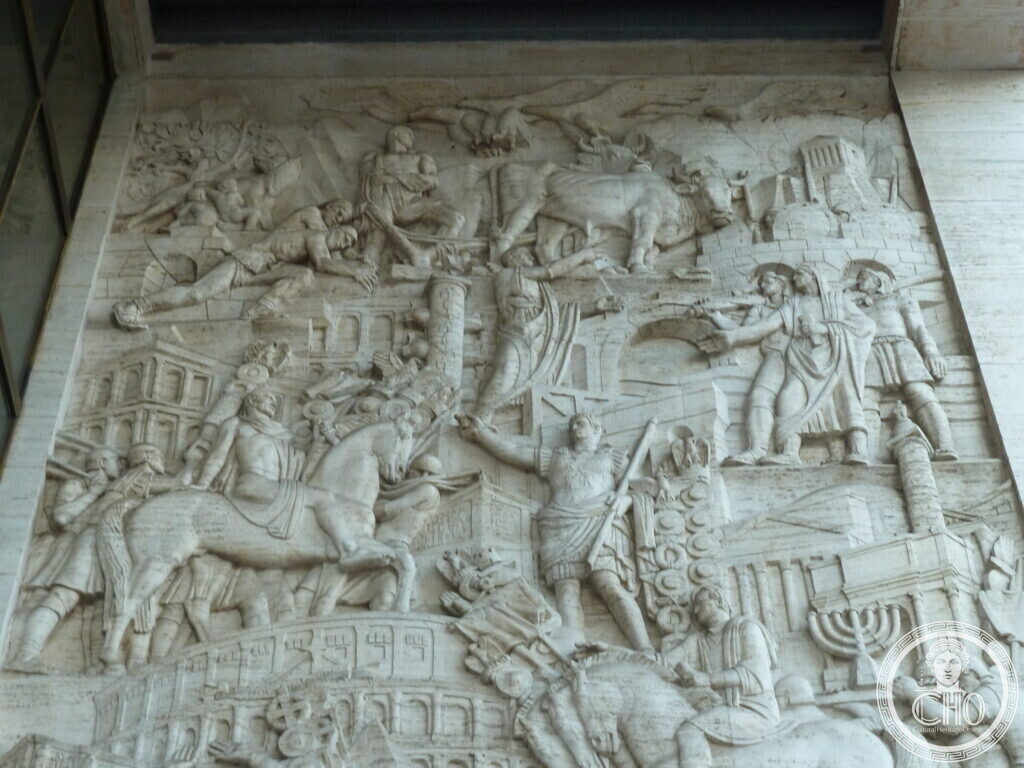
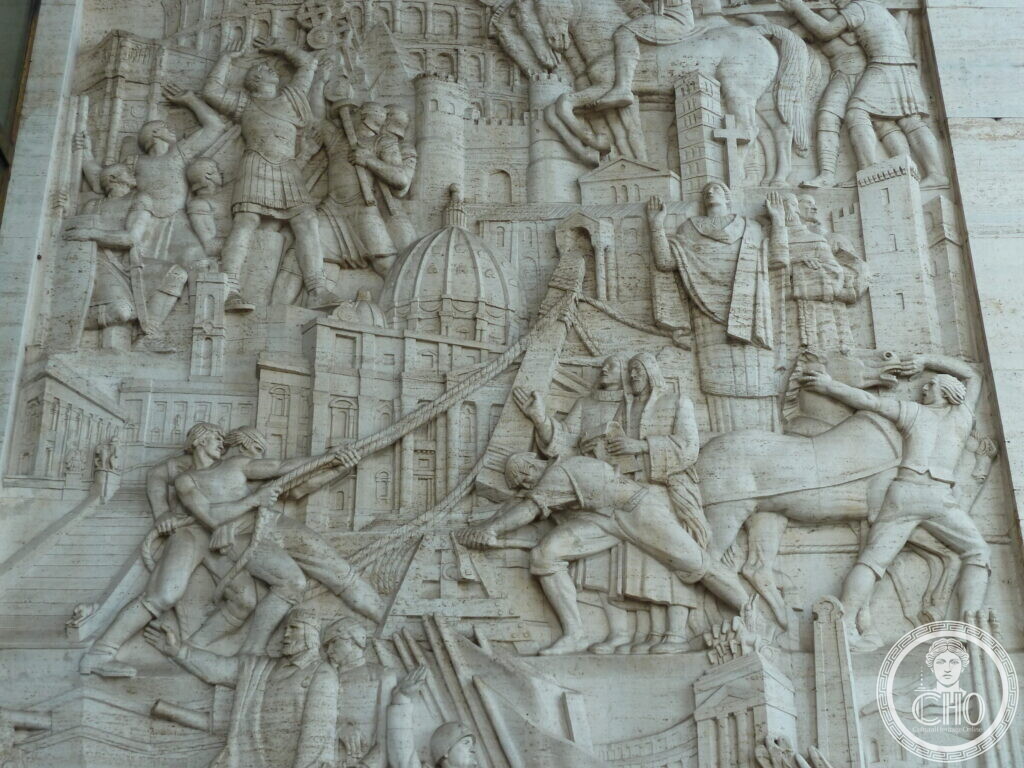
The relief is carved in slabs of travertine and is read from left to right and from top to bottom, following the model of the Column of Trajan. The upper register shows the she-wolf suckling Romulus and Remus, the eagles seen by the twins, the furrow traced by the plough to mark the first perimeter of the city, and the Temple of Jupiter Capitolinus. The lower registers represent the Republican and Imperial periods, including the Colosseum and the Pantheon, the conversion of Constantine, the church of Santa Maria in Cosmedin, the dome of the new Saint Peter’s, the erection of the obelisk under Pope Sixtus V, Garibaldi on horseback, the monument to Victor Emmanuel II, and concluding with Mussolini on horseback acclaimed by two children. The photographs show a mounted soldier with a flag and figures raising their arms, oxen, soldiers, a menorah, classical buildings, labourers hauling ropes near a domed church, and the full vertical panel set within the stone façade.
Do you know more about this place?
If you know a date, a name, a document, a plaque or a photograph that tells its story, write to Sofia at [email protected] or through the contact page. What arrives with a source goes into this page, with your name as the contributor.
Nearby
- Palazzo della Civiltà Italiana — the symbolic centre of the EUR, a short distance from the Palazzo degli Uffici
- The Genius of Sport by Italo Griselli, Roma — bronze statue located in front of the Palazzo degli Uffici
- Palazzo degli Uffici (EUR) — Gaetano Minnucci and the First Building of the E42 — the building that houses this bas-relief
- Salone delle Fontane — the other wing of the same complex, a short walk away
- Palazzo dell’INPS all’EUR — nearby institutional building in the EUR district
Gallery
Sources
- EUR S.p.A., La Storia di Roma – Bassorilievo Morbiducci | Arte EUR: description of the relief, its location, reading order, historical scenes, propagandistic intent, and the defacement of Mussolini’s face in 1943.
- Walks in Rome, EUR in Rome – Walks in Rome (Est. 2001): general context of the EUR district and its Fascist-era programme.
- Cosa Vedere a Roma, Palazzo degli Uffici e rifugio antiaereo di Mussolini • Cosa Vedere a Roma: details on the Palazzo degli Uffici, its construction dates, and the relief’s subject matter.
- Renato Prosciutto, Palazzo degli Uffici and Salone delle Fontane in Rome: confirmation of the relief’s authorship, location, medium, and narrative structure.
- Minube, Storia di Roma attraverso le opere edilizie a Roma: 1 opinioni e 4 foto: description of the relief’s subjects and its setting at the Palazzo degli Uffici entrance.
- Passaggi Lenti, EUR Roma: storia, Mussolini, E42 e cosa vedere: context for the EUR project, the Palazzo degli Uffici, and the relief’s anti-fascist reading.
- Stefano Vigolo, photographs and notes to the editorial staff (2026): identification of the subject, GPS coordinates, and date of the photographs. Not a published source.
Find it on the map
See this place and what’s around it →📷 Become a Cultural Heritage Online photographer
Share your photos of places: they stay published under your name as the author. The more they're seen, the more you get noticed — and soon a contest will reward the most appreciated photos.
Log in or sign up free to add a photoIs this page about you?
This page is read by travellers and heritage enthusiasts who find it on Google. Tell us how you are connected to this place and we will take it from there.