

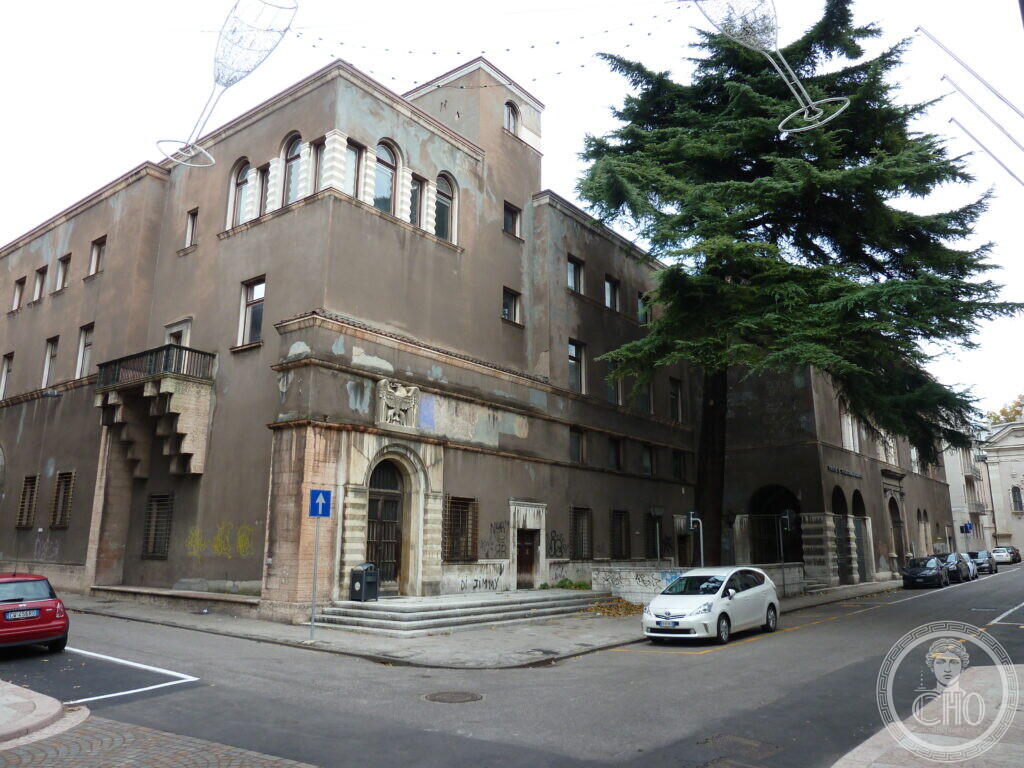
A large rationalist post office palace in Piazza Alessandro Vittoria, designed by Angiolo Mazzoni and built between 1929 and 1934, which incorporates fragments of earlier buildings and still serves as the central post office of Trento.
At a glance
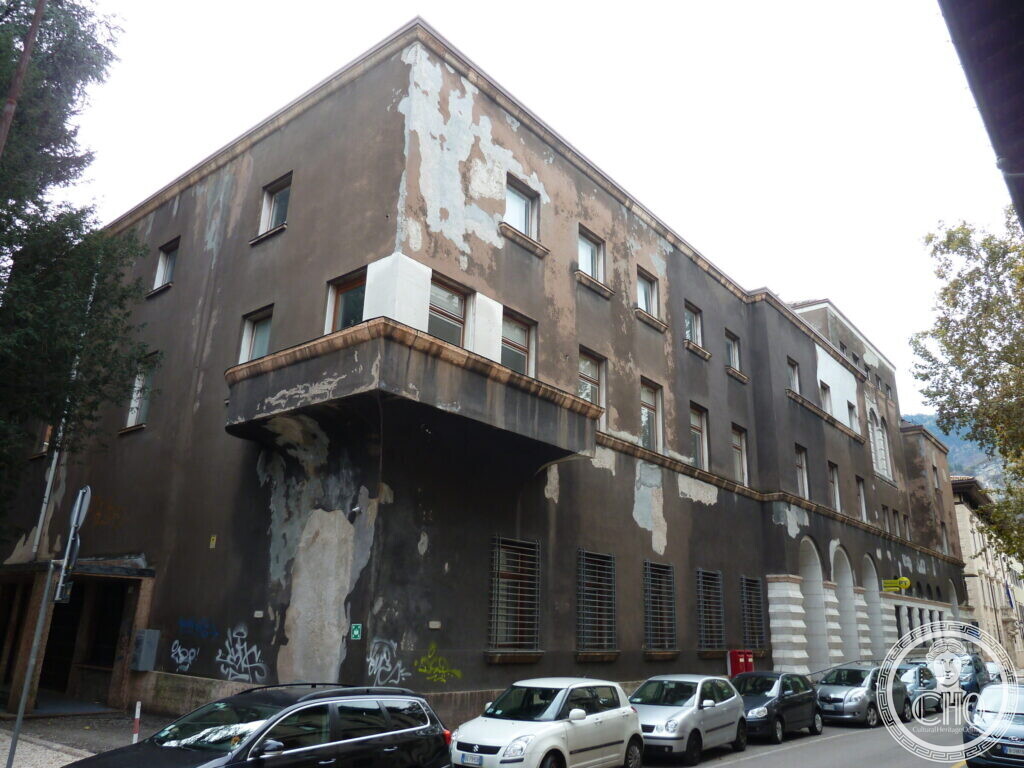
The building stands on the site of the former Renaissance Palazzo dei Baroni a Prato, which was destroyed by fire in 1845 and replaced by the Habsburg post office designed by Friedrich Setz. The present palace was created between 1929 and 1934 by the Florentine engineer and architect Angiolo Mazzoni, who was one of the most prolific designers of public buildings, railway stations and post offices in the first half of the twentieth century. The façade was originally plastered in Savoy blue as a symbol of Trento’s Italian identity, but today the exterior appears weathered and brownish. The building is partially accessible during post office opening hours.
Key facts
- Where: Piazza Alessandro Vittoria 1, 38122 Trento
- What: Palace, now headquarters of the central post office
- When: 1929–1934
- GPS: 46.0669, 11.1237 · Open in Google Maps
History
The history of the site begins in 1512, when the Renaissance Palazzo of the Baroni a Prato family was built with a celebrated Italian garden. In 1830 the building was sold and converted into a sugar refinery, becoming the first manufacturing business located within Trento’s historic centre. A fire partially destroyed the structure on 13 December 1845. In 1889 the Viennese architect Friedrich Setz designed a monumental Habsburg post office for the site, transmitting the power of the Empire in a rigorous Austro-Hungarian style. In the 1930s Angiolo Mazzoni was commissioned to transform it into the Italian post office palace. The project kept fragments of the earlier buildings, including the 1512 portal on Via Santa Trinità, some arcades of the colonnaded courtyard and a three-light window with Ionic capitals. The building was inaugurated in 1934.
What you see
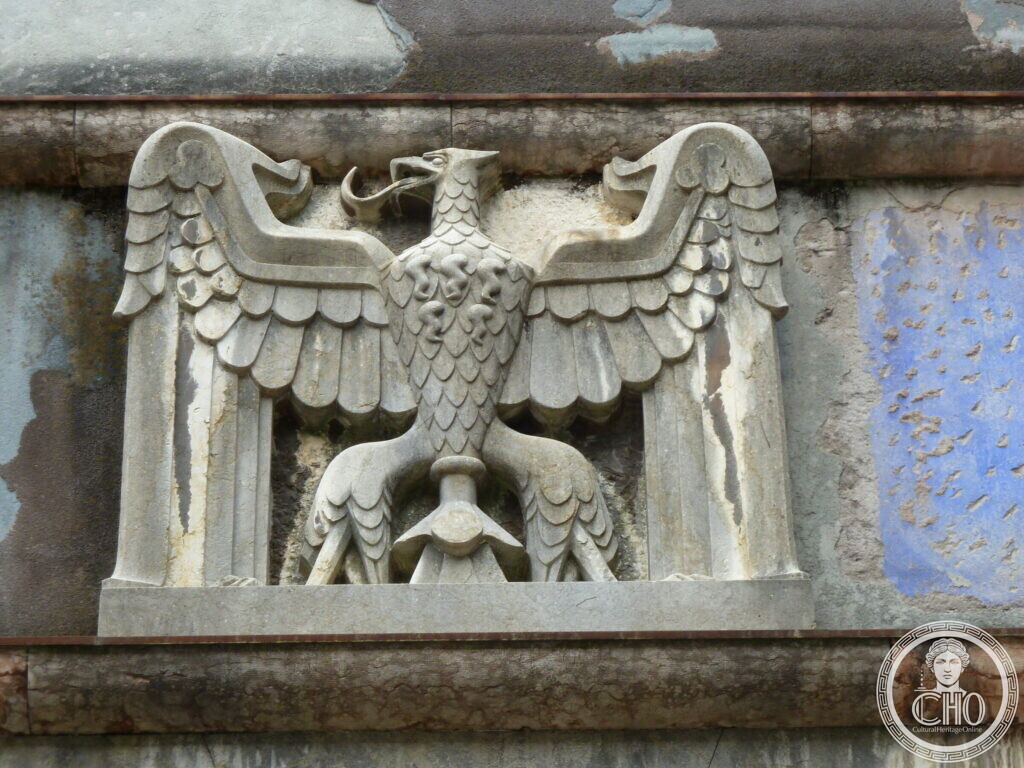
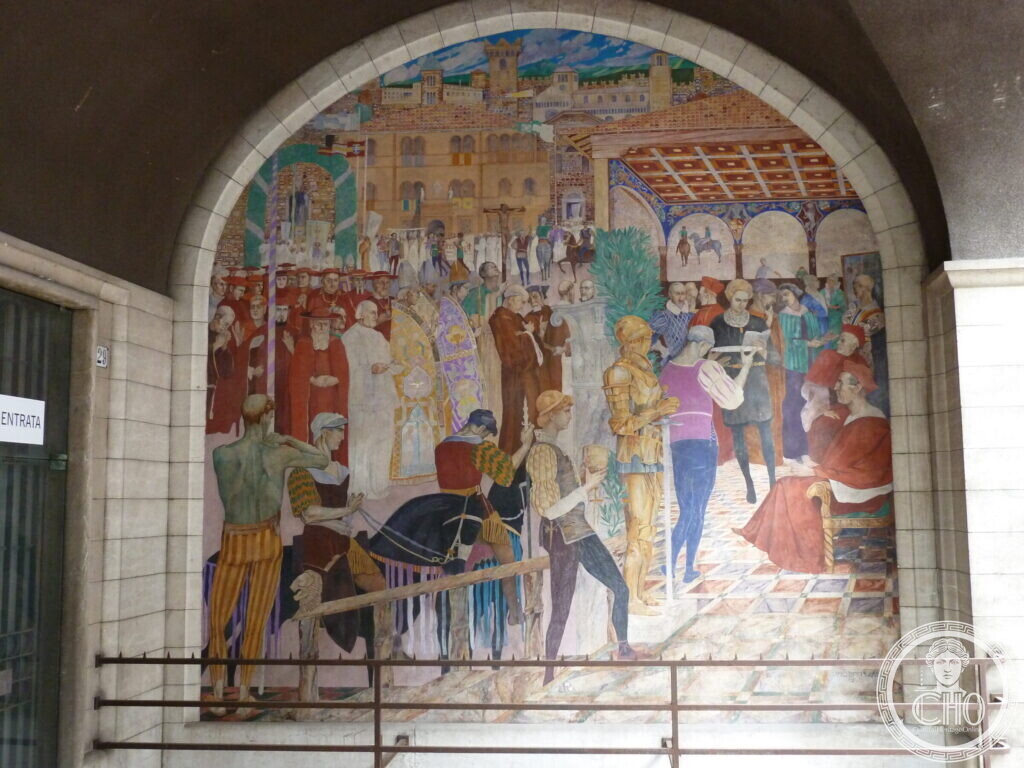
The photographs show a large multi-storey building with a corner tower and a stone entrance portal surmounted by a sculpted eagle with spread wings holding a fasces in its claws. The side façade has weathered, peeling render, barred ground-floor windows and a projecting corner balcony, with cars parked along the street. A tall conifer stands beside the building. Inside a passage, an arched mural shows a crowded historical scene with robed figures and knights before a walled town; beneath it the word ENTRATA appears. The mural is by Luigi Bonazza and depicts the reception of three cardinals at the Palazzo a Prato during the time of the Council. Mazzoni made extensive use of local materials: ochre porphyry from Predazzo for the letter box, yellow marble from Mori for the staircase steps, and white limestone from Pila for the external diamond-pointed pilasters. The exterior walls were originally plastered in Savoy blue, symbolising Trento’s Italian identity, but this colour is no longer visible. Inside, Gino Pancheri, Enrico Prampolini and Fortunato Depero created frescoes on the second floor and polychrome stained-glass windows, many of which have been lost. A statue of San Cristoforo by Stefano Zuech stands in a niche on the south side of the palace.
Do you know more about this place?
If you know a date, a name, a document, a plaque or a photograph that tells its story, write to Sofia at sofia@culturalheritageonline.com or through the contact page. What arrives with a source goes into this page, with your name as the contributor.
Nearby
- Palace of the Autonomous Province of Trento – Virtual Tour 360° — another monumental public building in central Trento.
- Mart – Civic Gallery of Trento – Virtual Tour 360° — the city’s main modern and contemporary art gallery, a short walk away.
- Casa Cazuffi-Rella, Trento — a frescoed historic house in the historic centre.
- Fontana del Nettuno, Trento — a monumental fountain in the historic centre.
Gallery
Sources
- Comune di Trento, Palazzo delle Poste: architect, date, address, materials, artists and the incorporation of earlier fragments.
- il Dolomiti, Il Palazzo delle Poste tra un presente di degrado e un futuro che si spera all’altezza del sua passato: site history, 1889 Habsburg post office, 1934 inauguration and Savoy blue plaster.
- Trentino History, Il Palazzo delle Poste: 1512 origin, 1830 sugar refinery, 1845 fire, Mazzoni’s intervention and decorative programme.
- Around Us, Palazzo delle Poste – Futurist post office palace in Trento, Italy: construction dates, local materials and original Savoy blue plaster.
- Vita Trentina, Palazzo delle Poste di Trento: il progetto di riqualificazione: architect, date, materials and decorative programme.
- FAI, PALAZZO DELLE POSTE | I Luoghi del Cuore – FAI: architect, date, address, materials and decorative programme.
- Stefano Vigolo, photographs and notes to the editorial staff (2026): identification of the subject and visual details. Not a published source.
Find it on the map
See this place and what’s around it →📷 Become a Cultural Heritage Online photographer
Share your photos of places: they stay published under your name as the author. The more they're seen, the more you get noticed — and soon a contest will reward the most appreciated photos.
Log in or sign up free to add a photoIs this page about you?
This page is read by travellers and heritage enthusiasts who find it on Google. Tell us how you are connected to this place and we will take it from there.