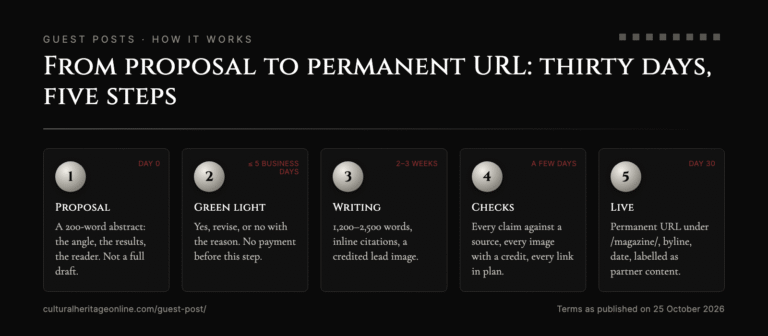
What a dissemination page here gives an EU-funded project: a permanent URL, a byline, a date, an editorial review and a visible partner-content label. Three plans, from $150; what is refused.
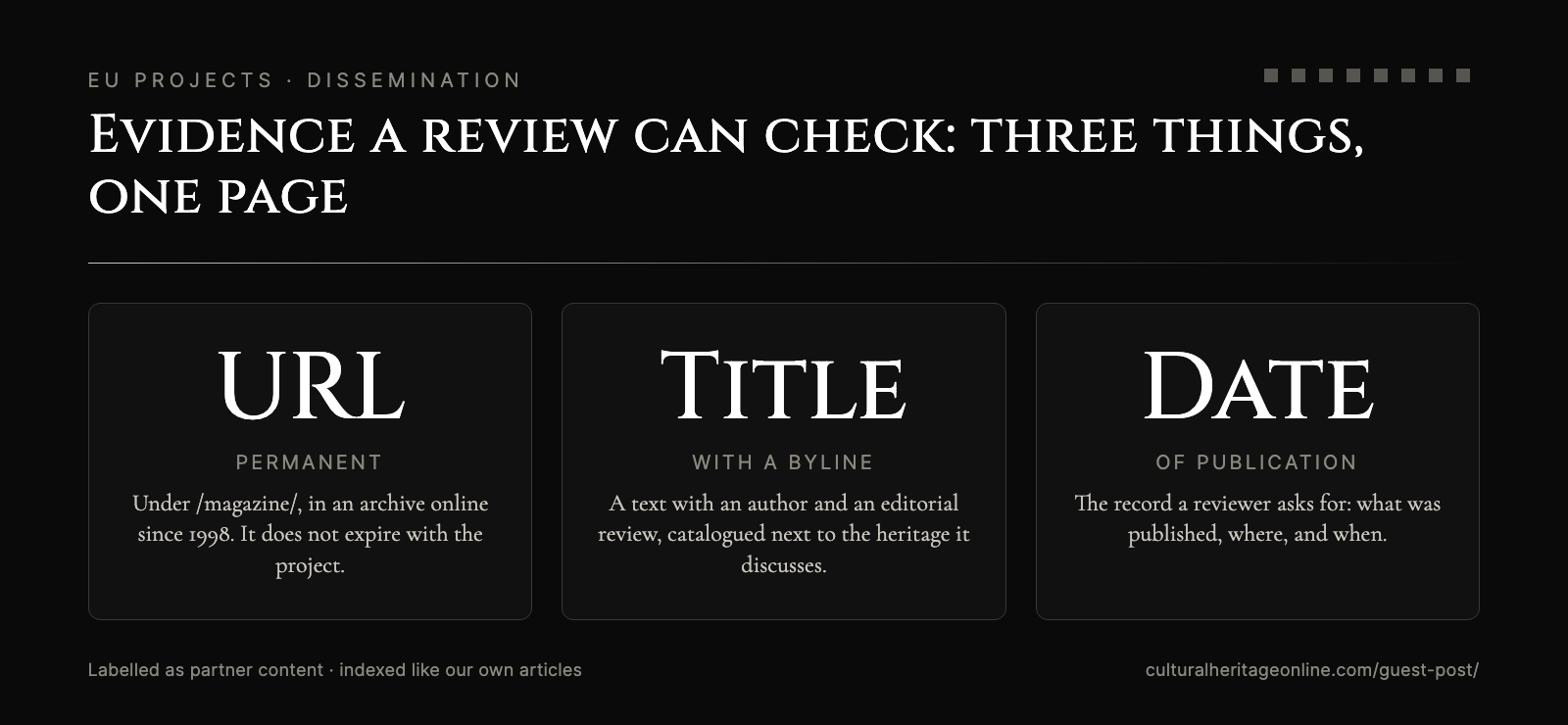
A dissemination obligation is satisfied by evidence, and evidence has a date, a URL and an archive that keeps it. This is what a page here gives a project, and what it does not.
1. What “dissemination evidence” means
Most European projects have a dissemination work package and a budget line for it. When the review comes, the question is not how many posts were published; it is what can be shown: a page that exists, a URL that resolves, a text that says what the project found, and a record that it was published on a certain date.
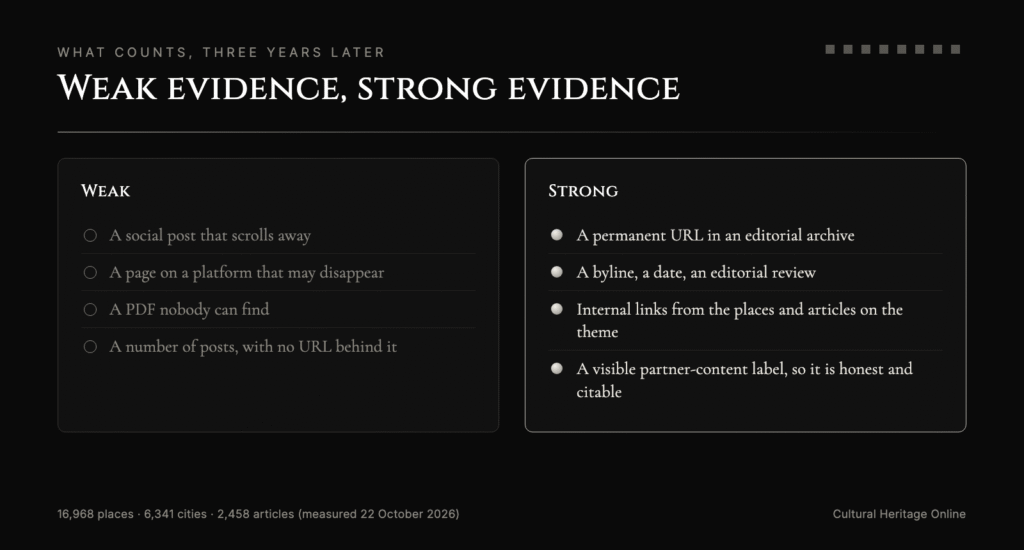
A page on a platform that disappears, or a social post that scrolls away, is weak evidence. A permanent URL inside an editorial archive is strong evidence, because it can be cited, linked from the project’s own site, and found months later.
2. What a page here gives
- A permanent URL under
/magazine/, not a temporary landing page. - A text with a byline, a publication date and an editorial review.
- Thematic cataloguing, so the article sits next to the heritage it discusses.
- Internal links from the place-cards and the articles that already cover the same ground.
- A visible label saying that the article is partner content, which is what makes it honest and what makes it usable as evidence.
- Indexing by search engines on the same terms as our own articles, and a page that AI search tools can read as a source.
The archive around the article is not scenery: 16,968 documented places, 6,341 cities and 2,458 articles (figures measured on 22 October 2026). An article about a project on Roman water systems sits next to the places, the routes and the articles that already discuss them, and that is what makes it findable by someone who was not looking for the project.
3. What it is not
It is not a link farm: outbound links are limited by plan, and they are labelled. It is not a press release: a release is rewritten or refused. It is not a page that will say whatever the client wants: claims need a source, and the editorial pass is mandatory on every plan.
A guest article that reads like an advert is refused at the proposal stage, before anyone writes a word: the archive has twenty-eight years of editorial behind it, and one paid page would be visible.
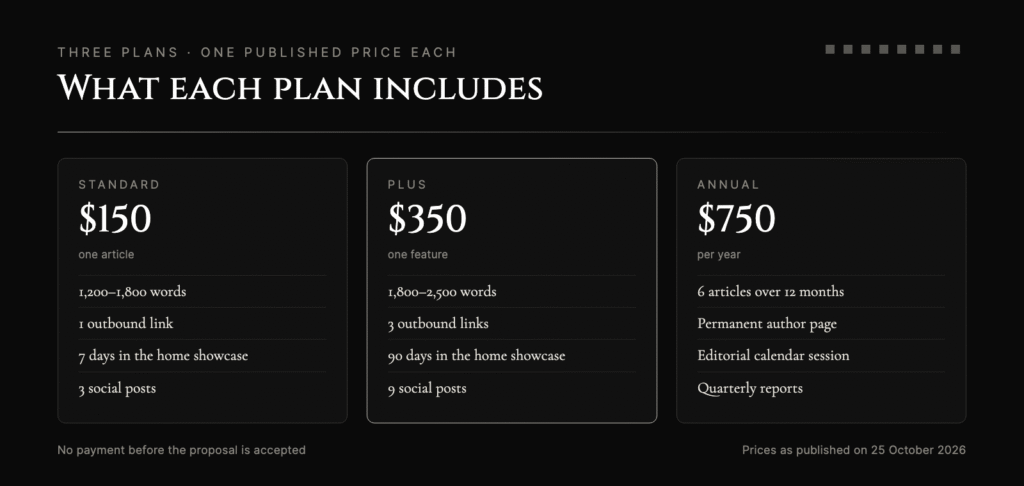
4. The three plans
- Standard, 150 dollars: one article of 1,200 to 1,800 words, one outbound link, seven days in the home showcase, three social posts.
- Plus, 350 dollars: one feature of 1,800 to 2,500 words, three outbound links, ninety days in the home showcase, nine social posts.
- Annual, 750 dollars: six articles over twelve months, a permanent author page, an editorial calendar session, quarterly reports.
The full terms are on the programme page.
5. What to send
A 200-word abstract with the angle, the results you want to show, and the audience you are writing for. The editorial team checks it against the archive: does it add something the archive does not already cover?
If it does, the article is written with your material: the project’s results, the images with their credits, the institutional references. If it does not, we say so before anyone pays.
6. How the review works
Every article passes a human editorial pass: source verification, language editing, SEO and AI-search structuring, internal links to the related archive content. No automated pipeline, no auto-publish. The article is labelled as partner content and published under /magazine/.
7. Why an archive, and not a post
A project that ends leaves a reporting obligation behind. A page that is still online in three years, still linked from the project’s site, still findable by someone searching the theme, is the difference between a dissemination activity and a dissemination result.
8. How to write the abstract
Four sentences are enough. What the project found, in one sentence that a non-specialist understands. What the article would add to what the archive already has on the theme. Who the reader is: a researcher, a planner, a policy officer. Which two or three sources back the central claim.
Do not send a press release and call it an abstract. The editorial team reads the four sentences to answer one question: is there an article here, or is there an announcement here? An announcement has its place, but it is not this one.
Questions we are asked
Is the page permanent?
Yes. It has a permanent URL under /magazine/ and it enters the archive; it is not removed when the project ends.
Can we cite it in the final report?
Yes: the URL, the title and the publication date are the three things a review asks for.
Do you accept articles not in English?
The editorial language is English. A text in another language is translated editorially, not machine-translated without review.
Will the article be labelled as sponsored?
Yes. Partner content is labelled, and the outbound links are marked accordingly.
Can we choose the links?
Within the limits of the plan: one outbound link on Standard, three on Plus. They must be relevant and they are checked.
Do you guarantee citations or AI mentions?
No. We guarantee a page that is built, indexed and linked like our own articles. What search engines and AI tools do with it is not ours to promise.
Read the plans and send a 200-word proposal: culturalheritageonline.com/guest-post/
Sources
- Cultural Heritage Online, Editorial Guest Posts programme page (plans, process, labelling), https://culturalheritageonline.com/guest-post/ — read 25 October 2026
- Cultural Heritage Online, Editorial guidelines §10 editorial independence and §11 how our texts are written, https://culturalheritageonline.com/editorial-guidelines/
- Cultural Heritage Online, Advertising and affiliate transparency, https://culturalheritageonline.com/advertising-affiliate-transparency/
Spotted an error? Write to editorial@culturalheritageonline.com and we correct it the same day.