
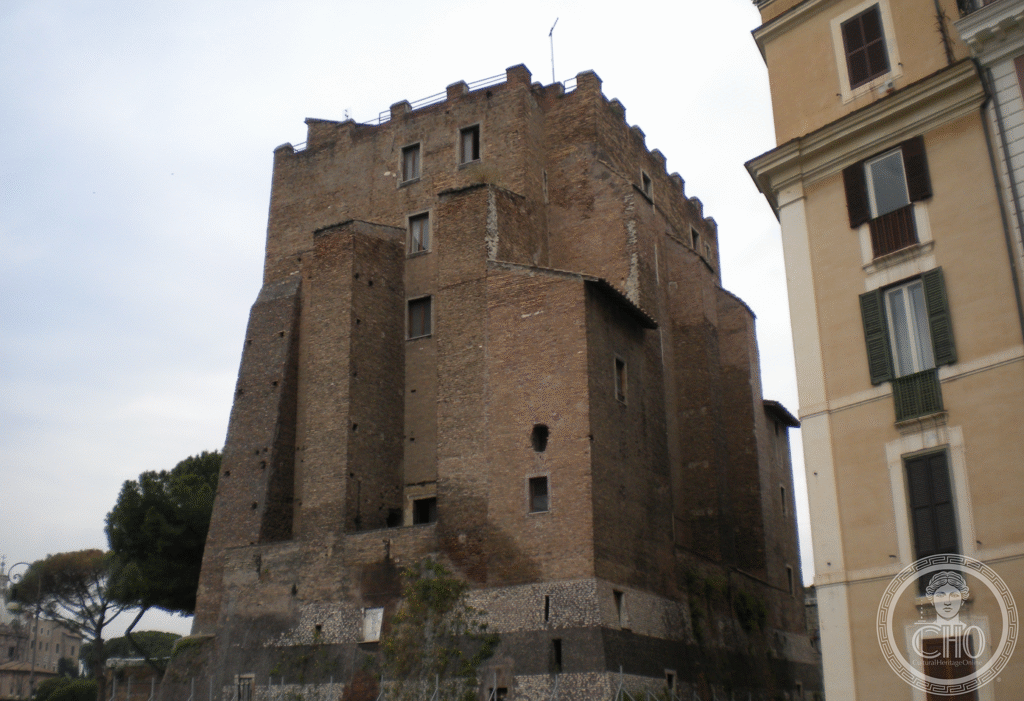
What stands today is the base of a medieval tower that once rose two or three times higher, built into an exedra of Vespasian’s Temple of Peace and brought down, over four centuries, by earthquakes.
At a glance
The Torre dei Conti stands at the eastern end of the Imperial Fora, where Via Cavour meets Via dei Fori Imperiali. It was raised on the remains of one of the exedrae of the Temple of Peace, the forum Vespasian built after the Jewish War, and the Comune di Roma dates a first fortified core here to perhaps as early as the ninth century. In 1203 Pope Innocent III had it enlarged for his own family, the Conti di Segni, to a design by Marchionne d’Arezzo. The twenty-nine metres visible today are only the lower part of what it was.
Key facts
- Built on: an exedra of the Temple of Peace (Forum of Peace), Vespasian, 71–75 AD
- Enlarged: 1203, for the Conti di Segni, under Pope Innocent III; design attributed to Marchionne d’Arezzo
- Height today: 29 metres — the base alone
- Height once: more than 50–60 metres
- Damaged by: the earthquakes of 1348, 1630 and 1644
- Closed to the public: since 2007
- GPS: 41.8936, 12.4879 · Open in Google Maps (OpenStreetMap)
History
The tower belongs to the age when the great Roman families fortified themselves inside the ruins of the ancient city. The Conti di Segni, the family of Innocent III, took the exedra of the Temple of Peace as a foundation already built, and in 1203 raised on it a tower that dominated the whole quarter. Petrarch, who saw it standing, called it «Turris illa toto orbe unica» — that tower, unique in the whole world.
Earthquakes took it apart in stages. The Comune di Roma names three in particular, in 1348, 1630 and 1644; after each the upper storeys came down and were not rebuilt. What was left served humbler purposes: a hayloft, and a coal store. The sloping buttresses that now give the tower its stepped silhouette were added to hold the surviving stump upright.
What you see
A compact block of brickwork, far wider than it is tall, with four heavy buttresses battered outwards at the corners and a line of crenellations along the top. Small irregular openings pierce the walls where floors once met them, and at the foot runs a retaining wall of reused ancient blocks. The tower looks on to Via dei Fori Imperiali, the avenue cut through the Imperial Fora in 1932 as Via dell’Impero and renamed after the Second World War.
The collapse of 3 November 2025
The tower had been closed to the public since 2007 and was under restoration as part of the Caput Mundi programme, funded through Italy’s national recovery plan, when a section of it gave way. The Comune di Roma records «consistenti crolli interni» — substantial internal collapses — on 3 November 2025. A first fall shortly after eleven in the morning buried a worker and injured three others; a second, around one o’clock, slowed the fire brigade’s rescue. Octav Stroici, sixty-six, was brought out alive after some eleven hours under the rubble and died in hospital soon after midnight. An autopsy ordered by the Rome prosecutors gave crush trauma as the cause of death, and an investigation into the collapse was opened.
The photograph at the head of this page shows the tower as it stood before that day.
Nearby
- Forum of Augustus — across Via dei Fori Imperiali, 120 metres away
- House of the Knights of Rhodes — the other medieval survival inside the Fora
Sources
- Roma Capitale – Turismo Roma, Torre de’ Conti: the exedra of the Temple of Peace, the ninth-century core, the enlargement of 1203 under Innocent III for the counts of Segni, Marchionne d’Arezzo, the original height of over 50–60 metres, the earthquakes of 1348, 1630 and 1644, the use as hayloft and coal store, the closure of 2007 and the internal collapses of 3 November 2025
- AGI, Crollo a Roma, la Torre dei Conti «unica» per Petrarca (3 November 2025): the present height of 29 metres as the base of a taller structure, and Petrarch’s «Turris illa toto orbe unica»
- Il Post, È morto l’operaio estratto dalle macerie della Torre dei Conti (4 November 2025), and LaPresse, L’autopsia: Octav Stroici è morto per trauma da schiacciamento (7 November 2025): the sequence of the two collapses, the rescue, the death and the autopsy, and the Caput Mundi restoration works
- The Art Newspaper, Mayor aims to erase Mussolini’s mark on Rome: Via dell’Impero, opened in 1932 and renamed Via dei Fori Imperiali after the Second World War
Find it on the map
See this place and what’s around it →📷 Become a Cultural Heritage Online photographer
Share your photos of places: they stay published under your name as the author. The more they're seen, the more you get noticed — and soon a contest will reward the most appreciated photos.
Log in or sign up free to add a photoIs this page about you?
This page is read by travellers and heritage enthusiasts who find it on Google. Tell us how you are connected to this place and we will take it from there.