
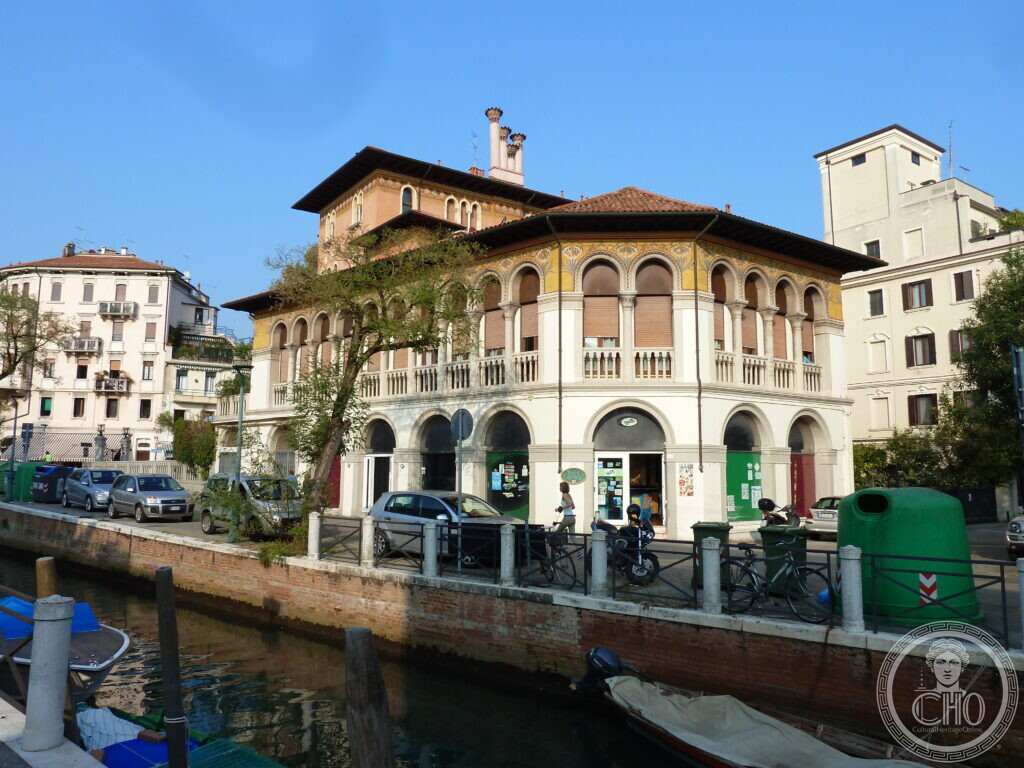
A corner house on the Gran Viale that a bank turned into its Lido seat, inaugurated on 27 April 1926 in front of the King.
At a glance
The former seat of the Cassa di Risparmio di Venezia stands at the corner of via Ascalona 1 and Gran Viale Santa Maria Elisabetta 4, a few steps from the lagoon landing of the Lido. The Comune di Venezia’s catalogue of the island’s architecture records it under the names «Ex sede della Cassa di Risparmio di Venezia», «villa Teresa» and «villa Gaidano», with the engineer Ignazio Saccardo as designer, the Cassa di Risparmio di Venezia as client and 1926 as the year of construction. The bank’s new seat was inaugurated on 27 April 1926, on the day King Vittorio Emanuele III visited the Lido. The bank left in 1976, and since 2000 the building has been converted into residences.
Key facts
- Address: via Ascalona 1 – Gran Viale Santa Maria Elisabetta 4, Lido di Venezia
- Designer: Ignazio Saccardo, engineer
- Client: Cassa di Risparmio di Venezia
- Built: 1926 (Comune di Venezia catalogue); inaugurated 27 April 1926
- Other names: villa Teresa, villa Gaidano
- Size: three and a half storeys, 10.5 m high, 213 m² of ground area (Comune di Venezia catalogue)
- Style: eclectic, with Renaissance-Lombard and medievalising elements
- Today: residences, since 2000
- GPS: 45.4167, 12.3690 · Open in Google Maps (OpenStreetMap, house number)
History
According to the research of Vincenzo and Pierpaolo Zagnoni reported by 25venice.press, in 1920 the building belonged to the Zanco family and was already, at least in part, in use by the Cassa di Risparmio di Venezia, which asked the engineer Saccardo for plans to adapt it; between 1923 and 1926 it was the property of the bank. The Comune’s catalogue gives 1926 as the year of construction and lists the earlier names of the house, villa Teresa and villa Gaidano.
On 27 April 1926 the new seat was inaugurated. King Vittorio Emanuele III arrived at the Lido at ten in the morning by royal launch and was driven to the ceremony; the same day he visited the works of the Tempio Votivo and the popular housing at Sant’Elena. Politicians, bankers, civil and religious authorities were present, among them the Cardinal Patriarch Pietro La Fontaine. A commemorative plaque of the inauguration is still on the building.
In 1976 the bank moved to Piazzale Santa Maria Elisabetta, into the ground floor of a residential block on the site of the former Hotel Lido. The vacated rooms were taken by C.A.P.L.I., later renamed AV.A.L. (Associazione Veneziana Albergatori Lido), and an accountant’s office stayed there until 1996. In 2000 the property passed to the company Cavallino Mare del Nord and the building was converted into residences.
What you see
The Comune’s catalogue describes a regular plan on three and a half storeys, the ground floor partly faced in stone and otherwise plastered, with a garden around it. On the ground floor the windows are round-arched and the corner entrance is recessed; on the first floor single, double and triple round-arched openings alternate, joined by pilasters, with balconies behind wrought-iron parapets, a relief of the lion of Saint Mark and a circular patera. The wrought iron of the entrance door and of the lantern is singled out as fine work. The second floor covers only part of the building, with two large corner windows under thick lintels. From the canal, what strikes first is the first-floor loggia of slender arches under a painted frieze, and the tower-like block with its tall chimney rising behind.
Nearby
- Hotel Excelsior — at the sea end of the Lido, the grand hotel of 1908
- Via Lepanto 11–19 — the «Sette Camini» houses by Giuseppe Piamonte, 1925
Sources
- Comune di Venezia, Municipalità di Lido-Pellestrina, L’architettura del Lido — scheda 077, Ex sede della Cassa di Risparmio di Venezia (and its building description): names, address, designer, client, year, storeys, height, area, the decorative elements and the style
- Nadia De Lazzari, 25venice.press, Cento anni fa il Re al Lido, il 27 aprile 1926 che fece storia (22 April 2026): the inauguration of 27 April 1926 and the King’s visit, the Zanco ownership in 1920, the bank’s ownership 1923–1926, the move of 1976, the later occupants, the conversion of 2000, the plaque
Find it on the map
See this place and what’s around it →📷 Become a Cultural Heritage Online photographer
Share your photos of places: they stay published under your name as the author. The more they're seen, the more you get noticed — and soon a contest will reward the most appreciated photos.
Log in or sign up free to add a photoIs this page about you?
This page is read by travellers and heritage enthusiasts who find it on Google. Tell us how you are connected to this place and we will take it from there.