
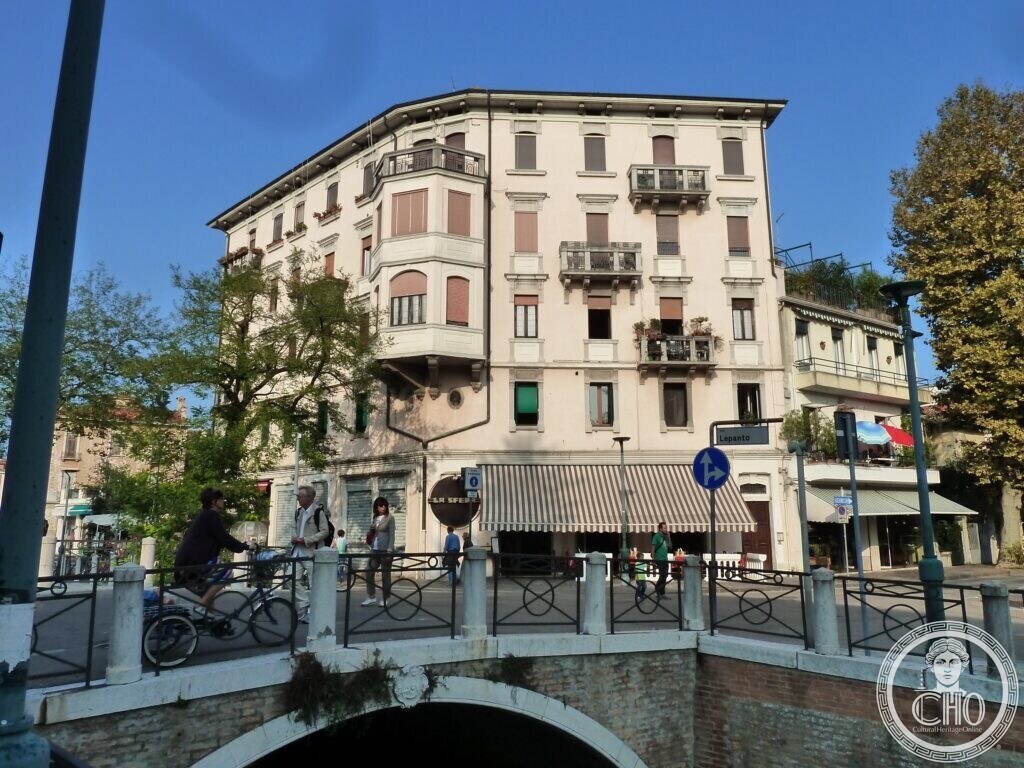
Where the Lido’s canal meets its main streets, a tall block of shops and flats marks the corner. It was raised to its present height in 1925, when the island was turning from a bathing resort into a town.
At a glance
This is the commercial and residential building at Via Lepanto 11–11d and 19–19d, on the Lido of Venice, facing the canal a few steps from the Gran Viale Santa Maria Elisabetta. The City of Venice’s catalogue of the Lido’s architecture records it as the work of Giuseppe Piamonte for the client Manlio Salmoiraghi, with building works that raised it to its present form in 1925.
Key facts
- Address: Via Lepanto 11–11d, 19–19d, Lido di Venezia
- Designer: Giuseppe Piamonte
- Client: Manlio Salmoiraghi
- Date: raised to its present form in 1925
- Use: shops at street level, flats above
- GPS: 45.41501, 12.37018 · Open in Google Maps
History
The Lido grew fast in the first decades of the twentieth century: the Hotel des Bains opened in 1900, the Excelsior in 1908, and the Gran Viale was widened for the tram. Around its landing stage a small town took shape, with shops, flats and villas. The block in Via Lepanto belongs to that moment: the catalogue does not describe an entirely new building but works of sopraelevazione, raising an existing one to its current form, in 1925.
A note on the name and the date. The notes that reached us with the photograph call it the Palazzo dei Sette Camini, or the block at the Quattro Strade, and credit it to the engineer Daniele Donghi in 1923. We have found no source for the name, and the City’s catalogue says otherwise on the rest: it gives Giuseppe Piamonte and 1925, and lists only Villa Franca among Donghi’s works on the Lido. We follow the catalogue. If you know where the name comes from, write to us.
What you see
A tall, pale block on a corner, with a rounded bay rising through the floors, stone-framed windows, iron balconies and a deep cornice under the roof. At street level a striped awning shades the shop on the corner. In front, a small stone bridge with an iron railing crosses the canal.
Nearby
- Tempio Votivo della Pace — the domed war memorial church, a short walk away
Sources
- Comune di Venezia, Municipalità di Lido Pellestrina, L’architettura del Lido, scheda 078, «Edificio commerciale e residenziale in via Lepanto 11-19» (archived copy): address, Giuseppe Piamonte, Manlio Salmoiraghi, raising works of 1925
- Same catalogue, biography of Daniele Donghi (archived copy): his works on the Lido
- Rete tranviaria del Lido di Venezia, Italian Wikipedia, and SeeVenice — how an island was transformed into a city: the Hotel des Bains (1900), the Excelsior (1908) and the widening of the Gran Viale for the tram
- OpenStreetMap: the photograph’s position at Via Lepanto 11d
Find it on the map
See this place and what’s around it →📷 Become a Cultural Heritage Online photographer
Share your photos of places: they stay published under your name as the author. The more they're seen, the more you get noticed — and soon a contest will reward the most appreciated photos.
Log in or sign up free to add a photoIs this page about you?
This page is read by travellers and heritage enthusiasts who find it on Google. Tell us how you are connected to this place and we will take it from there.