
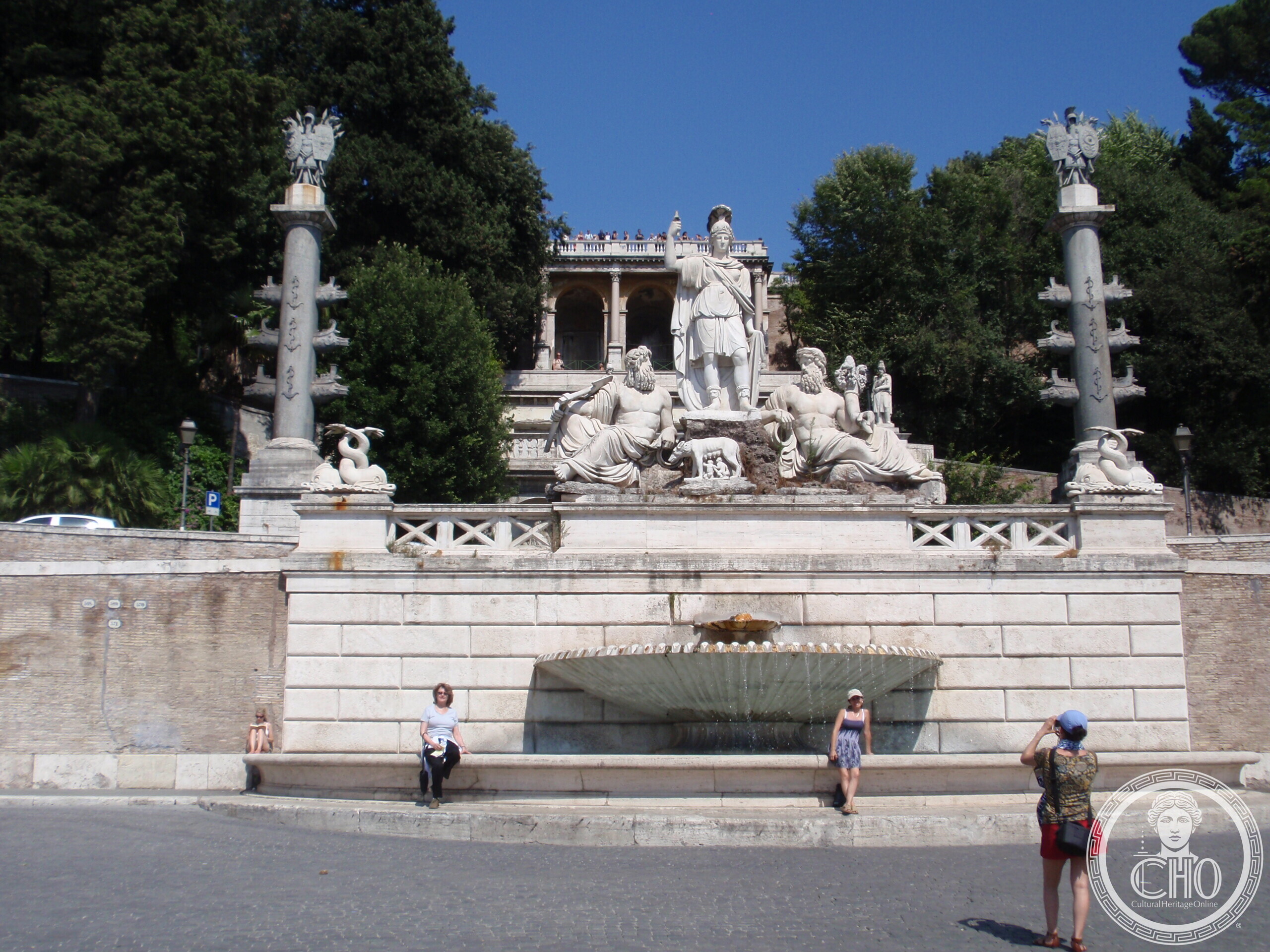
At the foot of the Pincio terrace, the armed goddess Roma sits between the river gods of the Tiber and the Aniene, with the she-wolf and the twins at her feet. The fountain is the eastern half of Valadier’s great ellipse, and the mirror of the Neptune fountain opposite.
At a glance
The monumental fountain of the Dea Roma stands in the eastern hemicycle of Piazza del Popolo, below the terrace of the Pincio. It was completed in 1823 to a design by Giuseppe Valadier, the architect who turned the square into a vast ellipse in the early nineteenth century, and the sculptures were carved by Giovanni Ceccarini. The goddess, helmeted and holding a spear, is flanked by the allegories of the Tiber and the Aniene; at her feet the she-wolf suckles Romulus and Remus. A large semicircular travertine basin receives the water from a shell above. The twin fountain of Neptune occupies the western hemicycle. The whole square was restored in 1997–1998.
Key facts
- Completed: 1823
- Design: Giuseppe Valadier · Sculpture: Giovanni Ceccarini
- Figures: the goddess Roma, armed, with helmet and spear; the river gods Tiber and Aniene; the she-wolf with Romulus and Remus
- Materials: marble for the figures, travertine for the semicircular basin and the shell
- Pair: mirrored by the Fountain of Neptune in the west hemicycle
- Restored: 1997–1998, with the whole monumental complex of the square
- GPS: 41.91089, 12.47718 · Open in Google Maps
History
Valadier’s redesign of Piazza del Popolo, carried out from 1810, replaced the old trapezoidal square inside the Porta del Popolo with an ellipse closed by two hemicycles, and connected it to the Pincio above by ramps and the terrace. The two fountains at the centres of the hemicycles were part of the plan from the start: Neptune on the river side, Roma on the hill side, each with its river gods.
Ceccarini’s group of 1823 gives the square its civic image: the city as a warrior goddess, the two rivers of Rome, and the legend of its founding. The travertine of the basin and the steps is the same stone as the hemicycles, so that fountain and square read as one work.
What you see
A tall wall of travertine with the sculptural group on top: the seated Roma in the middle, the two reclining river gods at her sides, the wolf and twins below her. Water falls from a shell into the wide semicircular basin. Above and behind rises the terrace of the Pincio, flanked by the two tall columns with trophies that mark the ramps.
Nearby
- Santa Maria del Popolo — the church by the gate, on the north side of the square
Sources
- Turismo Roma — Fontana della Dea Roma di Piazza del Popolo: the date 1823, Valadier’s design and Ceccarini’s sculpture, the figures, the semicircular travertine basin and the shell, the twin fountain of Neptune, the ellipse of the square, the restoration of 1997–1998
- Treccani, Dizionario Biografico — Giuseppe Valadier: the redesign of Piazza del Popolo with the two hemicycles and the connection to the Pincio
Find it on the map
See this place and what’s around it →📷 Become a Cultural Heritage Online photographer
Share your photos of places: they stay published under your name as the author. The more they're seen, the more you get noticed — and soon a contest will reward the most appreciated photos.
Log in or sign up free to add a photoIs this page about you?
This page is read by travellers and heritage enthusiasts who find it on Google. Tell us how you are connected to this place and we will take it from there.